Warring States & the First Emperor
-

Hou Sheng — The Chancellor Who Destroyed Qi Without Lifting a Finger
In the final years of the Warring States period, as Qin stood on the verge of unifying China, the last state left standing in its way was Qi. Yet what decided Qi’s fate was not the strength of a foreign army. It was betrayal from within. At the center of that betrayal stood one man: Hou Sheng, chancellor to King Jian of Qi. Another chancellor who took Qin’s gold and brought down his own country was Guo Kai of the…
-
Why the Tiger Tally Never Came to Japan
Why the Tiger Tally Never Came to Japan This piece continues from [Jade Gui, Bi, and Yue: The Jade Regalia of Rule], where I traced how the yue —the ceremonial axe—stood for the right to move an army. Here I follow that right forward, into the Warring States, where China turned it into something with the opposite logic: the tiger tally. And I follow it as a foreigner, because I am Japanese, and the tiger tally is the one Chinese…
-
Queen Daochang of Zhao (Lady Chang): The Courtesan Who Brought Down Li Mu — and Was Named for the Floor
Queen Daochang of Zhao (趙悼倡后), also known as Lady Chang or Queen Chang, was the consort of King Daoxiang of Zhao and the mother of King Qian, the last king to rule from Handan. Born into an entertainer household, she rose to Queen Dowager, took Qin’s gold, and helped destroy Li Mu — the general who was Zhao’s last defence. Three months later, Zhao fell. Readers of Kingdom know her as a villain of the Zhao court, and the histories…
-
Zhao Qian (King Youmiu): Was Kingdom’s Last King of Zhao Really a Fool?
This article continues the story begun in “[Posthumous Names],” and stands as one worked example of the series’ opening piece, “[History Is Written by the Victors].” In the manga Kingdom, Zhao Qian appears as the strange, unstable king of Zhao — the state’s very last ruler. The history books dismiss him in a word: benighted, a fool. But read the single poem he is said to have composed in his place of exile, and you find something else: a man…
-
Li Mu in Real History (Kingdom’s Ri Boku): Never Defeated, Killed by His Own King
Li Mu (李牧) — known as Ri Boku in the manga and anime Kingdom — was a general of the state of Zhao in China’s Warring States period and one of its Four Great Generals. He never lost a battle. In 229 BCE, his own king had him executed on a charge of rebellion, after Qin bribed the courtier Guo Kai. Three months later, Zhao’s capital Handan fell. Quick facts Died: 229 BCE, executed on the order of King Qian…
-
The Heirloom Seal of the Realm: The Empty Stone That Ruled China for a Thousand Years
This article continues from [The He Shi Bi (the jade that became the Heirloom Seal)]. The jade once guarded at the cost of lives was recut into the Chuanguo Xi — the Heirloom Seal of the Realm, the object that declared its holder the rightful Son of Heaven. For a thousand years it was seized, chipped, hidden, and at last lost forever. Why did emperors crave a single stone so badly? And why do replicas still sell today? This is…
-
King Daoxiang of Zhao (Tou Jou in Kingdom): The “Fool King” Made and Sold by His Teacher
King Daoxiang of Zhao (Tou Jou): The King Made and Sold by His Teacher In Kingdom, Tou Jou, King Daoxiang of Zhao, is the ruler who drove out the veteran general Lian Po (Ren Pa) and set his kingdom on the road to destruction. History carved two characters over him: fool king. But “fool king” hides more than it reveals. Why did he make the same ruinous choice again and again? The answer leads to one man: his lifelong teacher,…
-
Kaku Kai in Kingdom: The Real Traitor Who Killed Ri Boku — and How He Died
If you follow Kingdom, you already hate one man on sight: Kaku Kai (Guo Kai), the minister of Zhao who took Qin’s gold, drove out the veteran Ren Pa (Lian Po), and slandered the brilliant 〔Ri Boku (Li Mu)〕 into an executioner’s hands. Zhao held two of the age’s greatest generals — and tore off its own arms. Histories call Guo Kai a bought traitor and leave it there. But I don’t think gold is the whole story. Underneath the…
-
Sei Ou Ken (King Jian of Qi) : How “Peace Addiction” Destroyed the Last Great State | Kingdom
In *Kingdom*, the fall of each state usually comes on the battlefield. But **Qi**, the last of the great eastern states, fell almost without a sword being drawn. Its ruler, **King Jian (Tian Jian)**, sat on a mountain of soldiers and surrendered anyway. This is the story of how forty years of peace, a bribed chancellor, and one seductive idea — *”China will be one, so why prepare for war?”* — destroyed a kingdom from the inside. The Boy King…
-
Beyond Sun Tzu: Wei Liao, the Strategist Who Helped Buy China’s First Empire
Why “winning without fighting” turned out to be a matter of arithmetic If you’ve read one book of Chinese military strategy, it’s almost certainly Sun Tzu’s The Art of War. It sits on the recommended reading list at West Point and is studied at Sandhurst. What far fewer Western readers know is that Sun Tzu’s book is only the most famous of seven — the Seven Military Classics of Ancient China, the canon formalized in 1080 under the Song dynasty.…
-
The Fengshan Ritual: China’s Supreme Ceremony of Heaven and Earth
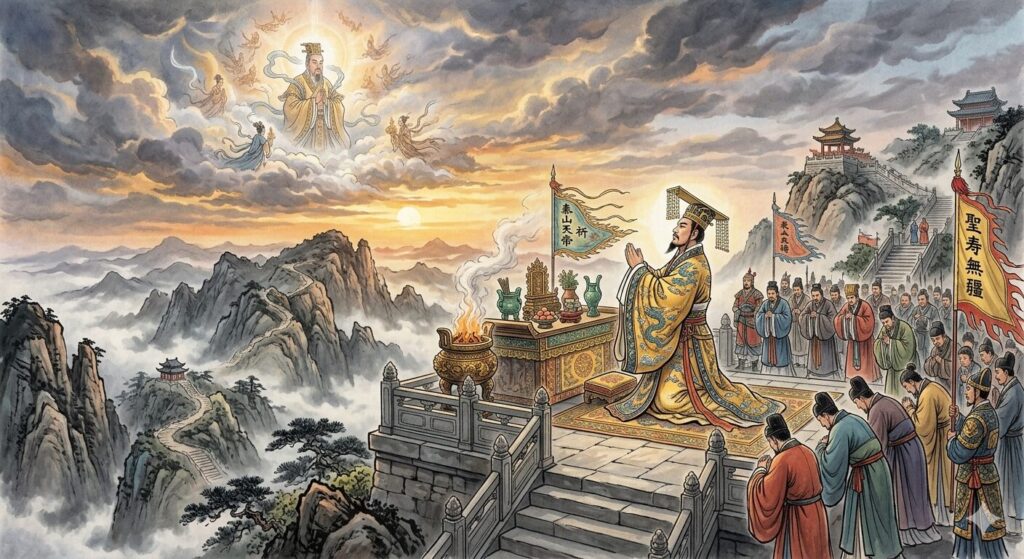
The Fengshan Ritual: China’s Supreme Ceremony of Heaven and Earth Only the Son of Heaven Could Perform It — From the First Emperor to the Song Dynasty A Hierarchy of the Sacred: Who Could Worship What To a reader shaped by Christianity or other Western religious traditions, this may seem deeply strange. In those traditions, prayer is available to everyone — the poorest farmer and the most powerful king kneel before the same God, and no earthly rank determines one’s…
-
Lü Buwei (Ryo Fui in Kingdom): The Merchant Who Bought a King — and Lost Everything
If you know Kingdom, you know Ryo Fui — the chancellor who nearly rivaled the young king Ei Sei. He was real. Lü Buwei (Lu Buwei) began as a merchant in Handan, bought a forgotten hostage prince as a “rare asset worth hoarding,” made him king of Qin, and became the most powerful man in the state. Then the boy he had guarded grew up into the First Emperor — and destroyed him. In the article on 〔Bu coins (the…