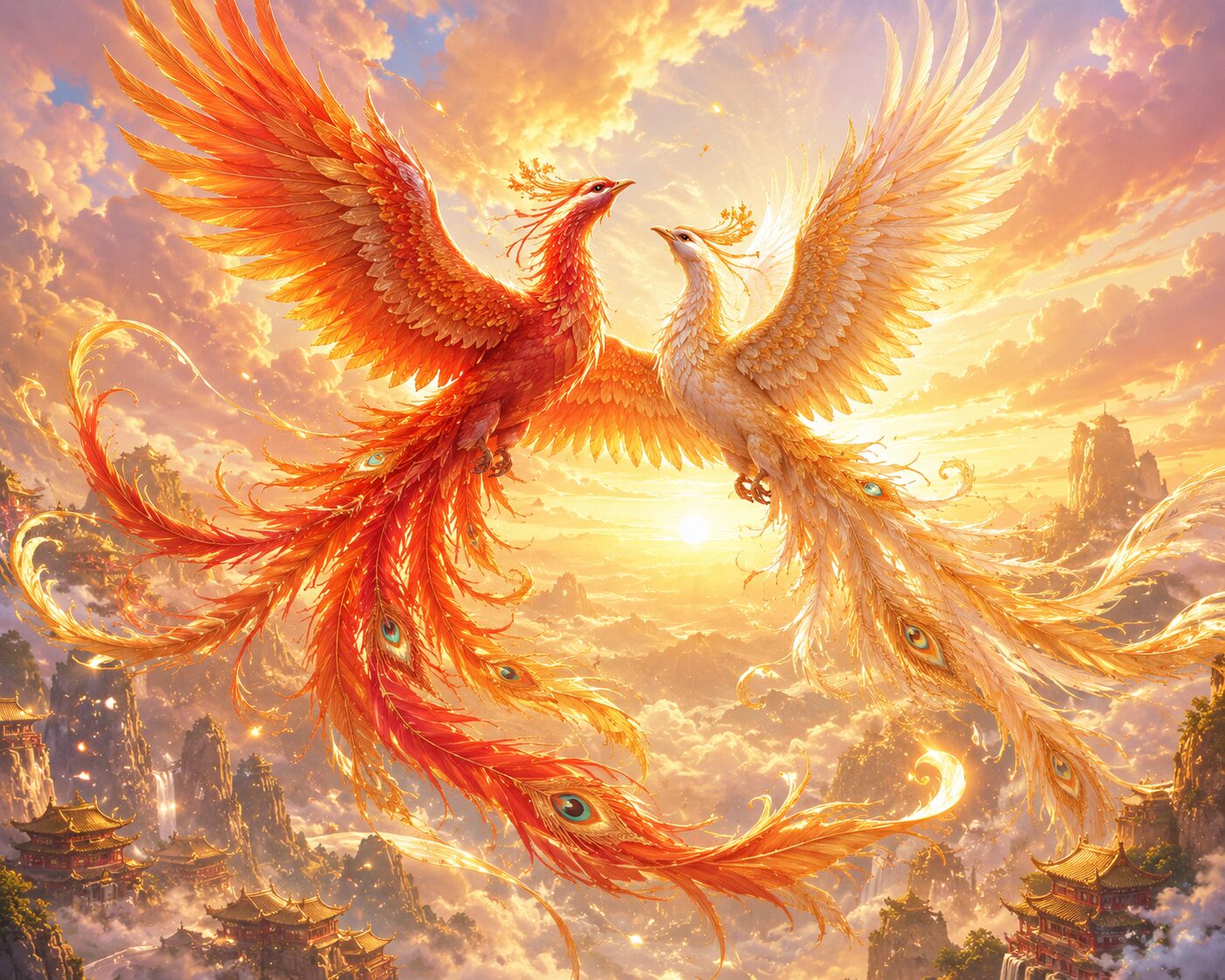
If you’ve watched Empresses in the Palace (the 2011 Chinese palace drama also known as The Legend of Zhen Huan), you’ve heard “Feng Huang Yu Fei” (凤凰于飞) — the haunting closing theme sung by Liu Huan. To me, it isn’t a song about the throne at all. It’s the secret love song of Prince Guo and Zhen Huan.
A note for first-time viewers
Empresses in the Palace follows Zhen Huan, a young woman who enters the harem of the Yongzheng Emperor and slowly rises to the very top of the imperial court. Along the way she falls in love — not with the emperor, but with his half-brother, Prince Guo (the seventeenth prince).
The two of them love each other deeply and vow to give up everything to be together. But Prince Guo is summoned away to war. When Zhen Huan hears a false report that he has died, she returns to the emperor’s harem — not out of love, but to protect the child she is carrying, Prince Guo’s child.
Enduring a life she despises, she rebuilds her power inside the palace. Eventually the emperor grows suspicious of the two and, out of jealousy, orders Zhen Huan to poison Prince Guo. She intends to drink the poisoned wine herself — but Prince Guo realizes what is happening, switches the cups, and dies in her place. In the end, Zhen Huan corners the emperor and tells him the truth: the children were never his. The revelation destroys him.
So when this song plays over the credits, I don’t hear a ballad about empire. I hear two people who once made music together — and the love that fate refused to let them keep.
Where the title comes from
The phrase “feng huang yu fei” (凤凰于飞) — “the phoenixes fly together” — is over two and a half thousand years old. It comes from the Classic of Poetry (Shijing), in the “Greater Odes,” in a poem called “Juan’e”:
凤凰于飞,翙翙其羽 — “The phoenixes fly, the beating of their wings sounding out.”
A small but important point: 翙翙 (huìhuì) describes the sound of the wings beating as the birds take flight — the ancient dictionary Shuowen Jiezi glosses the character as “the sound of flying.” It is not, as it’s sometimes loosely rendered, about feathers “shining beautifully.”
In its original setting, the flying phoenix was an auspicious omen — a symbol of virtue gathering around a wise ruler. But over the centuries, “feng huang yu fei” came to mean something more intimate: a harmonious couple, a marriage of two souls in step with each other. That double meaning is exactly why the song hurts. It borrows a phrase that traditionally blesses a happy union — and turns it inside out. By the final lines, the phoenixes have flown far away, leaving no trace. One of the pair is simply gone.
The images that carry the song
The lyrics move like memory itself — soft, drifting, hard to hold. Old dreams have gone faint; the past has blurred. A love is compared to flowers glimpsed through fog and the moon seen on the surface of water: beautiful, real to the eye, and impossible to grasp. Voices that once filled a room fall silent. Vows are made — never to forget, never to betray — and still fate has the last word.
Two images near the end are worth knowing:
- The qin and the di (the zither and the flute). In the song, after everything is lost, only these two instruments remain. For me, they are the two lovers — the music they made together, now with no one left to answer.
- The wutong tree (the Chinese parasol tree). In Chinese tradition, the phoenix will roost on no tree but the wutong. When cold autumn rain falls on its leaves and they rustle and tremble, the sound has long stood for parting and lost love. The song closes there: listening to fine rain on the wutong, memories swaying with the wind.
Two more phrases help unlock the song’s longing. Chang xiang si (长相思) means to keep yearning for someone even across distance and separation. Chang xiang shou (长相守) means to stay together and grow old side by side. The singer hopes for both — and is left with neither.
✦ Satoe’s Take
The line that stops me every time is the one where, after all the striving, only the qin and the di are left behind. Those instruments are the days when Prince Guo and Zhen Huan made music and spoke heart to heart. Now the hands that played them and the voice that answered are gone, and the instruments simply sit there in the quiet.
“Feng huang yu fei” was supposed to be a blessing — two birds flying happily together. Yet here the phoenix flies far away and leaves no trace. One bird is no longer beside the other. Taking a phrase meant for joy and using it for farewell — that, to me, is where the deepest grief of this song lives.
And there’s the cruelest truth of all: what Zhen Huan won was not what she wished for, and what she wished for she could never win. She gained the highest position in the palace. But all she ever truly wanted was to grow old quietly beside the man who played the flute for her. The life she seized and the life she longed for never once touched.
Here is how I read the song’s heart, in my own words —
Those dreamlike days fade into the haze of spring, into the autumn moon. My memories drift like flowers seen through mist, like the moon upon the water — drifting close, then gone. When you came, I could hear your gentle voice; when you left, there were no words at all. We loved each other, our hearts drawn close — and yet I lost you. The one who chanted poems with me, who answered my songs in kind, is here no more. Endlessly we longed for each other; I wished that we might grow old side by side. But now only the qin and the di remain — the ones we named Eternal Longing and Lasting Togetherness. We knew the joy of love, and made our vows. We swore never to forget, never to betray. Yet against fate we were powerless. What I gained was not what I wished; what I wished, I could not gain. Fate only mocked us, toyed with us, and cast us aside. Love and vow alike scattered like falling petals. I longed to meet you again, to be wrapped once more in tender love. But the headwind broke that hope in two. The phoenixes rose together, the beating of their wings ringing high — and now our love has flown far away, without a trace. Autumn rain comes down upon the parasol tree. The soft rustle of its leaves is the trembling of my heart; and like leaves that sway as the wind wills, my heart sinks low.
This is an analysis of the song’s meaning and background. The full lyrics are copyrighted to their writers; for the original Chinese lyrics and a singalong, please look to a licensed source such as the official release or streaming platforms.
← Back to the full guide: The Songs of Empresses in the Palace & The Legend of Mi Yue Explained