> A companion piece to the Late-Qing series. Where the Chinese essays celebrate “being summoned by the Son of Heaven” as the supreme honor, this Japanese poem turns that same summons inside out.
—
A crab in hiding receives the sovereign’s call
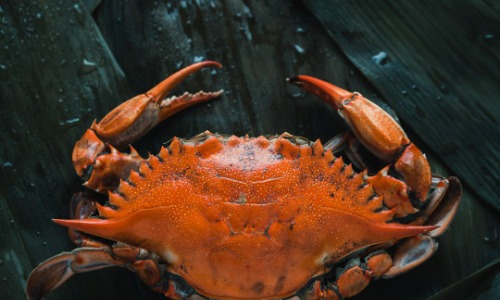
Book 16 of the Man’yōshū (Japan’s oldest poetry anthology, eighth century) holds an unforgettable poem, number 3886. Its annotation calls it “a song composed to voice the pain of a crab.” It was performed by hokaibito—the lowest of wandering beggar-entertainers—and it speaks in the first person of a single reed crab (ashigani).
A crab has built a hut in the reeds of a Naniwa inlet and lives there in hiding. Word comes that the sovereign summons it. Why me? the crab wonders. Surely I know the truth plainly. Am I called as a singer? A flute-player? A koto-player? No—it is none of these. Yet a summons is a summons, so it travels to the capital, passes through the gate, and receives its lord’s command. And then:
A horse is tethered by a rope, an ox by a nose-cord—but not the crab. Elm bark is stripped and hung and dried in the sun, pounded in mortar after mortar; the inlet’s harsh first salt is drawn off. Then my lord presents a splendid jar, filled with spices, and commands me: Get inside. Tears spill from my eyes. And into my weeping eyes my lord rubs the salt—rubs in the salt—and cures me into kitahi, the dried delicacy, and savors me with a word of praise: “Delicious.”
The summons, turned inside out
In the Chinese half of this series, to be summoned by the Son of Heaven—to pass the imperial examinations and serve at court—was the supreme dream of a man’s life. This crab poem is that dream’s photographic negative.
The crab was in hiding—living exactly the Confucian counsel “in a corrupt age, roll yourself up and tuck yourself away.” And still it is dragged out and consumed. It imagines it may be wanted for some usefulness—its song, its music. That hope is precisely the examination candidate’s hope. To be summoned by the sovereign is also to be eaten by the sovereign. And the one who sees this clearly is not the successful official inside the system, but the lowest outsider, the beggar-performer who sings it.
Everyone rushes to become the crab
There were three doors to the sovereign’s side. Men memorized the classics—drilling the Four Books and Five Classics until they had stopped thinking for themselves—to pass the examinations. Men who could not pass castrated themselves and entered as eunuchs by another door. Women cultivated their beauty and entered the harem as a single flower.
Three doors, one destination: the place where you are summoned is the place where you are consumed. Each door demanded that you cut something off—men their thinking minds, eunuchs their bodies, women everything about themselves but their beauty. The most perfected form of the cage is not a prison, but a long line of people leaping into it of their own will. And the only one who saw the line for what it was happened to be the beggar too lowly to stand in it.
And what was the whole line gathered for? For a word of approval from the sovereign. To be told well done—to pass the examination, to receive office, to be noticed and favored—that was the entire dream. So listen once more to what the sovereign says over the finished crab: “Delicious.” That is his praise. That is the very word the whole line is starving to hear. The approval they hunger for, and the verdict pronounced over a creature that has been successfully eaten, are one and the same word. In this world, to earn the sovereign’s highest praise is to have been, at last, perfectly consumed. The crab did not fail to win imperial favor. It won it completely—by dying, and tasting good.
The cruelty is not the cage—it is the bait of sincerity
There is a deeper turn. To go to the sovereign is not, in itself, the mistake. The poem’s sharpest grief lies elsewhere: it is the crab who sincerely wants to be of use that gets eaten on the way. The crab went eagerly, hoping its song or its music might serve. That earnest wish to be useful is exactly what is consumed. The one devoured is not the greedy or the ambitious, but the one who only, purely, wanted to help. Power’s deepest cruelty is not punishing the wicked—it is tasting and swallowing goodwill, goodwill and all.
The softest rope: to be granted
A single verb sits at the center of all this, and English cannot quite carry it. Japanese has tamawaru; the Chinese of the Qing court had cì (賜): to be granted something, as grace, by one so far above you that the gift itself is the honor. You do not “get” a thing from the sovereign—you receive it, bowing. The entire Qing system of rewards ran on it: to be granted the yellow riding-jacket, the peacock feather, the right to ride a horse inside the Forbidden City, a plaque in the emperor’s own hand—these were the summits of a subject’s life.
So look once more at the crab. It waited for the sovereign’s words, wondering what grace it might be granted. The words it received were: get into the jar. And because they were the sovereign’s words, the crab climbs in. Tears overflow; salt is rubbed into its eyes; still it does not move—because they are the sovereign’s words. The poem makes a point of this: a horse is tethered by a rope, an ox by a nose-cord—but the crab needed no rope at all. The honor of being granted the sovereign’s word was itself the softest rope, and it held the creature still while it was salted and sank to the bottom of the jar. What bound the crab was not iron, but reverence.
And this grace reaches even into death. To be granted death—handed a length of white silk or a cup of poisoned wine by the emperor’s own order—was, terribly, still an honor: a recognition of rank, a permission to die by one’s own hand with one’s face intact. The truly abject end was the one not granted at all—to be spat upon by nameless low eunuchs and clubbed to death, beneath the sovereign’s notice entirely. By that cold measure the crab—savored by the emperor’s own hand, sent off with a word of praise—ranks among the honored. To be eaten by the sovereign stands above dying unnoticed. That is how completely the hunger to be granted something from the throne could bind a life: it could make even being devoured feel like grace.
If this was banquet entertainment, the banquet is the horror
Scholars hold that this was originally a comic banquet song, performed to amuse the table. But notice what that means. Who is laughing at the table? People close to power, well-fed. And they are entertained by the spectacle of a naive, well-meaning crab being seasoned and devoured. This is the predator savoring the approach of trusting goodwill—”let’s eat it.”
In Japanese there is the phrase “a duck comes carrying its own green onion” (kamo ga negi wo shotte kuru): a kamo, a gullible mark, makes itself even easier to cook by bringing the very garnish that improves the dish. What does the crab bring? Look at the recipe: above all, elm bark, used to strip away the fishy smell. Here is the chill. To the diners, this trusting little crab is, after all, a base and smelly creature. So it cannot be eaten as-is: deodorize it with elm bark, cure it with salt, ferment it in the jar—only then is it “fit to eat.” The crab carries in the very thing needed to mask its own stink, sincerity and all, to be dressed for the table as a “lowly, smelly thing.”
What the sovereign actually ate
The dish is worth getting right, because it carries the meaning. Two preservation methods appear in the poem, and they are different things:
– Hishio (醢)—a salted fermented paste. Wet, soft, it soils the fingers. The crab is pounded, salted, sealed in the potter’s jar, and left to ferment.
– Kitahi (腊)—a dried cured delicacy, elegant enough to arrange on a formal tray. It was a dish of the Nara court banquet.
The poem describes both, in sequence: the crab is first made into the wet fermented hishio, then dried into kitahi—the refined, dry, court-worthy form. So what the sovereign savored was no common fish, but a labor-intensive court delicacy—and to make one elegant spoonful of it, a whole living creature was pounded, salted, fermented, and dried.
And note: this is not a dish you grill and eat at once. Fermentation takes time. The eater does not pounce. He packs it away and waits, mouth watering, for the flavor to ripen.
The hundred-day banquet
This is also the banquet of those who refuse reform.
Consider the Hundred Days’ Reform of 1898. The young reformers around the Guangxu Emperor issued edict after edict to save a sinking dynasty. The entrenched old guard did not rush to crush them. They watched, smiling, for a hundred days. They let it happen—let the reformers gather momentum, name every ally, lay out every ideal—because a dish tastes better once it has fully ripened. The hundred days were the fermentation time.
And here is the most chilling property of fermentation: the eater need not lift a finger. It proceeds on its own; the crab’s own enzymes transform the crab. The reformers, by their own frantic activity—every edict, every exposed ally, and finally the desperate plot to seize the Empress Dowager Cixi through Yuan Shikai, whose betrayal exposed everything—fermented themselves. No one forced them; they pickled, ripened, and readied themselves for the table. The more earnestly they moved to be useful, the more their own vigor advanced the curing.
Then, on the hundred-and-third day, when it was nicely ripe—”Well now, I suppose it’s my turn”—Cixi took up her chopsticks. The coup of 1898: in a single day the banquet ended, the edicts were annulled, and six “gentlemen” (Tan Sitong and the rest) were carried to the execution ground.
(In fairness: the reformers had themselves moved to seize and confine Cixi, and the discovery of that plot was the coup’s immediate trigger; her strike was reactive as much as predatory. The series does not flatten her into a simple villain. But the shape of what happened was, still, “let them work for a hundred days, then eat them in one.”)
Who wrote it—and from which side?
We have assumed the song came from below: the powerless jester, licensed like a fool to speak truth at the lord’s table. Perhaps. But there is a tell, and an English reader should have it spelled out. The poem carries a closing note: “composed to voice the pain of the crab.” That is a strange thing to add. If the crab itself were singing, no one would need to explain, from outside, that “this expresses the crab’s pain.” The note is written from a position standing outside the crab, looking down and pitying it—that is, from the eating side. The label “a beggar’s song,” too, may be a screen: in classical Japan, even when everyone knew the author, a poem that was awkward or transgressive was often filed as “poet unknown” or attributed to some lowly wanderer.
So perhaps this is not resistance smuggled up from below, but the table’s own people setting their predation to music—savoring the comedy of consuming trusting goodwill behind a solemn face of pity, hiding only their own identity in a beggar’s shadow. The poem that asks who devours whom keeps even its author’s standpoint under one last lid—and has held it there for thirteen centuries.
—
Notes on reading. The political readings above are my interpretation, not the poem’s documented intent; the original is a Nara-period comic song, and the authorship of Book 16’s “beggar songs” remains debated. The culinary details (hishio, the wet ferment; kitahi, the dried court delicacy; elm bark as deodorizer) follow the standard reading of the original text. Man’yōshū 3886, “song of the beggar-performers.”