Saorin

-

Why the Queen Dowager Outranked the Queen
In English, “Queen Dowager” sounds like a widow with a courtesy title — dignified, senior, and essentially retired. In Warring States China, 太后 (taihou) meant almost the opposite: the head of the entire inner court, ranked above the queen, and very nearly impossible to remove. Get this one word wrong and a whole category of Chinese history stops making sense. Why did women from the humblest backgrounds fight so hard to put a son on the throne? Why could nobody…
-
The Empress’s Clever Strategy in the Inner Palace | The Art of Never Dirtying Your Own Hands in Empresses in the Palace
Who is the most frightening character in the Chinese palace drama Empresses in the Palace (original title: 甄嬛传, The Legend of Zhen Huan)? Many viewers would name Consort Hua, who flies into rages and punishes people openly. But the truly frightening one may be the Empress, who always wears a gentle smile. In this article, I read the Empress’s moves at the time Zhen Huan and the other new candidates enter the palace, through my own interpretation, “Satoe’s Take.” *The…
-
Suiyu Xuan in Empresses in the Palace: Where Was Zhen Huan’s First Home, and What Does Its Name Mean? | The Cruelty of the Inner Palace Begins Before She Even Enters
If you have watched the Chinese palace drama Empresses in the Palace (original title: 甄嬛传, The Legend of Zhen Huan), you probably remember Suiyu Xuan (碎玉轩), the lodging given to Zhen Huan when she first entered the palace. Did Suiyu Xuan really exist in the Forbidden City? And why does it carry such an ominous name, “the Pavilion of Broken Jade”? If we follow the scenes surrounding Suiyu Xuan, we begin to see the quiet terror of the world called…
-
An Lingrong: The Only One Who Never Joined Zhen Huan
Empresses in the Palace character study (The Flowers of the Inner Court / Tragedies Born of the System). A counterpart to “[Concubine Qi]” (raised with too much love): An Lingrong was raised by toxic parents. Like [Shen Meizhuang] and [Huanbi], she found death to be the only way out. An Lingrong: The Only One Who Never Joined Zhen Huan In The Legend of Zhen Huan (known in English as Empresses in the Palace), few characters meet a more hopeless end…
-
Empresses in the Palace: Empress Chunyuan and Yixiu Were Born from One Real Empress — The True Story of Empress Xiaojingxian
Note: In the drama Empresses in the Palace *(Legend of Zhen Huan, 甄嬛伝), neither Empress Chunyuan nor Empress Yixiu actually existed. But behind both of them stands a single real empress: the Yongzheng Emperor’s principal wife, Empress Xiaojingxian (孝敬憲皇后) of the Ula-Nara clan (烏拉那拉氏). The Short Answer: Chunyuan and Yixiu Are the “Light and Shadow” of One Empress Let’s start with the most important point. Empress Chunyuan and Empress Yixiu are both fictional characters created for the drama. However, the…
-
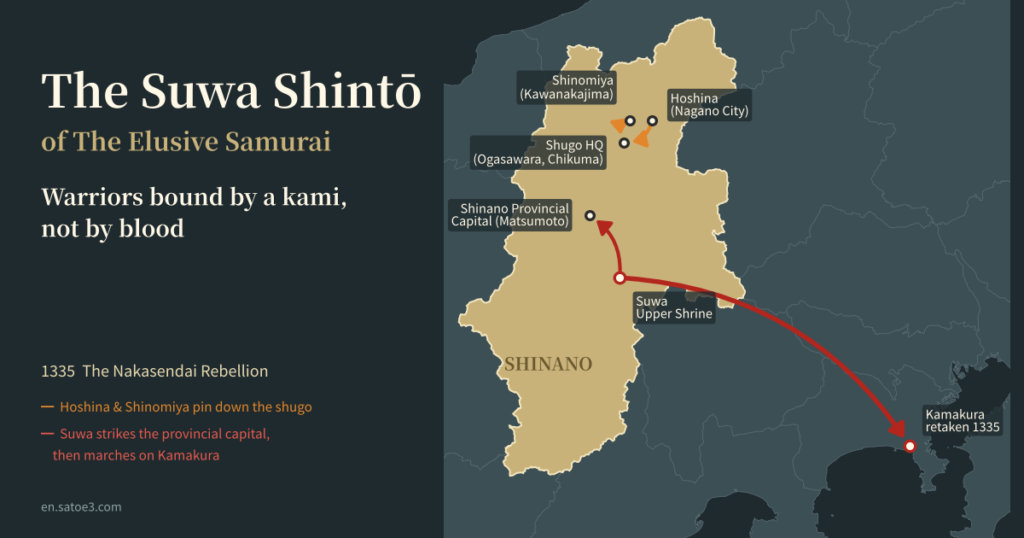
The Suwa Shintō of The Elusive Samurai: Warriors Bound by a Kami, Not by Blood
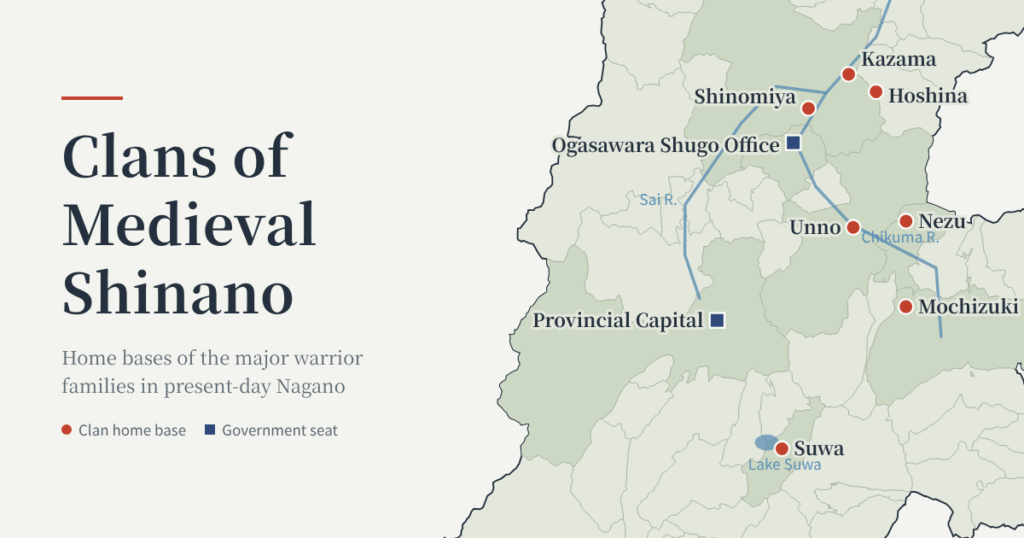
If you have read or watched The Elusive Samurai, you already know the Suwa Sect: Suwa Yorishige and his allies Hoshina, Shinomiya, Unno, Nezu and Mochizuki, who risk everything for the young Hōjō Tokiyuki. In history this group is called the Suwa Shintō (諏訪神党), literally “the band of the Suwa kami.” It was not a single family. Its warriors came from all over Shinano Province, today’s Nagano Prefecture. So what held them together? The answer is faith in the kami…
-
Why the Archers at Kamakura Are Still There: Eight Hundred Years of a Skill Nobody Could Steal
If you have seen photographs of Kamakura, you have probably seen this one. A rider in medieval court dress, bow drawn, thundering down a sand track past a wooden target. Yabusame — mounted archery — at Tsurugaoka Hachimangū. It is spectacular, and it photographs beautifully, and almost every caption describes it the same way: samurai horseback archery, a demonstration of martial skill. That description is accurate and it misses the entire point. The remarkable thing is not the shooting. It…
-
Are the Retainers in The Elusive Samurai Real? The Shinano Clans Behind Kazama, Nezu and Mochizuki — And What It Meant to Take a Name
Short answer first, because that is probably why you are here. Kazama Genba, Nezu Kamuro and Mochizuki Ayako are invented. No document records any of them. But the families they belong to — the Kazama, the Nezu and the Mochizuki — were real, and all three stood with Hōjō Tokiyuki, or stood close enough that the fiction is a reasonable one. So the characters are made up. Their placement is not. That is the easy part. The harder and more…
-
Why Did Godaiin Muneshige Sell His Own Nephew? ― Seven Days in a Fallen City “The Elusive Samurai”
If you found this page after watching or reading The Elusive Samurai, you already know the name Godaiin Muneshige. You probably also know the verdict that comes attached to it: scum, monster, the worst man in the story. I understand the reaction. He betrayed a nine-year-old boy who had been placed in his care by a dying father — and that boy was his own sister’s son. But I have spent a long time with this episode now, and I…
-
Who Was Ogasawara Sadamune? The Archer from The Elusive Samurai — and the Line That Still Rides at Tsurugaoka Hachimangū
If you have watched The Elusive Samurai (Nige Jōzu no Wakagimi), you know him as the antagonist: Ogasawara Sadamune, military governor of Shinano, a supernaturally gifted archer, and a distinctly strange man. If you have ever stood along the sand track at Tsurugaoka Hachimangū in Kamakura on the sixteenth of September and watched a rider in Kamakura-period hunting dress hit three targets at full gallop, you have seen something else entirely. These two things are the same thing. The riding…
-
The Oath That Outlived the House: What “Mihata Tatenashi” Still Does in Yamanashi
I went to the Shingen-ko Festival in Kōfu because of a BBC documentary. The programme was about the fact that the retainer families of the Takeda — a clan destroyed in 1582 — still exist, still know who they are, and still gather. That struck me as worth seeing in person. So in 2026 I went. What I saw there sent me back to rewrite everything I thought I understood about a single sentence. The line A man in Takeda…
-
Ueda in a Day: The Shrine of Oaths, and the Kamakura That Fell in Shinano
A car-free day trip from Tokyo — written for readers who arrived here through The Elusive Samurai. — If you have read The Elusive Samurai, you know how the story begins. Kamakura falls in 1333. A boy of the Hōjō house escapes and runs for Shinano, where a shrine priest called Suwa Yorishige takes him in. Two years later, Shinano rises. Most people who want to walk that story go to Suwa. That is the right instinct, and I have…