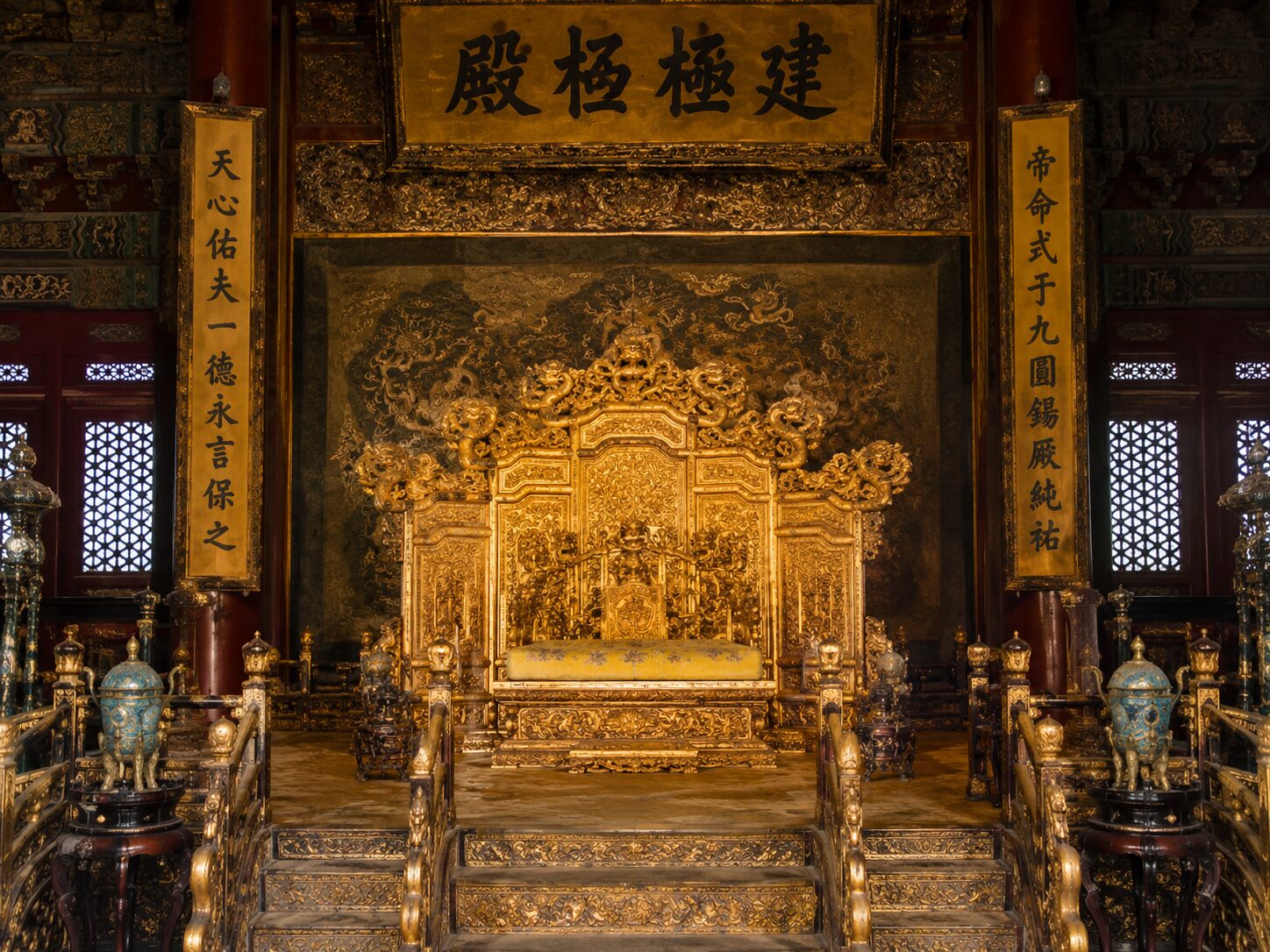
The boy named “joint rule” who was never let in.
The Tongzhi Emperor (1856–1875) was the son of Empress Dowager Cixi and the ninth emperor of the Qing dynasty. He took the throne at five, ruled in person for less than two years, and died at 18 — of smallpox, according to his own physicians, though a darker rumor of syphilis has followed him ever since.
His era name, Tongzhi (同治), means “joint rule.” The power was indeed shared — between his mother and the screen she sat behind. It was never shared with him.
He did not accept that quietly. He chose his own empress against his mother’s wishes. He received foreign envoys without demanding the kowtow. He tried to rebuild the Old Summer Palace and move his mother out of the Forbidden City. Every move was blocked. This is the story of the emperor, and of the wife he chose, who were crushed together for trying.
Tongzhi Emperor at a glance
- Personal name: Zaichun (載淳); temple name Muzong (穆宗)
- Born: 27 April 1856, Forbidden City, Beijing
- Reign: 1861–1875 (personal rule from February 1873)
- Died: 12 January 1875, aged 18 (19 by East Asian reckoning)
- Cause of death: smallpox, per court medical records; syphilis is a later rumor
- Parents: the Xianfeng Emperor and Empress Dowager Cixi
- Empress: Lady Alute (Empress Xiaozheyi), died March 1875
- Successor: his cousin, the Guangxu Emperor
A note on ages: this article uses Western ages. Chinese and Japanese sources often add one year.
What Does “Tongzhi” Mean? A Name That Shut Him Out
In August 1861 the Xianfeng Emperor died at the Chengde Mountain Resort, aged 30. His only surviving son, Zaichun, was five. Eight regent ministers took charge and chose a hopeful era name for the new reign: Qixiang (祺祥), “auspicious and blessed.”
The country badly needed a blessing. The Taiping Rebellion still raged. Anglo-French troops had burned the Old Summer Palace only a year before. The treasury was empty.
Qixiang never took effect. In November 1861, Cixi joined forces with Empress Dowager Ci’an — Xianfeng’s principal wife — and with the late emperor’s brother Prince Gong (Yixin). Together they overthrew the eight regents in the Xinyou Coup. Su Shun, the leading regent, was executed.
The regents’ era name was scrapped with them. The new name was Tongzhi (同治), “joint rule.” Officially it meant government shared by the two dowagers, the emperor and his ministers. In practice it meant the two dowagers ruled through the boy. He was excluded by his own name before he could read it.
✦ Satoe’s Take: Prince Gong did not back the coup out of loyalty to Cixi. I read it as loyalty to Ci’an, the legitimate senior widow. Cixi rode that wave — and would later turn on both of them.
Why Did Cixi Hold Power Instead of Her Son? Xianfeng’s Flawed Design
The Xianfeng Emperor tried to stop any one person from taking control after his death. He gave Ci’an a seal inscribed Yushang (御賞). He gave his son a seal inscribed Tongdaotang (同道堂), which Cixi kept on the boy’s behalf. An edict needed both seals to be valid. The eight regents drafted policy, and Prince Gong was kept at a distance.
It was a system of checks. Its flaw was that a seal held for a child belongs, in practice, to whoever holds it. Cixi controlled the boy’s seal, and over time she controlled what reached the throne at all. The single-person rule Xianfeng feared arrived anyway.
A famous story says Xianfeng also left Ci’an a secret edict allowing her to execute Cixi if she abused her power. This appears in later anecdotal accounts, not in official records, and should be read as legend.
Column: What Was “Curtain Rule” (垂簾聽政)?
Curtain rule let an empress dowager attend court seated behind a screen and decide state affairs for a child emperor. Custom did not allow a high-ranking woman to face male officials directly. The screen let her govern without breaking that rule.
Every edict went out in the emperor’s name. But the woman behind the cloth was in the same room, and every official knew it. Anything said to the emperor was said to her. The screen was thin. The silence it created was not.
The Tongzhi Restoration: A Revival Named After a Boy Who Had No Part in It
History remembers his reign for the Tongzhi Restoration (同治中興). In 1864 Zeng Guofan’s Xiang Army took Nanjing and ended the Taiping Rebellion. Li Hongzhang crushed the Nian rebels by 1868, and Zuo Zongtang went on to pacify the northwest.
Under the slogan of “self-strengthening,” these officials built China’s first modern arsenals, the Fuzhou shipyard and the China Merchants steamship line. It was a real revival. It belonged to the dowagers, Prince Gong and the provincial generals. The emperor whose name it carries was a child in the schoolroom.
Empress Alute: The Wife He Chose Against His Mother
In 1872, at 16, the emperor had to choose an empress. Cixi favored Lady Fuca. Ci’an favored Lady Alute (阿魯特氏), a Mongol noblewoman known for her learning and dignity. The emperor chose Alute. Lady Fuca entered the palace as a consort instead.
It was his first open act of defiance, and Cixi did not forget it. Accounts of the court say the emperor spent most of his time with Alute, and that Cixi told the young couple to spend less time together and more on study. Whatever the exact words, the message was clear: even his marriage was hers to manage.
February 1873: Personal Rule Begins
On 23 February 1873 the dowagers formally handed over government, and the curtain came down. The emperor was 16. For the first time, edicts were supposed to be his own.
The 1873 Audience: An Emperor Who Did Not Demand the Kowtow
Foreign envoys had been asking for an audience for years. The obstacle was the kowtow — kneeling three times and touching the forehead to the floor nine times. To the Qing court it showed proper submission to the Son of Heaven. To Western diplomats it meant declaring their own sovereigns inferior.
On 29 June 1873, at the Ziguang Pavilion (紫光閣), the Tongzhi Emperor received the envoys of Japan, Russia, the United States, Britain, France and the Netherlands. They bowed instead of kowtowing. It was the first time a Qing emperor accepted foreign envoys on these terms.
Japan’s representative, Soejima Taneomi (副島種臣), held the rank of ambassador and was received first, ahead of the Western ministers. For a Japanese reader, it is a striking scene: a Meiji statesman standing at the very door where the old Chinese world order met the new one.
The Old Summer Palace Gamble
In 1873 the emperor ordered the rebuilding of the Yuanmingyuan, the Old Summer Palace destroyed in 1860. Officially it was a gift to the two dowagers.
✦ Satoe’s Take: I suspect it was also an escape route. If his mother lived outside the Forbidden City, the reports reaching him might no longer pass through her hands first.
The treasury could not bear the cost. In 1874 Prince Gong, Prince Chun and other senior officials jointly urged him to stop. The emperor reacted by dismissing them. The two dowagers then stepped in, reinstated the princes and halted construction. It was a public reminder of who still held power — a year and a half into his “personal” rule.
How Did the Tongzhi Emperor Die? Smallpox vs. the Syphilis Rumor
Short answer: the Tongzhi Emperor died of smallpox on 12 January 1875, in the Eastern Warm Chamber of the Hall of Mental Cultivation (養心殿). His physicians’ daily case records survive, and they describe smallpox. The story that he died of syphilis is a rumor with no support in those records.
He fell ill in December 1874. The rumor that grew around his death went like this: lonely and kept from his wife, the young emperor slipped out of the palace in disguise and visited brothels in the city. Some versions add that the smallpox diagnosis was a cover, because syphilis could not be named for the Son of Heaven.
Why did the rumor stick? It fit a story people already believed — a dissolute young ruler, a palace full of secrets. But the men who examined him at his bedside wrote smallpox, day after day.
✦ Satoe’s Take (as a dentist): Syphilis and smallpox run on completely different clocks. Syphilis begins with a hard, painless, deep ulcer at the site of infection — in the mouth, when the infection is oral. Weeks later a red rash spreads across the body. Then the disease falls silent, often for years, before it finally attacks the heart, blood vessels and nerves. It is measured in years, not weeks. The emperor fell ill in December and was dead by mid-January. A course that short does not fit syphilis. And a court physician examining the emperor every day would have recognized syphilis at its earliest stage. When I read the records, I see doctors following a smallpox case — not hiding a different disease.
✦ Satoe’s Take: Who started the syphilis rumor, no one knows. I only note that it moved the blame for his death from the palace to the young man himself — and away from the question of who had kept him so isolated.
What Happened to Empress Alute?
The most painful scene of his life comes from the memoir of Yun Yuting (惲毓鼎), a court official who wrote it decades later. In his account, Alute visited the dying emperor, who complained to her of his mother’s interference. Alute told him to recover — they would have better days together.
Cixi learned of the conversation. According to the same account, she burst in, dragged the empress out by her hair and struck her, while the emperor lay too ill to stop it. This is one memoir, written long after the event, and cannot be confirmed. But it has shaped how the story is remembered.
The emperor died with no son and no named heir. Alute died on 27 March 1875, about ten weeks after him. The cause was never clearly recorded. Rumors said she was starved, or took her own life, or was pregnant. None of these can be proven.
✦ Satoe’s Take: If Alute had lived and borne a son, she would have become empress dowager herself — a rival to Cixi. Whatever the cause of her death, it removed the one person who could have blocked Cixi’s next regency.
After Tongzhi: Cixi Rules Again
Cixi placed her three-year-old nephew Zaitian on the throne as the Guangxu Emperor. He was adopted as Xianfeng’s son, not Tongzhi’s, so Tongzhi’s line simply ended — and a child emperor meant another regency.
In April 1881, Ci’an died suddenly after a short illness. She had seemed in good health, and rumors of poison have never faded. There is no proof.
In 1884, after setbacks in the war with France, Cixi dismissed Prince Gong from the Grand Council. With Ci’an and Prince Gong both gone, the checks Xianfeng had built were finished. Cixi would dominate the court until her death in 1908.
He Was Not Weak. It Simply Was Not Enough.
Britannica calls him a weak, uninterested ruler. Look at what he actually tried in his short life. He refused his mother’s choice of empress. He received foreign envoys without the kowtow. He tried to rebuild a palace that would have put distance between himself and his mother. When the princes opposed him, he tried to dismiss them.
Each attempt was reversed. His early death also closed the last real chance for the Qing to change course under an adult emperor. The question of what he might have done passed to the next young man behind the same screen: the Guangxu Emperor.
Tongzhi Emperor Timeline
- 1856 — Born 27 April in the Forbidden City
- 1861 — Xianfeng dies in August; Zaichun succeeds at five; Xinyou Coup in November; era name changed from Qixiang to Tongzhi
- 1864 — Nanjing falls; the Taiping Rebellion ends
- 1868 — Nian Rebellion suppressed
- 1872 — Chooses Lady Alute as empress over Cixi’s candidate
- 1873 — Personal rule begins (23 February); receives six nations’ envoys without the kowtow (29 June); orders the Yuanmingyuan rebuilt
- 1874 — Construction halted after the princes’ protest; falls ill with smallpox in December
- 1875 — Dies 12 January, aged 18; the Guangxu Emperor succeeds; Empress Alute dies 27 March
- 1881 — Empress Dowager Ci’an dies suddenly
- 1884 — Cixi dismisses Prince Gong
Column: Why the Kowtow Mattered
For the Qing court, the proper greeting for any foreign envoy was the three kneelings and nine prostrations (三跪九叩頭). In Chinese eyes it placed the envoy’s ruler beneath the Son of Heaven.
- 1793 — Macartney mission (Qianlong Emperor). Britain sought trade. Macartney would not perform the full kowtow, and the mission went home with nothing.
- 1816 — Amherst mission (Jiaqing Emperor). Amherst also refused, and was sent away without ever seeing the emperor.
- 1873 — Tongzhi Emperor. Eighty years after Macartney, envoys finally stood before a Qing emperor and bowed instead.
From Qianlong demanding submission to Tongzhi accepting a bow, you can trace the whole arc of the Qing — from believing it was the center of the world to facing the world as it was.
Frequently Asked Questions
How old was the Tongzhi Emperor when he died? He was 18 (19 by East Asian reckoning). He died on 12 January 1875.
Did the Tongzhi Emperor die of syphilis? No reliable evidence supports this. His physicians’ records describe smallpox, and his illness lasted only about a month — far too short for syphilis, which develops over years. The syphilis story is a later rumor.
Who was the Tongzhi Emperor’s mother? Empress Dowager Cixi, who ruled through him as regent.
Who was the Tongzhi Emperor’s wife? Empress Alute (Empress Xiaozheyi). She died about ten weeks after him.
Did the Tongzhi Emperor have children? No. His cousin became the Guangxu Emperor.
Sources and Further Reading
- Tongzhi Emperor — Wikipedia
- Tongzhi — Encyclopaedia Britannica
- Empress Xiaozheyi (Alute) — Wikipedia
- Yun Yuting (惲毓鼎), Chongling Chuanxin Lu (崇陵傳信錄) — memoir source for the sickbed scene
Series: The Fall of the Qing — six reigns, 120 years
← Previous: The Rise of Cixi: How a 25-Year-Old Concubine Came to Rule the Qing
Next: The Guangxu Emperor: The 103-Day Reform, Imprisonment and Poisoning →