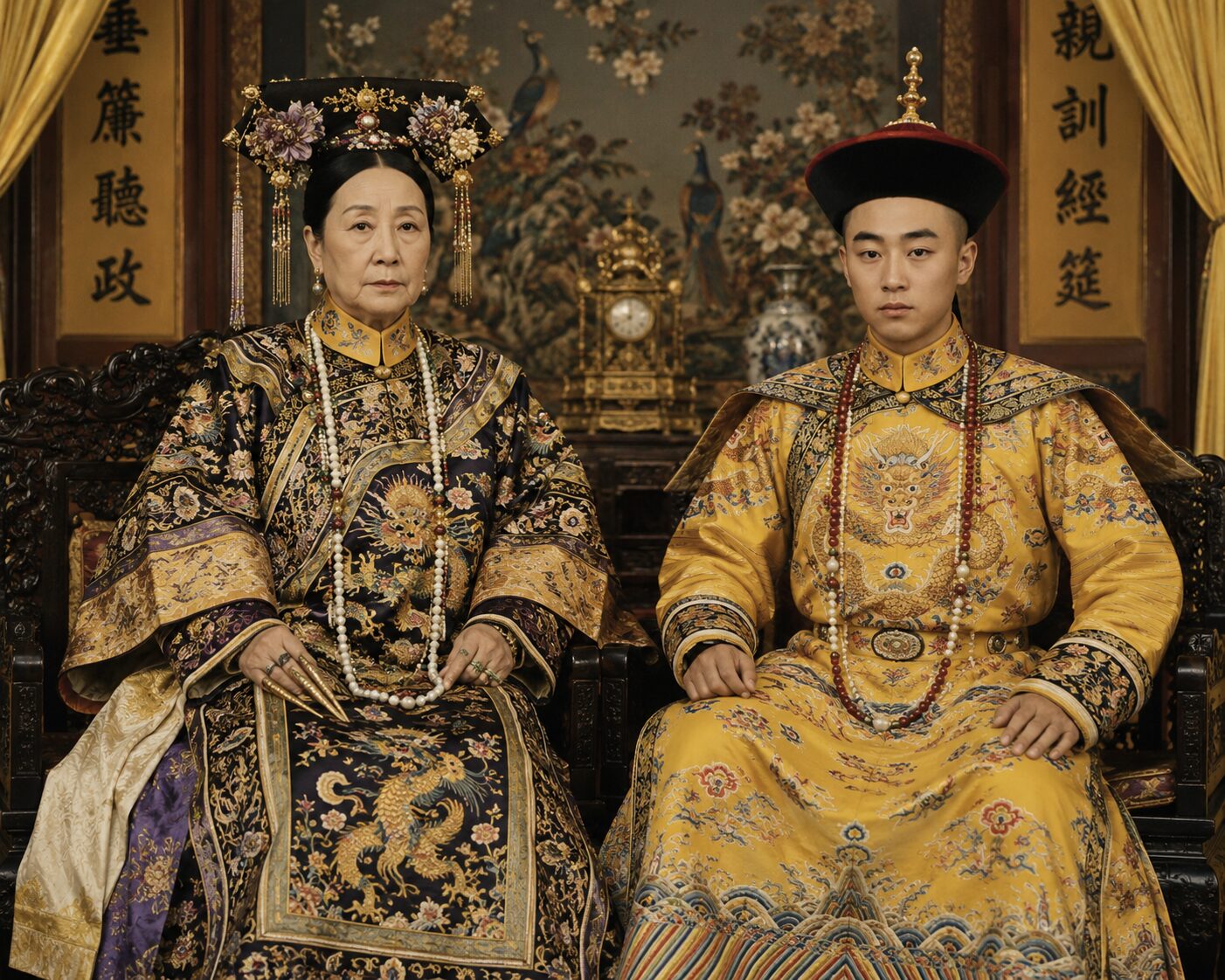
The Guangxu Emperor:
The Emperor Who Said He Didn’t Need Power
Imprisoned by Cixi, possibly poisoned — yet Guangxu never broke. He launched 103 days of reform to save China. The emperor who chose mission over power.The Guangxu Emperor and the 103-Day Revolution That Failed
Late Qing Dynasty Series
“If it would save the country, I do not need to hold power.”
No emperor in Chinese history was supposed to say this. Princes fought and bled for the throne. Empress Dowager Cixi — who could never be emperor herself because she was a woman — spent nearly half a century maneuvering, threatening, and outlasting everyone around her to keep real power in her own hands. The entire logic of the imperial court ran on the hunger for power.
And yet the Guangxu Emperor, already seated on the Dragon Throne, said he was willing to let it go.
He may have been a failure as an emperor. But as a human being, he may have been the most imperial of them all.
I. A Child Brought to Court at Age Four
His name was Zaitian (載湉), born in 1871. His father was the seventh son of the Daoguang Emperor. His mother was Cixi’s younger sister. That bloodline determined everything.
In 1875, the Tongzhi Emperor died young, leaving no heir. The four-year-old Zaitian was brought to the Forbidden City to take the throne. Separated from his mother. Placed in a palace. Given a new name for an era: Guangxu — “Glorious Succession.”
For Cixi, the child emperor was a political instrument — a way to continue ruling through the curtain, the system by which a regent hears court business from behind a screen. But she also raised him herself. Guardian and captive. Mother and warden. This is the relationship that would define — and eventually destroy — both of them.
II. The Defeat That Changed Everything
In 1887, the Guangxu Emperor formally began his personal rule. Cixi remained at her Summer Palace. The real power stayed with her.
Then came 1894. The First Sino-Japanese War.
China — the Middle Kingdom, the center of civilization — was defeated by Japan. Not by Britain or France, the great Western empires that had been humiliating China for decades. By Japan, a small island nation that had only begun modernizing thirty years earlier.
This was not just a military defeat. It was a collapse of a worldview.
My reading is this: the war changed Guangxu from a suppressed emperor into a man with a mission. He was no longer merely seeking power. He needed reform as the only tool left that could save a country already being carved apart by foreign powers.
III. Understanding Why Heaven Matters
Before we can understand what Guangxu was trying to do, we need to understand something about the Chinese political universe that has no real equivalent in the Western tradition.
The God of the Bible chose a people and kept them. The Christian God does not abandon his faithful. There is a famous story — Quo Vadis, Domine, “Where are you going, Lord?” — in which the apostle Peter, fleeing persecution, meets Christ on the road. The question assumes that God can be followed. That God will stay.
God makes covenants. Heaven makes no promises.
The God of the Bible grieves. He sees suffering and is moved. He stays. And if you stray, he waits for your return.
Heaven does not grieve. Heaven does not stay. Heaven simply leaves — without a word, without a warning. And it never comes back.
Heaven does not choose a people. Heaven watches how you rule. If you rule with virtue — with justice, with genuine care for the people — Heaven’s favor rests on you. If you don’t, it moves on. No warning. No second covenant. The favor simply… shifts.
This is the Mandate of Heaven (天命, Tianming). And it created a specific kind of dread that has no equivalent in Western political thought. It wasn’t the fear of sin. It wasn’t the fear of heresy. It was the fear of waking up one day and discovering that Heaven had already withdrawn its mandate — and you just hadn’t noticed yet.
The proof that Heaven had withdrawn? Simple: you lost power. Whoever wins, wins by Heaven’s sanction. Whoever falls, deserved to fall.
There is no martyrdom in this system. No appeal. No moral victory in defeat. Just the verdict of history.
Which means the Guangxu Emperor — watching China humiliated by Japan, watching foreign powers claim Chinese territory — was watching Heaven’s mandate slip away in real time. And he knew it.
IV. The 103 Days: A Revolution Disguised as Reform
On June 11, 1898, the Guangxu Emperor issued the Decree Defining the National Policy and launched what history would call the Hundred Days Reform (百日維新). In 103 days, he issued a cascade of edicts: abolish the Eight-Legged Essay exam format, establish new Western-style schools, reorganize the military, eliminate redundant government posts.
Was this reckless? In retrospect, perhaps. But Guangxu had no time for the careful, consensus-building reform that might have succeeded. The partition of China by foreign powers was not a future threat. It was already happening.
The Three Pillars He Was Attacking
Here is my own interpretation, and I want to be clear that it is mine: the standard explanation — “Cixi was conservative and crushed the reforms” — is too simple. Look carefully at what Guangxu was actually trying to do, and you realize that the reforms were a simultaneous attack on the three structural pillars of Cixi’s power.
Pillar One: Personnel. By reforming the exam system and establishing new schools, Guangxu would produce officials who owed their careers to merit and to him — not to Cixi’s network.
Pillar Two: Finance. By creating something resembling modern accounting and audit, he would expose the systematic diversion of state funds that had been going on for decades. Cixi treated the imperial budget as her personal account — money flowed out to build the Summer Palace, to fund lavish court life, to pay for the cover-ups of financial irregularities.
Pillar Three: Command. This was the most critical. All imperial edicts passed through the Grand Council (軍機處), which was effectively under Cixi’s control. Guangxu could issue any reform order he liked — but every order passed through her hands. He needed to create a direct command channel, bypassing the Grand Council entirely.
The dismissal of six senior ministers, the bypassing of the Grand Council, the promotion of Yuan Shikai — these were not isolated reform measures. They were moves in a single strategy to dismantle all three pillars at once.
Guangxu was calling it “reform.” What he was actually doing was closer to revolution. And Cixi saw it clearly. That is why she moved.
V. What He Was Actually Trying to Change
The Eight-Legged Essay and the Mind It Created
To understand why abolishing the imperial exam system was so explosive, you need to understand what that system actually was.
Imagine that the United States suddenly announced that bar exams, medical board exams, and the SAT were all abolished overnight — and replaced with something completely different. Now imagine that some of the people most affected had spent their entire lives, since early childhood, doing nothing but preparing for those exams. That is a fraction of what the abolition of the Eight-Legged Essay meant to the people it affected.
The Eight-Legged Essay (八股文) was not a test of thought. It was a test of perfect reproduction. The format was completely fixed — eight sections, in a prescribed order, on topics drawn from Confucian classics. The question was not “what do you think?” The question was “what would the sages have thought?” Original interpretation was penalized.
Compare this to the essay tradition that emerged in the West from Montaigne: “I think this, because…” Personal observation. Independent logic. The individual perspective as the source of value.
The Eight-Legged Essay was the exact opposite.
In English: it wasn’t about expressing thought. It was about perfectly reproducing the right answer.
And this was not merely a problem of exam format. The Eight-Legged Essay institutionalized a specific way of not thinking. To pass, you had to suppress independent interpretation. Decades of that training produced officials who had been systematically trained to stop thinking for themselves. The system produced the minds that ran the country.
Why Western Knowledge Couldn’t Simply Be “Added On”
Western learning rests on a foundation of mathematics, logic, and natural science. From there, engineering, medicine, economics, and law are derived. The underlying habit of mind is: form a hypothesis, test it against reality, revise.
Traditional Chinese learning centered on the Confucian classics, the histories, and poetry. The underlying assumption was: truth already exists, in the words of the sages. The task is to understand it correctly. Mathematics and natural science existed, but they were practical crafts — the province of artisans and merchants, not scholars.
Asking imperial officials trained in the classics to implement Western-style fiscal reform was like hiring someone for their ability to write beautiful classical poetry and then asking them to manage a modern budget with double-entry bookkeeping. The problem was not willingness. The intellectual foundation was simply not there.
The Money Nobody Could Count
Because the exam system produced officials with no mathematical training, the actual state of imperial finances was, in a very literal sense, unknowable. Nobody in the court could accurately calculate where the money was going. Enormous sums disappeared without anyone being able to prove — in numbers — that they had disappeared.
It is widely believed that funds allocated for the modernization of the Beiyang Fleet were diverted to build Cixi’s Summer Palace. This was possible precisely because nobody could track the money with any rigor. The failure of Chinese military modernization was not only a problem of technology. It was a problem of having no one capable of managing a modern defense budget.
My reading: what Guangxu needed was not just “modern talent” in the abstract. He needed people who could read numbers, manage budgets, and expose embezzlement. The abolition of the Eight-Legged Essay and the founding of new schools was simultaneously an education reform and a prerequisite for any real financial accountability.
The Privilege That Looked Like a Job
The elimination of redundant government posts was not merely administrative tidying. For the Manchu aristocracy, these posts were birthright. You didn’t earn them. You inherited them — along with the salary that came with them. Eliminating those posts meant stripping an entire class of its guaranteed income.
It wasn’t about ideology. It was about money and privilege.
Every interest group that Guangxu’s reforms threatened — the exam-system officials, the tutors who taught the Eight-Legged Essay for a living, the Manchu nobility with their inherited sinecures, the Grand Council officials whose power depended on being the bottleneck for all imperial orders — became his enemy simultaneously.
The One Thing That Survived
In 1898, during the Hundred Days, Guangxu established the Imperial University of Peking — the institution that would later become Peking University, one of China’s most prestigious universities today.
Almost everything else from the Hundred Days was destroyed. But this survived. Even Cixi could not bring herself to abolish it entirely. It was closed briefly during the Boxer Uprising in 1900, reopened in 1902, and became Peking University in 1912.
My reading: even the most conservative elements of the court could not deny that China needed a new kind of educated person. The idea of the institution was too obviously right, even to its enemies.
VI. Betrayal and the End of 103 Days
As the walls closed in, the reformers made a desperate gamble. Tan Sitong secretly approached Yuan Shikai and revealed a plan to place Cixi under house arrest. Yuan appeared to agree. Then he reported the plan to the general Ronglu.
But here is something that is often overlooked: on September 19, 1898, Cixi returned abruptly from the Summer Palace to the Forbidden City and seized control of the emperor — before Yuan’s betrayal reached her. She had been moving independently. Yuan’s report was self-preservation theater after the fact.
On September 21, Cixi declared the resumption of her regency. The Guangxu Emperor was confined to the Yingtai, an island pavilion in the middle of a lake within the Zhongnanhai complex. The six reformers known as the Six Gentlemen of the Wuxu Reform were executed. The 103 days were over.
VII. Ten Years of Deliberate Humiliation
Cixi announced publicly that the emperor was gravely ill and unable to govern. In reality, she had him confined.
I have visited the Summer Palace. I have stood in the place where Cixi held court in her later years — the lavish halls where foreign envoys and senior officials came to pay their respects. After their audience with Cixi, they would walk past a small building nearby. Music drifted through the walls. The sounds of banquets. Laughter. The emperor could hear it all from his confinement. In those early years, he could still go out to his small courtyard and listen. The windows were still open.
This was not simply imprisonment. It was a calculated lesson: this is what power looks like, and this is what you are not. Cixi was waiting for him to break. To become her obedient son again.
He never broke. He never became what she was waiting for. So it escalated.
I have also visited the Yingtai, where he was held in his final years. The windows of his rooms had been plastered over with plaster. No light from outside. No sound. And according to the guide’s account, the food sent to him was Cixi’s deliberate leftovers — allowed to rot before delivery.
On November 14, 1908, the Guangxu Emperor died at the age of thirty-eight. Cixi died the following day.
She had fed him as a mother feeds a child. When he defied her, she fed him poison. The logic was the same. The hand was the same.
Modern forensic analysis of his remains has detected arsenic levels consistent with poisoning. The question of who ordered it may never be definitively answered. But I find myself less interested in the forensic question than in the political one: Cixi did not want the Guangxu Emperor alive after her own death. If he survived, the reformers would return. Everything she had built would be dismantled. She arranged for him to die one day before she did.
VIII. The Emperor Who Belonged to a Different Tradition
In the oldest layer of Chinese political mythology, the sage-kings Yao and Shun did not fight for power. They accepted the throne as a responsibility to the people. When Yao chose a successor, he passed over his own son and gave the throne to the man he judged most worthy. Power was not a prize. It was an obligation.
The First Emperor of Qin stands at the opposite pole. He invented the word huangdi — “emperor” — combined the titles of the three sovereigns and five emperors of antiquity into a single term, and tried to make his dynasty last ten thousand generations. He institutionalized power. Made it permanent. For two thousand years afterward, that is what an emperor was: the apex of power, the embodiment of the will to dominate.
The Guangxu Emperor was the legal heir of the First Emperor’s invention. He sat on a throne built on that two-thousand-year tradition of power as domination.
But his spirit was somewhere else entirely.
My reading: this is both beautiful and tragic. The sage-kings could afford their virtue because the people around them could receive it. The court of the late Qing was populated entirely by people who understood power only as something to be seized and held. A beautiful spirit in that environment was not inspiring. It was simply weak.
And yet he did not give up. That, I think, is the essential thing about this man.
IX. The Verdict
The Guangxu Emperor did not fail because his reforms were wrong. He failed because he tried to dismantle the structure of power while possessing none of it himself. And — the cruel irony — the very quality that made him willing to say “I don’t need power” was exactly what made it impossible for him to obtain it.
In 1905 — seven years after the Hundred Days Reform — the Qing dynasty abolished the imperial examination system. In 1912, the dynasty itself fell. The things he had risked his life to change did eventually change. They changed after his death.
Cixi had two sons. One she bore: the Tongzhi Emperor. One she chose and raised: the Guangxu Emperor. Both, as they grew, tried to push her aside. Both died before her.
The Guangxu Emperor said he did not need power. Cixi never released it — not for a single day, until she died.
These two people lived in the same palace for nearly fifty years, as mother and son. In the face of the thing that power does to people, this is what a mother and son became.
Late Qing Dynasty Series | satoe’s historical blog
Series: The Fall of the Qing — six reigns, 120 years.
← Previous: Tongzhi Emperor (1856–1875): Reign, Death, and Cixi’s Son
Next: Empress Dowager Longyu and the Fall of the Qing →