HOW TO READ BUDDHIST STATUES IN JAPAN | Part 1
What Are All These Buddhist Statues Doing?
A Beginner’s Guide for Travelers to Japan
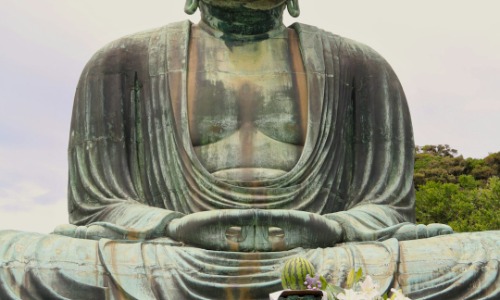
You may have seen it already — perhaps in a photo before your trip, or on a postcard at the airport: the Great Buddha of Kamakura, sitting serenely in the open air, one hand raised with the palm facing outward. It is one of the most iconic images in Japan.
But what is that hand gesture saying? And why does almost every large Buddhist statue in Japan seem to strike a similar pose?
Across Japan — in temples, museums, mountain shrines, and quiet garden corners — you will encounter hundreds of Buddhist figures. They sit, stand, hold objects, raise their hands. Some look peaceful. Some look fierce. Some have many arms.
Once you know a few basics, these figures stop being mysterious and start telling you stories. This guide will give you just enough to make every encounter with a Buddhist statue genuinely interesting.
Step 1: Who Was the Buddha?
Everything starts with one historical person: Siddhartha Gautama, a prince born in what is now Nepal, around the 5th century BCE. He left his palace life, spent years in deep meditation, and eventually reached a state of complete spiritual awakening. From that moment he was called the Buddha — a Sanskrit word meaning “the Awakened One.”
He then spent decades traveling and teaching, sharing the path to enlightenment with anyone who would listen. When he died, he left behind a community of followers and a body of teachings that would eventually spread across all of Asia — and shape the art and architecture of Japan for over a thousand years.
? In Japan, you will often see the label “Shakyamuni” (釈迦牟尼, Shaka Muni). This simply means “Buddha of the Shakya clan” — the historical person himself.
Step 2: The Three Main Types of Buddhist Figure
As Buddhism spread and developed over centuries, it created a rich cast of spiritual figures. For first-time visitors, three categories are the most useful to know.
|
Nyorai (如来) Buddha |
Bosatsu (菩薩) Bodhisattva |
Myo-o (明王) Wisdom King |
|
|
Who are they? |
Fully enlightened beings |
On the path to enlightenment; helpers of humanity |
Fierce protectors who fight ignorance and evil |
|
Appearance |
Simple robe, no jewelry, calm expression |
Royal dress, jewelry, ornaments |
Fierce face, flames, weapons |
|
Mood |
Serene, transcendent |
Compassionate, active |
Powerful, urgent |
|
Examples |
Shakyamuni, Amitabha, Vairocana |
Kannon, Maitreya, Manjushri |
Fudo Myo-o, Ragaraja |
? Think of it as a journey: Bodhisattvas are still traveling the road. Buddhas have arrived. Wisdom Kings are the fierce companions who keep you moving when you want to give up.
Step 3: Reading the Hands
One of the most rewarding things you can do in front of a Buddhist statue is look at the hands. The gestures — called mudrā in Sanskrit — each carry a specific meaning. Here are the three most common ones you will encounter in Japan.
“Do not be afraid” — Abhaya Mudrā
One hand raised to chest height, palm facing outward, fingers pointing up. This says: you are safe here, there is nothing to fear.
This is the gesture the Great Buddha of Kamakura is making with his right hand. Nearly 800 years old, seated in the open air, he has been offering this reassurance to everyone who visits ever since.
“I will grant your wish” — Varāda Mudrā
One hand lowered, palm facing outward and slightly forward, as if offering something. This expresses the figure’s willingness to hear and fulfill the prayers of those who come to them.
“Meditation” — Dhyāna Mudrā
Both hands rest in the lap, one on top of the other, palms facing upward. This is the posture of deep, undistracted meditation. You will often see this on seated Buddha figures.
? When a statue raises one hand and lowers the other — “Do not be afraid” and “I will grant your wish” together — it is offering both protection and compassion at the same time.
Step 4: Other Things to Look For
The Halo (光背 kōbai)
The disc or flame-shaped form behind the head or body represents sacred light radiating from an enlightened being. You will find halos in Christian art too — the idea of divine radiance appears across many world religions.
The Ushnisha
That rounded bump on the top of the head of many Buddha figures is called the ushnisha. It is not a hairstyle — it is a physical sign of supreme wisdom, one of the traditional “marks of a great being.”
The Elongated Earlobes
Long earlobes on Buddha figures are a reminder of Siddhartha’s royal past, when he wore heavy jeweled earrings. After renouncing his worldly life, he removed them — but the stretched lobes remained as a symbolic trace of his origins.
Multiple Arms
Some figures — especially Bodhisattvas like Kannon — are depicted with many arms, each holding a different object or making a different gesture. This represents the figure’s limitless ability to help many beings simultaneously, in many different ways.
You Are Ready to Look
With just these basics in mind, every Buddhist statue you encounter in Japan becomes something to read rather than just admire. Instead of “a lot of old figures,” you start to see individual characters — each with a role, a personality, and a message expressed through posture, gesture, and appearance.
In the next part of this series, we will stand in front of a specific statue and read it together, step by step. See you there!
(Satoe)