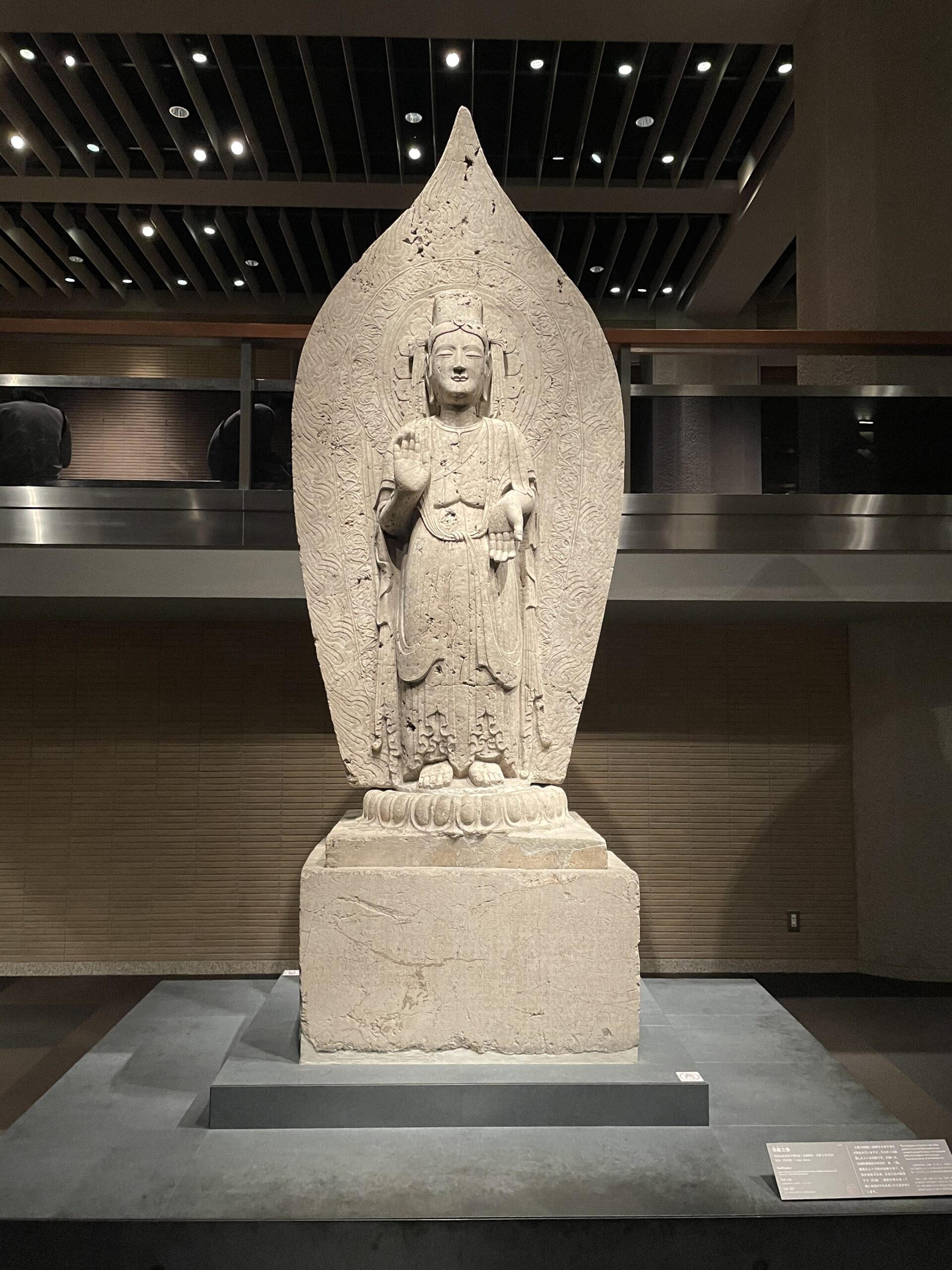
A Bodhisattva from the Northern Qi Dynasty
Visiting the Tokyo National Museum — Oriental Gallery, Room 1
I recently visited the Oriental Gallery at the Tokyo National Museum — and it was wonderful!
The moment I stepped into Room 1 on the first floor, a single statue caught my eye: a Standing Bodhisattva, created in Shanxi Province, China, in 552 CE during the Northern Qi dynasty. That predates even the beginning of Japan’s Asuka period. It is a piece from a truly distant past.
During the guided tour I found myself wanting to know more, so I went home and looked everything up myself. I am not a specialist — I am a dentist who loves history — but I hope I can share what I found in a way that is easy and enjoyable to read.
What Is a Bodhisattva?
Let’s start with the word itself. “Bodhisattva” is a transliteration of the Sanskrit Bodhisattva, meaning “a being who is on the way to enlightenment.”
A Bodhisattva is a compassionate being who pursues enlightenment through spiritual practice while simultaneously working to save others. Once their training is fully complete, they attain Buddhahood (Tathāgata). So a Bodhisattva exists in an in-between stage — not yet a Buddha, but actively practicing and helping others along the way.
Their practice includes not just personal discipline, but also acts of compassion and salvation toward all living beings. They are spiritual practitioners who serve others while walking their own path.
? The visual form of the Bodhisattva is said to be modeled on the appearance of Shakyamuni before he renounced worldly life — dressed as an Indian royal or nobleman, adorned with elaborate jewelry and ornaments. (I will share photographs of this in a future post.)
Reading the Statue’s Gestures
The Right Hand: Abhaya Mudrā (“Fear Not”)
The right hand of this statue is raised to chest height, palm facing outward, fingers extended together. This gesture is called the Abhaya Mudrā (in Japanese: semui-in, 施無畏印).
It means “Do not be afraid.” The gesture signifies that the Bodhisattva removes the fears and anxieties of people and offers them a sense of peace and protection.
According to Buddhist tradition, this gesture originates from the story of Shakyamuni stopping a drunken elephant that was charging toward a crowd — raising his hand to protect the people.
The Left Hand: Varāda Mudrā (“Grant Wishes”)
The left hand is lowered with the palm facing forward and outward. This is called the Varāda Mudrā (in Japanese: yogan-in, 与願印).
It expresses the compassionate intention to hear the wishes of the people and grant what they desire. Together, the two gestures form a single message: “Do not be afraid — I am here, and I will receive your prayers.”
The Halo and the Arabesque Pattern
The Halo: Visualizing Sacred Light
Behind the statue is a kōbai (光背), or halo — a representation of the radiant light emanating from the body of a holy being. It visually communicates the divine and sacred nature of the figure.
Halos are not unique to Buddhism. They appear in Christian iconography around saints and holy figures, and can be traced back to Zoroastrianism, which predates Buddhism. The halo is a universal visual language of the sacred, shared across religions and cultures around the world.
The Arabesque: A Pattern That Traveled the Silk Road
Carved into this halo is an arabesque pattern — in Japanese called karakusa-monō (唐草模様). It depicts intertwining vines and leaves in a flowing, continuous design, and is considered an auspicious motif symbolizing longevity and prosperity.
Its origins lie in ancient Egypt and Mesopotamia. Traveling along the Silk Road, it spread across Central Asia and had reached China by around 500 CE, before arriving in Japan during the Nara period.
The fact that this arabesque appears on a statue made in Shanxi Province in 552 CE tells us that the pattern had already taken root in China by that time — carried eastward over centuries of cultural exchange.
Closing Thoughts
This Standing Bodhisattva, created in 552 CE, has stood quietly for nearly 1,500 years, holding out two gestures: “Do not be afraid” (right hand) and “I will receive your wishes” (left hand).
On its halo, an arabesque pattern whose roots stretch back to ancient Egypt speaks to the long history of human connection across the Silk Road.
The Oriental Gallery has so much more to explore. I plan to visit several more times and introduce other exhibits here on the blog. I hope you will join me for the next installment!
(Satoe)