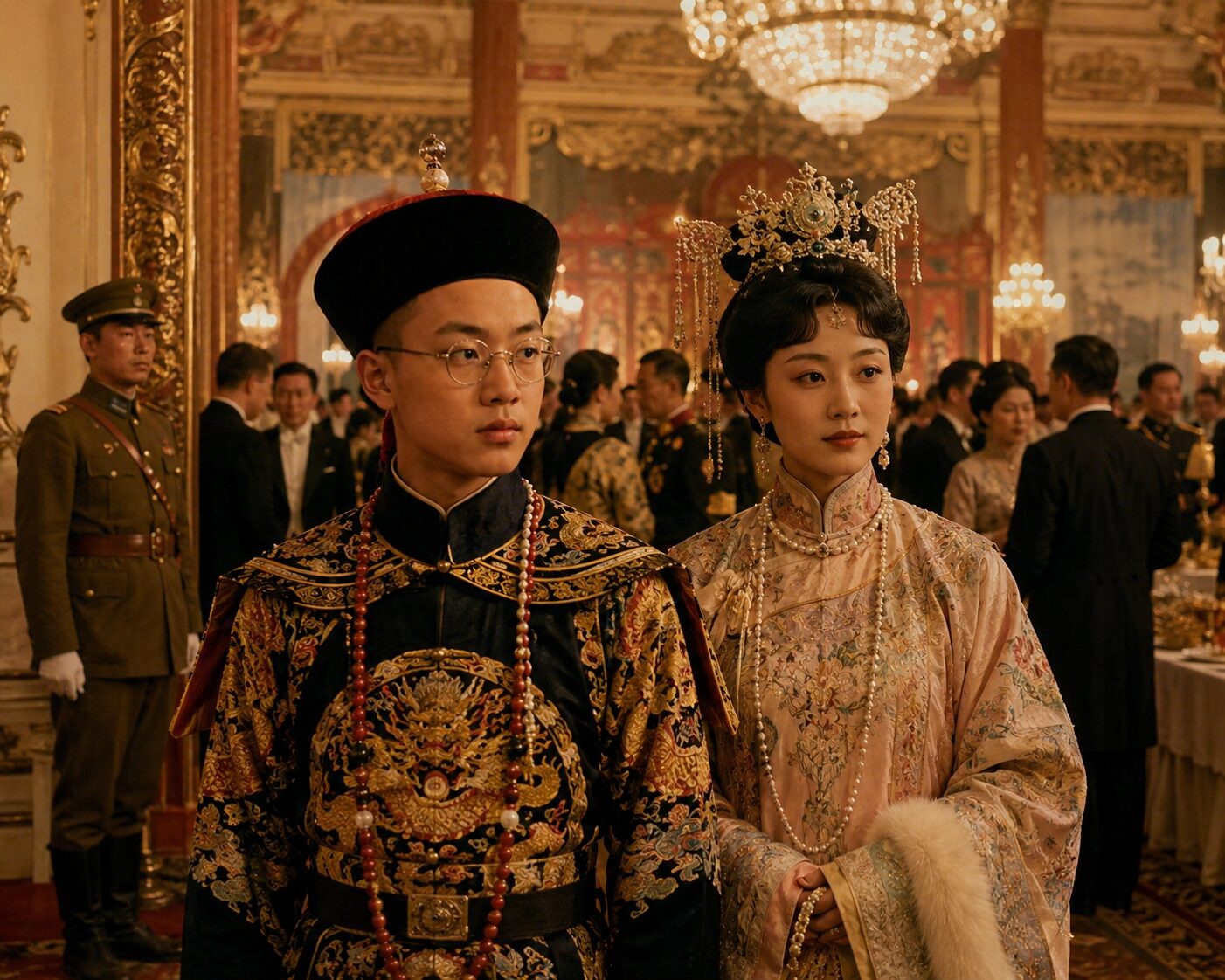
The Shadows of Manchukuo: What Really Happened Behind the Puppet Emperor Puyi
“A Mikoshi Should Be Light” — The Hidden Architecture of Manchukuo’s Founding
Introduction — A Structure of Power Unique to Japan
There is a Japanese saying: “A mikoshi should be light.” A mikoshi is the portable Shinto shrine that crowds hoist onto their shoulders and carry through the streets during a festival. A light one is easy to carry — and if something goes wrong, you can simply set it down and walk away. And the bearers underneath? No one can quite tell who they are. This is not really about festivals. It is a description of how power works in Japan. And what matters most is that this structure is peculiarly Japanese. Consider China. When the Empress Dowager Cixi held power by “governing from behind the screen,” everyone knew she was there. The screen was a matter of ceremonial form; it was never meant to hide the true holder of power. Everyone understood who was really in command. Korea was much the same. When someone pulled the strings from behind the scenes, the identity of that person was generally common knowledge. Manipulation took place, but the manipulator was never truly hidden. Japan is different. In Japan, the bearers are genuinely unknown. They are not concealed as a matter of form — it is that you actually cannot tell who they are. The question “Who decided what?” is one that later historians sometimes cannot answer no matter how many documents they comb through. The ambiguity is not a byproduct of the system. The ambiguity is the system. This stands in contrast to the Western model of power as well. In the West, the powerful step into the open. Responsibility is clearly located, and the strong leader is held up as the ideal. When things fail, the powerful figure himself falls. In Japan, when things fail, the mikoshi is set down. The bearers walk away — and no one can say exactly who they were. After the Second World War, the United States initially believed that Emperor Hirohito bore responsibility for the war. At the Tokyo Trials, many people were judged. But most of those who stood trial were merely “the ones who had been hoisted up.” The true bearers remained in the shadows to the end. The conspiracy behind the founding of Manchukuo can be read through this same logic. Behind the splendid robes and the rituals of state, a precise and cold machine of manipulation was turning. And the men who turned that machine will, in all likelihood, never be fully identified. That, I believe, was not an accident, but an intended result.Chapter One — Puwei, the “Other Candidate” for Emperor
After the Manchurian Incident of 1931, when the Kwantung Army set about choosing a puppet emperor for its new state, the man initially favored by a considerable number of Japanese was the Qing prince Puwei, of the Prince Gong line.Who Was Puwei? — Prince Gong and the Zongshe Party
When we speak of Puwei as “the other candidate,” it is worth establishing that he was no mere “talented imperial relative.” Puwei was the heir to the house of Prince Gong — the line of Yixin, the brother of the Xianfeng Emperor who had led the Self-Strengthening Movement. His was a family that symbolized the legitimate Qing succession, and he himself harbored political ambition. In 1912, when the abdication of the Qing emperor was being debated, it was Puwei who resisted to the very end. Together with men such as Liangbi and Tieliang, he organized the Society to Preserve the Constitutional Monarchy — the so-called Zongshe Party — and called for total resistance against the revolutionaries and the survival of the Qing. Even after the abdication he never abandoned his dream of restoration, and he drew steadily closer to Japanese power. Here is something we must not overlook: at the heart of that same Zongshe Party was another imperial prince devoted to Qing restoration. Prince Su, Shanqi — the biological father of Kawashima Yoshiko (Aisin-Gioro Xianyu), and the very man who gave his daughter away to be adopted by the Japanese Kawashima Naniwa. In other words, Puwei and Shanqi were comrades caught up, from the moment of abdication, in the same current: the dream of reviving the Qing with Japanese help. And the man who linked the two on the Japanese side, Kawashima Naniwa, came from the city of Matsumoto in Nagano Prefecture. Yoshiko, the daughter entrusted to him by Shanqi, also moved to Matsumoto along with her adoptive family. ✦ My Interpretation What I feel strongly here is that the web of personal connections surrounding the candidates for Manchukuo’s puppet throne is bound together by a single thread: the Zongshe Party. Puwei, Shanqi (Prince Su), his daughter Kawashima Yoshiko, and Kawashima Naniwa of Matsumoto — long before the Kwantung Army ever conceived of Manchukuo, in the immediate aftermath of the 1911 Revolution, all of them had already gathered around the same dream of “Qing restoration.” Manchuria was not simply “chosen” by Japan one day out of the blue. Manchukuo was built atop a network of relationships that had been cultivated over twenty years, from the very moment of abdication. Seen this way, the fact that Puwei rose as a candidate was anything but coincidence. From the beginning, he was one of the figures bound up in this long chain of fate. (I would like to explore the connection between Kawashima Yoshiko, the house of Prince Su, and Matsumoto in a separate article.) Puwei was an able man. He possessed political skill, he had a proper and respectable wife, and his household was united. As a legitimate Qing successor he left nothing to be desired. Many of the Japanese involved had thrown their support behind the movement to install him. And then, abruptly, the Kwantung Army decided to “consolidate” everything around Puyi. ✦ My Interpretation The reason Puwei was not chosen was, I suspect, that he was too capable. A man who is hard to control makes a poor puppet. And one further point, I think, was decisive: he had a proper wife, and his wives stood united. As I will discuss below, the Japanese side appears to have had a plan to install a Japanese concubine and make the future succession run through Japanese blood. The solidarity of Puwei’s wives sealed off completely any crack through which such a scheme could enter.Puwei’s End — A Denied Post, a Cancelled Stipend, and a Mysterious Death
After Manchukuo was founded, Puwei held no office of any kind. By Puyi’s command he was given nothing more than the role of conducting the ancestral rites at the Qing imperial tombs. But those rites were performed too perfectly. They displayed, flawlessly, the dignity of a legitimate heir of the Qing — a faultless act of veneration. And watching it, Puyi felt threatened. Puyi refused to grant Puwei any official post and cut off even his daily stipend. The man once championed by so many Japanese was, financially and in standing alike, slowly cornered. In January 1936, Puwei traveled to Changchun (Hsinking) to seek an audience with Puyi and stayed at the Xinhua Hotel. There, at the age of fifty-six, he suddenly died. The cause of death is shrouded in mystery. He left no grave, and his household possessions were all scattered. ✦ My Interpretation The timing of Puwei’s death was simply too convenient. A sudden death, just as he had come to Changchun seeking an audience with Puyi. Cause unknown, no grave, possessions dispersed — these are not the traces of a “natural death,” but the traces of “a man erased.” You do not dirty your own hands; you corner him through jealousy and institutional exclusion, and only at the very end do you quietly finish him off. If that is what happened, then this too is one form of the logic of the mikoshi. That said, this is Satoe’s own conjecture, and it has not been confirmed as historical fact.Puwei’s Death — “Erased,” or Otherwise?
The account in the main text — that Puwei died suddenly at fifty-six at the Xinhua Hotel in Hsinking in January 1936, while waiting for his summons from Puyi — is accurate as history. In his final years he is said to have lived amid “poverty and illness together.” There is, however, one piece of the aftermath I wish to add. After Puwei’s death, in response to the remonstrances of the Qing nobility, Puyi recognized the right of Puwei’s line to inherit the title of Prince Gong. Because his grown sons had died young, the title passed to his eldest surviving son, the seventh child Yuzhan (毓嶦), who was permitted to study at the private school within the Manchukuo imperial palace. ✦ My Interpretation This epilogue urges a careful reservation about the “traces of a man erased” reading offered above. Had Puyi truly wished to bury Puwei as an “enemy” once and for all, he would have had no need to recognize his family’s inheritance of the title. Allowing that succession is, if anything, the posture of “having treated him properly in death.” This is precisely why Puwei’s death can be read two ways. One is the reading in the main text: a “death too convenient to be coincidence.” The other is the possibility that “a natural death from poverty and illness has been read by later generations as a tale of conspiracy.” I cannot conclude in favor of either. But by recording the fact of the inheritance alongside the rest, I want to leave readers able to weigh both possibilities. What can be confirmed as historical fact extends only as far as the “sudden death”; beyond that lies the realm of conjecture — and that, I want to emphasize once more.The Real Reason Puyi Was Chosen
Puyi, on the other hand, came equipped with the “weaknesses” that made him so convenient as a puppet. First, a personality easily controlled. And the decisive factor: the situation of his wives. His principal wife, the Empress Wanrong, and his secondary consort, Wenxiu, were not united at all. If anything they were rivals, and each in her own way left room for manipulation. Wanrong was vain, with a deep attachment to her status as “Empress.” Treat her well, and she could be tamed with ease. Wenxiu was politically astute, and she was trying to stop Puyi’s drift toward Japan. But for that very reason, she was also the first obstacle that had to be removed.Chapter Two — The Succession Scheme: Japanese Blood for the Throne
The Skeleton of the Plan
Behind the Kwantung Army’s choice of Puyi, I believe, lay a long-term plan that went beyond the mere installation of a puppet emperor. The goal was to make Puyi’s successor a child of Japanese blood. To that end, the wives first had to be “rearranged.” Drive out the politically dangerous Wenxiu; keep Wanrong on as a formal Empress while preparing an environment to welcome a Japanese concubine. A child born to that concubine would become a future emperor of Manchukuo — this, I believe, was the skeleton of the plan.Obstacle One — Removing Wenxiu
Wenxiu was astute. She saw through how Puyi was being drawn in by Japan, and she tried to resist. The method employed against her was “extreme mistreatment.” By subjecting Wenxiu to relentless cold treatment and continual humiliation, they would break her loyalty and drive her to leave of her own accord. The cruelty of that treatment is starkly clear in the numbers. The monthly allowance at the Tianjin residence was 1,000 yuan for Wanrong, against a mere 180 yuan for Wenxiu — roughly one-sixth. The handling of their rooms was even more blatant. Wanrong was given quarters on the second floor; Wenxiu was assigned the first floor — and, what is more, in the same wing as the servants. An imperial consort, housed in the same quarters as the servants. This is no longer “mistreatment” but a denial of her very existence. Combined with the extraordinary favor of Wanrong’s 1,000 yuan, the gulf between the two women stands out all the more cruelly. ✦ My Interpretation This disparity in treatment cannot, I think, be explained by chance or by Puyi’s personal preferences alone. To satisfy Wanrong perfectly as “Empress” while step by step degrading Wenxiu to something beneath a servant — surely these are the traces of a calculated operation. In 1931, Wenxiu finally chose divorce. For the wife of a Chinese imperial figure to demand a divorce from the emperor was, at the time, an unprecedented event. But as she left, Wenxiu dropped an unexpected bomb.The Collapse of the Plan — Wenxiu’s Lawsuit and the Exposure of the “Secret”
Wenxiu took the divorce negotiations to court. And in the course of that case, Puyi’s sexual impotence became public. This meant the fundamental collapse of the plan. No matter how many Japanese concubines were brought in, no child could ever be born to Puyi. The plan to make “the successor of Japanese blood” crumbled to its foundations under Wenxiu’s single blow. ✦ My Interpretation Wenxiu survives in history as “the woman who demanded a divorce from the emperor,” but her testimony in that lawsuit had the effect of destroying the Japanese side’s long-term plan at its root. Whether she intended this, or whether it merely came about as a consequence, we cannot know. But Wenxiu was a clever woman — and so perhaps it was not entirely unconscious.What Became of Wenxiu — The Price of Victory
Wenxiu won a large settlement in court. But the life that followed was harsh. The act of divorce drew fierce resentment from Qing aristocratic society. To petition the emperor for a divorce was regarded as an unheard-of “betrayal.” Wenxiu was isolated from the web of Qing relationships. In that isolation, she squandered the settlement. She reached for a life that had been forbidden to her at court — hiring four maids of her own, trying to recover her former aristocratic existence. But that life did not last long. When the money ran out, Wenxiu took to selling cigarettes on the street to make a living. A consort of the Qing, living as a street vendor. And she died in utter poverty. (For more, please see the separate article on Wenxiu.) ✦ My Interpretation Whether there was any direct operation against Wenxiu after the divorce, we cannot know. But the structure is worth noting: the very act of divorce invited the resentment of Qing aristocratic society and isolated her. Without the Japanese side lifting a finger, a “different force” — Qing society itself — cornered her. That she squandered the settlement to hire maids looks, too, like the sorrowful attempt of someone stripped of her court life to recover the dignity she had lost. To the very end, I wonder, was Wenxiu not still searching for the place where she truly belonged?Obstacle Two — The “Management” of Wanrong: From Favor to Ruin
While Wenxiu was being removed, the operation against Wanrong was proceeding in a different form. We must first look at the reality of the “palace.” The building used as Manchukuo’s imperial palace in Changchun (Hsinking) had originally been the office of the Jilin–Heilongjiang Salt Transport Bureau. It was a two-story structure of grey brick and timber, administered by the Kwantung Army. Far from a majesty befitting the name “imperial palace,” it was a piece of bureaucratic office architecture. Puyi was housed in its western side and Wanrong in the east, the two of them pulled apart by the very space itself so that they would come together as little as possible. A few Chinese servants still remained around Wanrong. But in reality they were placed under strict Japanese surveillance. Taking the form of “the Empress’s attendants,” the arrangement was in substance a structure for sealing Wanrong inside a system of watch. After the move to Manchukuo, the Chinese servants around Wanrong were gradually removed and replaced with Japanese. Reliable countrymen were eliminated, and she was enclosed among Japanese alone. With this, Wanrong’s connection to the outside Chinese world was completely severed. And then there was opium. Wanrong had suffered from a mental illness from the start, and opium had in part been used as a drug to suppress her symptoms. But the Japanese servants in Manchukuo, even as she came to crave amounts beyond what she wanted, did not stop her — they gave her as much as she wished, as much as she wanted to smoke. To favor her to the utmost as “Empress” — that promise was kept. Only, the content of that “favor” had, at some point, changed its nature. To supply opium without limit was at once to satisfy Wanrong and to drive her into complete addiction. According to the records of the Imperial Household Office, in the single year from 1938 to 1939 alone, Wanrong purchased some 740 liang of opium, consuming roughly two liang a day. These are the figures of a severe addiction. Yet Wanrong did not simply become a wreck from the outset. According to Chinese sources, she retained her sanity at first, and amid conditions amounting to house arrest she tried to seek aid from the government of the Republic of China, and once attempted to plan an escape while Puyi was away visiting Japan. But escape never came. Contact with Puyi was cut off, ties with the Chinese were severed, and the watching eyes never dimmed. In an isolation with no way out, her mental state deteriorated steadily, and the more it deteriorated, the more she craved opium. Opium eroded her sanity, and the more her sanity was lost, the more she depended on opium — and in that vicious circle Wanrong was caught. ✦ My Interpretation The operation against Wanrong, I think, came in two stages. The Tianjin period was the stage of “win her over by satisfying her as Empress.” The move to Manchukuo marked the shift to the stage of “remove the Chinese, separate her by space, and neutralize her with opium.” The very physical structure of the east–west division of the palace institutionally severed contact between Puyi and Wanrong. Once the political obstacle of Wenxiu had been removed, Wanrong’s position, I suspect, shifted from “someone to be used” to “someone to be managed and contained.” Did Wanrong herself, I wonder, ever realize it?Chapter Three — A Change of Target: Pujie and Saga Hiro
From Puyi to Pujie
The plan was revised. The target was shifted to Puyi’s younger brother, Pujie. Pujie already had a first wife.Pujie’s First Wife — Tang Shixia
Her name was Tang Yiying, with the courtesy name Shixia (Tang Shixia, 1904–1993). She came from the Tatara clan and was — remarkably — the niece of Consort Jin, the sister of the Guangxu Emperor’s Consort Zhen. Her father was Zhiqi, brother to the two consorts. Here, readers of my earlier article on Wenxiu may catch their breath. The Empress Dowager Duankang, who pushed out Wenxiu and installed Wanrong as Empress — her true identity was Consort Jin. In other words, the Empress Dowager Duankang (Consort Jin), who led the selection of the empress on Puyi’s side, had sent her own niece, Tang Shixia, in as the wife of Puyi’s brother Pujie. The choosing of the emperor’s consort and the choosing of his brother’s wife alike lay in the palm of the same dowager’s hand. Tang Shixia married Pujie in 1924, when he was seventeen and she twenty. But the two grew cold to each other early on; Shixia became the mistress of Zhang Xueliang, later took up with Lu Xiaojia, son of Lu Yongxiang, and is said to have carried off property from the Prince Chun mansion. This marriage had already broken from the inside, before any Japanese operation. On top of that, according to her own account (a memoir of her later years), the Japanese side, in order to have Pujie take a Japanese wife, pressed for a divorce from Shixia — and there was even a plot to kill her if she refused. Pujie, though consumed by the dream of restoration, still felt some affection, and is said to have secretly warned her of the danger. Shixia declared that she would “sooner be a lonely ghost of Cathay than a relative of a false emperor,” and turned her back, openly, on the puppet operations of Manchukuo. After the divorce she made a name for herself as a painter. Accomplished in the meticulous “northern school” landscape style, she moved to Taiwan in 1949, then to Hong Kong, where she taught at the University of Hong Kong, and lived until 1993. ✦ My Interpretation What moves me is the coincidence that Wenxiu and Tang Shixia — the “first women to whom each of the brothers was bound” — both turned their backs on the lean toward Japan and walked away on their own feet. Wenxiu with the blade of divorce; Shixia with the words “I will not be the relative of a false emperor.” These clever women saw early that this ship was going to sink. The very people the Japanese operation sought to remove were, ironically, those with the most clear-eyed gaze of all. And so, in 1937, Pujie married the Japanese woman Saga Hiro.The Precision of Choosing Saga Hiro
Saga Hiro was the daughter of the aristocratic Saga family — no mere “Japanese woman.” By marrying Pujie to a woman from a house related to the Meiji Emperor, the child born of them would carry both the blood of the Qing and the blood of a family related to the Japanese imperial house. The Saga family into which Saga Hiro (1914–1987) was born was a marquess’s house, a distinguished line of court nobility descended from the Sanjō branch of the Kan’in line of the northern Fujiwara (renamed from the Ōgimachi-Sanjō family). Traced back, its lineage is said to connect to the bloodline of the mothers of the Meiji and Taishō Emperors. The way the match was arranged is symbolic, too. In August 1936, Pujie was shown more than a dozen photographs of marriage prospects at the residence of Honjō Shigeru, the former commander of the Kwantung Army, and chose Hiro from among them. The go-between was Honjō Shigeru; the wedding was held on April 3, 1937, at the Military Officers’ Hall in Tokyo (now the Kudan Kaikan), causing enough of a stir that special newspaper editions were printed. That this was no private match between members of royal houses but a “marriage of state policy” staged by the very core of the Kwantung Army shows through in the lineup of those involved. And this marriage was linked to the Manchukuo Law of Imperial Succession, enacted in 1937. Modeled on Japan’s own Imperial House Law, it contained a clause providing that “if the emperor should have no descendants at all, the throne shall pass to the emperor’s brothers and their descendants.” After the childless Puyi was to come a male child born to Pujie and Hiro — such was the path the law laid out. And here there is one matter not to be overlooked. Hiro herself had not been told, at the time of her marriage, that Pujie already had a first wife (Tang Shixia). When she learned of it later, she is said to have been deeply wounded. ✦ My Interpretation The fact that Hiro had not been informed of the existence of the first wife throws into sharp relief the true nature of this “marriage of state.” The bearers of the mikoshi on the Japanese side concealed even the personal history of Pujie — the pawn they meant to move — from Hiro, the very woman being married to him. Hiro, too, was a single piece set upon the board without being shown the whole picture of the plan. Her wound was also, surely, the moment she realized she had been placed on the side of those “not let in on the matter.” What is cold about this plan is that it treated no one — not Wenxiu, not Tang Shixia, and not even Hiro, a Japanese — as an equal party. The logic of the mikoshi extended not only to those who were carried, but to every tool the bearers prepared. At the starting point of the strange life Hiro would later live, the one later called “the Wandering Princess,” there already lay this single shadow: that she had “not been told.” I want to keep that in mind. And yet — to leave this out would be unfair. This marriage, begun in political calculation, later nurtured a genuine love between Pujie and Hiro. The deception at the outset did not determine everything about their relationship. The irony of history, here too, does not run in a single straight line.Hiro’s “Pride” — From the Japanese Oral Accounts
From here on, let me note in advance, what follows is purely oral tradition (hearsay) handed down on the Japanese side. According to it, Hiro was a woman of great pride. After learning that Pujie had had a first wife, her dignity, if anything, drew taut and hard, and at the Japanese women’s association in Manchukuo she is said to have grown all the more haughty in her bearing. That Pujie treated her with such particular gentleness was, it is also told, out of consideration for her wounded pride. And in later years, this same pride is said to lie behind Hiro’s choice to cross over to China even after surviving the hardships of the postwar. For Hiro was a woman who had been encouraged directly by the Japanese imperial house and had crossed the sea by their wish — to marry Pujie, the man linked to a future emperor of Manchukuo, for the sake of Japanese–Manchurian friendship. Having once taken up the mission, she would not throw it down even after defeat and wandering. That, it is said, was her pride. ✦ My Interpretation The removal of Wenxiu, the divorce from Tang Shixia, and then the marriage to Saga Hiro and the Law of Imperial Succession. As the main text points out, this can be read as a single sequence of “revision and continuation.” But what I want to add, after laying out the historical facts, is the irony that this precise plan in the end bore no fruit. The children born to Pujie and Hiro were Huisheng in 1938 and Husheng in 1940 — both girls. The plan to produce “an emperor of Manchukuo carrying Japanese blood” had once collapsed when Puyi’s impotence was exposed in Wenxiu’s lawsuit; and even after the target shifted to Pujie, it again failed to be completed, this time in the form of no male child being born — never, in the end, brought to fruition at all. The bearers swapped out the mikoshi, prepared even the law, and designed the very bloodline. And still, the one thing they could not manipulate was the sex of the child to be born. The cold, precise “logic of the mikoshi” was betrayed, at the last, by living chance. Here I feel I glimpse a small retort of history against the arrogance of human design.The Imperial House Was Deceived Too — Shoku zai Kyūtei as a Witness
Looking back over this whole sequence of operations, what I find most “frightening” is not so much that the bearers at the center of the plan were cold, but that the people on its outside were acting in good faith. The Japanese imperial house, in all likelihood, truly wished for friendship between Japan and Manchuria. I cannot believe that the Empress Dowager Teimei (the mother of Emperor Hirohito) knew of Pujie’s marital history. The imperial house, surely, blessed this match in pure sincerity, as “a joyous event binding two countries together.” That good faith is well expressed in the welcome given to Puyi on his visit to Japan. In 1935, when Puyi came to Japan for the first time as Emperor of Manchukuo, Hirohito went out personally to the platform at Tokyo Station to meet him. It is said to be the only time in Japanese history that an emperor went to a station platform to greet a head of state in such intimate fashion. By the nationwide outpouring of welcome Puyi was deeply moved. They are said to have been the days on which he was most elated in his entire life. The instruction given to Saga Hiro lay along the same line of good faith. The Empress Dowager Teimei is said to have commanded Hiro to study thoroughly the affairs of the Qing court into which she was marrying, and to research the cuisine of the Qing court. To wish that a daughter marrying into a new country should come to know its culture deeply — that is neither politics nor conspiracy, but a straightforward act of care. And that instruction survives to this day in the form of a single book. It is Shoku zai Kyūtei — Imperial Cuisine: The Court Cooking of China — written by Saga Hiro. Having passed through a life of wandering, Hiro still set down the memory of the food of the Qing court and handed it on to the world. The good-faith words of an empress dowager have crystallized, more than half a century on, into a single cookbook. ✦ My Interpretation Here, I think, lies the most frightening thing about this conspiracy. Those who carried the mikoshi used even the good faith of the imperial house as a device. Precisely because the imperial house truly believed in Japanese–Manchurian friendship, truly welcomed Puyi, and truly commanded Hiro to “learn the culture of the house you marry into,” the cold plan advancing beneath it — concealing the existence of the first wife, substituting the younger brother for the impotent elder and assigning him a Japanese wife, making a male child born of them inherit the throne — became all the harder to see. Good faith is the finest disguise. Upon a stage where no one appears to be lying, the largest lie of all was in progress. The cookbook Shoku zai Kyūtei is therefore a witness in a double sense. One: as a record of culture that the woman Saga Hiro protected through to the end of her wandering. The other: as the silent evidence that the good faith the imperial house held was real. When we turn the pages of that cookbook, we can read there the warmth of people who gave their whole hearts without knowing they were being deceived. After the war, those judged at the Tokyo Trials were “the ones who had been hoisted up.” The bearers hid in the shadows. And the people used in their good faith — Puyi, Hiro, and probably even the imperial house — were placed upon the front stage of history, none of them ever realizing “I was the one being deceived.” The deepest terror of the logic of the mikoshi may seep not from malice, but from the side of good faith that was used. ✦ My Interpretation Looking at the whole flow from the removal of Wenxiu to the marriage of Pujie and Saga Hiro, it reads not as a succession of coincidences but as the revision and continuation of a plan grounded in a single will. Yet who drafted and carried out that plan remains unclear to this day. Was it the Kwantung Army, or was there some higher decision-maker above it? The bearers stay, to the very end, in the shadows.In Closing — The Structure of a Consistent Strategy
Surveying this whole sequence of events, a single strategic pattern comes into view. First, the capable are removed, one after another. Puwei drew Puyi’s jealousy with his “too-perfect rites” and vanished. Wenxiu was driven to leave of her own accord through cold treatment. Pujie’s first wife, Tang Shixia, departed by her own will. Second, no hands are dirtied. Rather than killing or expelling someone directly, you skillfully exploit the parties’ own emotions — jealousy, vanity, humiliation — to make them move of their own accord. Third, no locus of responsibility is left behind. The bearers are unknown. This is the practice of the logic of the mikoshi. The state called Manchukuo was built upon this logic. The Puyi who stood at the front was a light mikoshi; the heavy mikoshi (Puwei) was never chosen from the start. And the bearers went on hiding in the shadows, long after the war.A Closing Word — The Blood Continued, Not on a Throne, but in Japan
Let me add, at the last, a quiet epilogue. The bloodline the Kwantung Army designed in its effort to produce “an emperor of Manchukuo carrying Japanese blood” — pushing out Wenxiu, pushing out Tang Shixia, marrying Saga Hiro to Pujie, even preparing the Law of Imperial Succession — that blood, in the end, reached no throne at all. Huisheng, the elder daughter born to Hiro and Pujie, died young on Mount Amagi in 1957. The second daughter, Husheng, remained in Japan, married into a house with deep ties to her mother’s family, and raised five children — the grandchildren of Hiro and Pujie. That family lives in Japan still, quietly, as ordinary people, and the bloodline continues unbroken. ✦ My Interpretation There is, it seems to me, no irony deeper than this, and no salvation greater. The single bloodline that two empires tried to design for the sole purpose of passing on a throne survived, after all the designs of every empire had crumbled away, as one Japanese family and nothing more. The throne, the dynasty, the grand cause of “Japan and Manchuria as one body” — not one of them remained. What remained was the family itself. What the bearers tried to set upon the mikoshi was “the next emperor.” But what the mikoshi delivered at the last was neither emperor nor dynasty, but a mother and child who survived the crossing of the sea, and the life that continues beyond them. The cold plan, the desperate rescue, the countless invisible hands — after all of it has passed away, there is simply a person, living, connected to the next. That the point one reaches, following the shadows of Manchukuo all the way down, should be this single thing — in it, I feel a faint consolation. Who moved history, we cannot know. But that, at the end of it all, a human being lives on and carries the line forward — that much, at least, is certain.This article includes “Satoe’s interpretations” (marked ✦ My Interpretation). Please read it with the distinction between documented historical fact and personal interpretation in mind.
Related: Yoshiko Kawashima Beyond “The Last Emperor “: What Her Japanese Hometown Remembers