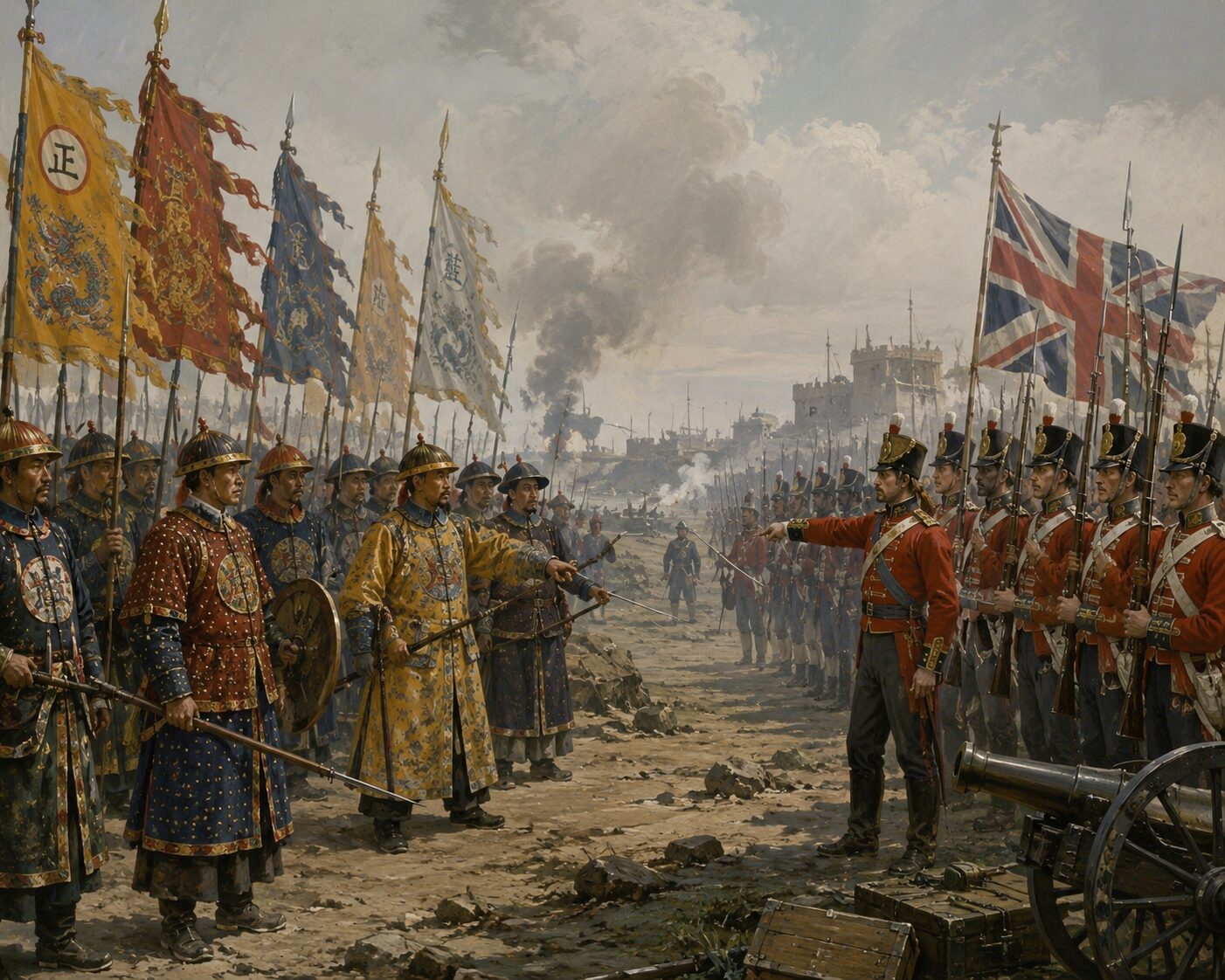
Daoguang Emperor:
Quick facts
- Born: 16 September 1782, Forbidden City, Beijing
- Died: 26 February 1850, Old Summer Palace
- Reign: 1820–1850 (7th emperor of the Qing dynasty)
- Personal name: Mianning (changed to Minning on accession)
- Temple name: Xuanzong · Era name: Daoguang, “radiant path”
- Father: Jiaqing Emperor · Successor: Xianfeng Emperor
- Known for: the First Opium War, the Treaty of Nanjing (1842), the 1831 salt reform, legendary frugality
The Daoguang Emperor was diligent, frugal, and a genuine reformer. He was also the first emperor of the Qing dynasty to inherit the throne as the eldest surviving son of the principal empress. And it was on his watch that China, for the first time in the dynasty’s history, was defeated by a Western power, ceded territory, and paid an indemnity.
By the old measure he was close to an ideal sovereign. He had simply been born into the one age that the old measure could not survive. To most Western readers the Opium War is the story. This article is about the man inside it, and the two virtues that undid him.
Two Virtues, Two Chains: The Key to Daoguang’s Character
If you reduce his character to its roots, you find two classical virtues.
The first is zūnzǔ (尊祖), reverence for the ancestors. It means inheriting and faithfully transmitting the wisdom, the teachings, and above all the law (the “ancestral statutes,” zǔfǎ) handed down by the founders. This is a virtue. It was also the root of his fatal rigidity. It is why he could not bend the frozen tax system, why he received his grandfather Qianlong’s worldview intact, and why, when he chose his own successor, he reached for orthodoxy rather than ability.
The second is bǎomín (保民), protecting the people and feeling their suffering as one’s own. This drove his extraordinary frugality, his refusal to lay new taxes on the peasantry, and his salt reform that broke the privileged merchants instead of the poor. This too was a real virtue. Against the great waves of his century, it amounted to bailing a sinking ship with a teacup.
In a time of peace, these two roots make a fine ruler. Daoguang, however, stood in a once-in-three-thousand-years rupture. The age demanded that he break the ancestral law and impose short-term pain on the people in order to remake the state. The two virtues that held him up became the two chains that held him fast. That is the core of his tragedy.
Why Was Daoguang So Devoted to Ancestral Law?
One fact is easy to pass over, and it explains a great deal. The Qing throne did not normally pass to the eldest legitimate son. As a Manchu conquest dynasty, the Qing chose heirs by ability. The emperor secretly named the most capable son, regardless of birth order or a mother’s rank. This was the system of secret heir designation (mìmì lìchǔ). Kangxi, Yongzheng, Qianlong, Jiaqing: none took the throne because he was the eldest son of the empress. The crown passed by merit and choice.
Daoguang was the first Qing emperor who also satisfied the Han-Confucian ideal of primogeniture, as the eldest surviving son of the principal empress. He was legitimate by both measures at once, the Manchu “chosen” legitimacy and the Confucian “bloodline” legitimacy. He was an heir beyond any possible objection.
This shaped the man. He was the purest living embodiment of the dynasty’s orthodox order, so he, of all people, had the least reason ever to doubt it. His reverence for the ancestral law ran to the marrow because he was himself the proof of that law’s rightness.
Did Daoguang Really Wear Patched Clothes?
Yes, but not where many accounts say. The stories of his thrift are many. He wore patched clothes, banned luxury in the harem, and kept the court’s annual spending to a fraction of his predecessors’.
One correction matters for accuracy. Some popular accounts claim he wore patched dragon robes. What he actually patched were private, everyday garments: leggings worn under the robes. Ceremonial dress was fixed by Confucian sumptuary law (fúzhì), and patching it would itself have been a breach of ritual propriety. His frugality lived where no one could see it.
And it was quietly devoured. When he ordered a torn pair of leggings patched to save money, the Imperial Household Department (Nèiwùfǔ) billed him a sum that could have tailored several new pairs. The officials padded the repair and pocketed the difference.
The same padding ran through the palace kitchens. Saga Hiro, who married into the former imperial family, recorded it in her book on Qing court cuisine. The Forbidden City’s household department inflated the price of a single egg many times over, and the emperor, it was said, was fooled into believing eggs were a great delicacy.
The patched leggings and the gilded eggs came from the same source. However hard the thrifty emperor economized, the corruption beneath his feet did not so much as flinch.
Daoguang’s Salt Reform: Striking the Merchants, Not the People
He was not idle. He issued anti-corruption edicts. His 1831 salt reform, carried out through the able official Tao Zhu, abolished the great salt merchants’ hereditary monopoly and let anyone buy a low-cost license to trade. Salt grew cheaper, the people’s burden lighter, and state revenue actually rose.
The blade fell on entrenched privilege, not on the poor. This was bǎomín in action: the classical ideal of “settling the people and enriching their livelihood” made into policy.
Daoguang and the Opium War: The Wound Beneath the Wound
Daoguang backed the hardliners and sent Lin Zexu to Canton to destroy the opium trade. He chose Lin for his toughness and was blind to the deeper thing about him: Lin studied Western geography, law, and weaponry, and saw what was coming. When the war turned against China, the emperor wavered, dismissed Lin, and lost.
In 1842 he signed the Treaty of Nanjing. Its terms were:
- the cession of Hong Kong Island
- a 21-million-dollar indemnity
- five treaty ports opened to foreign trade
- the loss of tariff autonomy, a term that is easily overlooked
The damage went deeper than prestige. The silver drained out by opium had already doubled the real weight of the land tax. The indemnity emptied his reserves. The surrender of tariff control took away the state’s power to raise its own revenue. The three pillars of Qing finance had begun to rot from within, and the fiscal collapse of the next reign was, in truth, prepared here.
Why Did Daoguang Kneel at the Ancestral Temple?
Here the English reader needs a sentence spelled out that a Chinese or Japanese reader feels at once. If zūnzǔ means inheriting and guarding what the ancestors built and entrusted, then its first object was the land itself.
So ceding Hong Kong was not, to Daoguang, merely a diplomatic defeat. It was the direct betrayal of his deepest virtue. He had lost, in his own reign, territory his ancestors had guarded.
That is why he knelt before the ancestral temple for a full day. He knelt not in grief, and not merely in shame, but in apology and in self-punishment: Forgive me; I have lost the land of the ancestors.
It is also why he forbade the carving of his own stele of sacred merit and virtue (shéngōng shèngdé bēi), the great monument a successor raises at an emperor’s tomb. A man who had failed to guard what the ancestors entrusted had no right to a stone praising himself.
His tomb, the Mu Ling, is uniquely plain. It is the only Qing imperial tomb built of unpainted wood, and it stands without a merit stele. He carried the guilt of betraying the ancestors to the end, and punished himself with it.
Why Did Daoguang Choose Xianfeng Over Prince Gong?
His last great act was the choice of an heir. Under the secret-designation system he could name any son. The field came down to two:
- his fourth son Yizhu: sickly and dull, but the eldest surviving son and born of the empress
- his sixth son Yixin: brilliant and accomplished
On a hunt at the southern park, Yixin came back laden with game. Yizhu loosed not a single arrow, explaining that he could not bear to kill the animals in the breeding season. When the emperor questioned the brothers on statecraft, Yixin spoke eloquently. Yizhu only bowed and wept, saying that a son who saw his father ailing could do nothing but grieve. His tutor had coached every tear.
What the boy performed has two names, and they are worth knowing.
- Rén (仁) is benevolence: “to love others,” a ruler’s compassion for his people. This was the mercy he showed the breeding animals.
- Xiào (孝) is filial reverence for one’s parents and forebears. This was the weeping deference he showed his father.
Together they make rénxiào, “humane filial virtue.” And they are exactly Daoguang’s own two roots: rén is bǎomín (care for the people), and xiào is zūnzǔ (reverence for ancestors). He chose the son who mirrored back the two virtues he most prized in himself. He picked not the ability his age demanded, but his own likeness.
Daoguang was not simply deceived. By the three-thousand-year-old doctrine that Heaven’s mandate rests on a ruler’s virtue, not his cleverness, choosing the “filial” elder son over the “talented” younger one was the correct way to guard the dynasty’s legitimacy. But that ancient measure was catastrophically wrong for a once-in-three-thousand-years crisis, which needed not ritual virtue but the power to act. In guarding the orthodoxy, he produced the hollow Xianfeng Emperor and tilted the dynasty toward its fall.
Daoguang’s Sons: Prince Gong, Prince Chun, and the Fall of the Qing
Two of his sons are often confused, so it helps to set them apart clearly.
Yixin, Prince Gong, the rejected younger brother, went on to become the dynasty’s foremost reformer. He led the Self-Strengthening Movement and the foreign-affairs office. His line did not bring the dynasty down. Indeed, his grandson Puwei plotted to restore the Qing after 1911.
The shadow over the dynasty’s end fell from a different line. Yixuan, Prince Chun, the seventh son, was the father of the Guangxu Emperor. As head of the naval board, he let funds meant for the fleet be diverted to rebuild the Summer Palace. His line produced the last two emperors, Guangxu and Puyi.
Zaiyi, Prince Duan, came from yet another brother’s line. He rode the Boxer uprising into a declaration of war on the foreign powers and pushed the dynasty to the brink.
Frequently Asked Questions
Was the Daoguang Emperor a good emperor?
By traditional standards, yes. He was frugal, conscientious, and devoted to both his ancestors and his people. But the virtues of a peacetime ruler could not meet the Western challenge of the 1840s, and he is remembered above all as the emperor who lost the First Opium War.
What did the Treaty of Nanjing cost China?
It ceded Hong Kong Island, imposed a 21-million-dollar indemnity, opened five treaty ports, and stripped China of control over its own tariffs. That last loss quietly undermined Qing finances for decades.
Who succeeded the Daoguang Emperor?
His fourth son Yizhu, who reigned as the Xianfeng Emperor (1850–1861). Daoguang chose him over his more capable sixth son, Yixin, Prince Gong.
In the End
Daoguang would have been remembered as a good emperor in almost any other century: frugal, conscientious, devoted to ancestors and people alike. But he lived when goodness and thrift were not enough. The most legitimate emperor the Qing ever had became the first to cede its land. The man who revered the ancestors most deeply was the one who had to tell them he had failed. His two virtues never wavered. They simply became the chains that held him still while the age moved on without him.