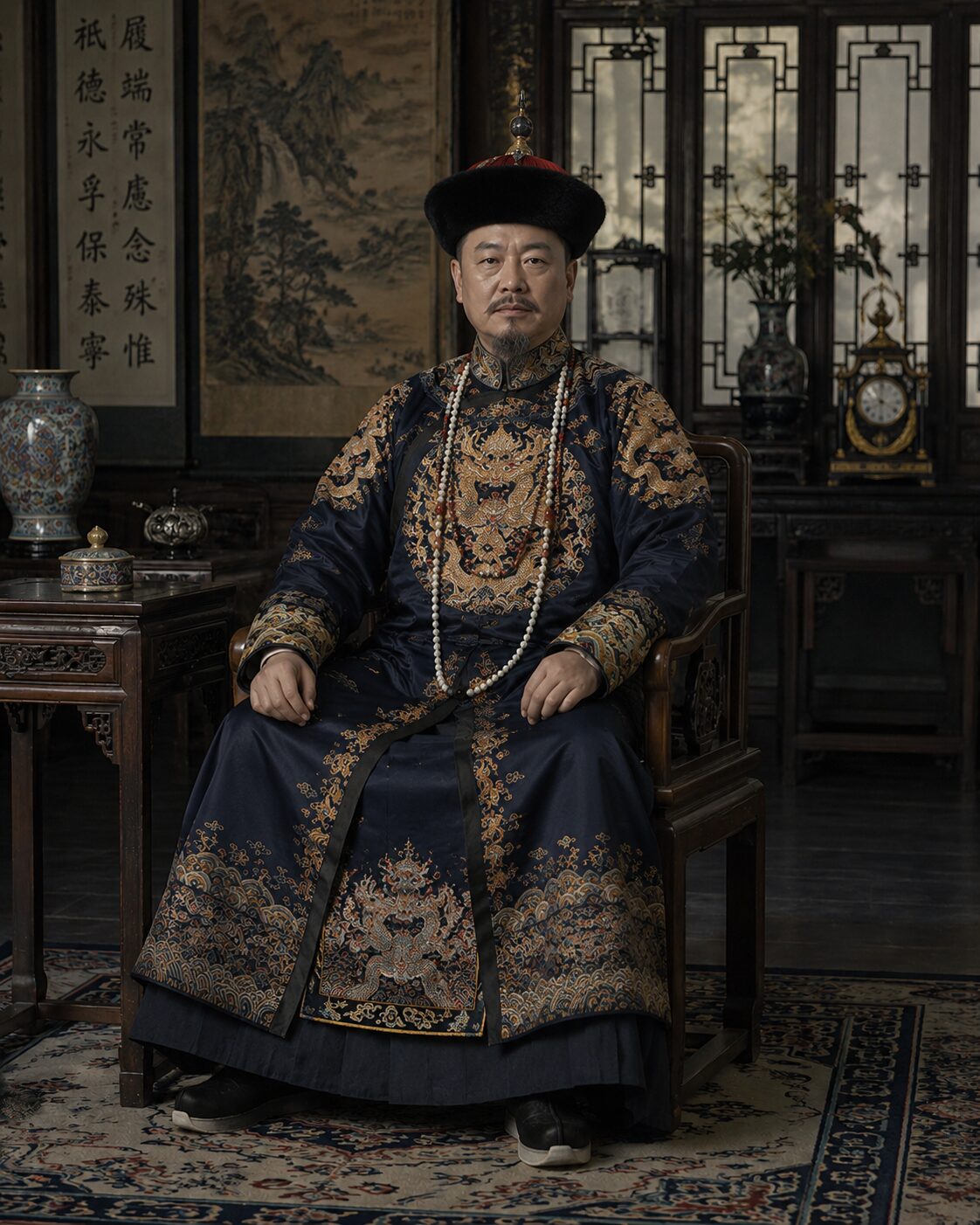
Late Qing Dynasty Series | The Prince Su Family
Prince Su Shanqi
A Qing Prince, a Japanese Samurai’s Son, and the Dream That Outlasted an Empire
In 1900, as allied Western forces threatened to shell the Forbidden City, a single Japanese man talked them out of it — in Chinese. His name was Kawashima Naniwa, and he was the son of a former samurai from a small Japanese castle town called Matsumoto.
A year later, that same man became the right hand of Shanqi, Prince Su — one of the most powerful and fascinating figures of late Qing China. Together they built Beijing’s first modern police force. Together they dreamed of rebuilding a collapsed empire. And together, they set in motion a chain of events that would produce one of history’s most remarkable and tragic lives: that of Yoshiko Kawashima, the Qing princess raised as a Japanese woman, who belonged fully to neither world.
This is the story of two men whose bond crossed every boundary that history had drawn between them — and of the dynasty whose fall neither could prevent.
Background for American Readers
The Qing dynasty (1644–1912) was China’s last imperial dynasty, founded by the Manchu people from northeastern China — an ethnic minority ruling a Han Chinese majority. The term “Iron Cap Prince” (鉄帽子王) denoted a rare hereditary privilege: a family whose noble title never diminished across generations, unlike most titles that dropped in rank with each heir. Only eight families held this distinction across the entire dynasty. Prince Su’s family was one of them.
I. Two Men, One Dynasty
Prince Su: The Iron Cap Lineage
Shanqi (善耆, 1866–1922) traced his ancestry to Hooge, eldest son of Hong Taiji — the second Qing emperor and one of the dynasty’s founding architects. This made the Prince Su family one of the eight “Iron Cap” houses: nobles whose rank could never be reduced, whose title passed intact from generation to generation, dynasty-long.
An iron cap, unlike a silk one, does not fade or rust. It was a fitting symbol for a family that had stood at the summit of Qing power for nearly three centuries.
Kawashima Naniwa: The Samurai’s Son from Matsumoto
Kawashima Naniwa (1865–1949) was born into a former samurai family in Matsumoto, Nagano Prefecture — a historic castle town in the Japanese Alps, best known today for its beautiful black castle. He entered the Tokyo Foreign Language School in 1882, dropped out, and made his way to China, where he served as a military interpreter during the First Sino-Japanese War of 1894.
That war deepened his connection to China profoundly. By 1900, when the Boxer Uprising erupted and Beijing descended into chaos, Kawashima was already a seasoned figure in the murky world of Sino-Japanese relations.
II. The Boxer Uprising — Where Their Fates First Crossed
What was the Boxer Uprising?
The Boxer Uprising (1900) was an anti-foreign, anti-Christian rebellion in northern China. A coalition of eight Western nations (including the U.S., Britain, France, Germany, and Japan) sent a joint military force to Beijing to suppress it and rescue foreign nationals. The violence was severe on all sides, and the aftermath reshaped China’s relationship with the outside world for decades.
Kawashima Saves the Forbidden City
As allied forces advanced on Beijing, some commanders considered shelling the Forbidden City — the imperial palace complex at the heart of the capital. Kawashima Naniwa, believing it was a priceless cultural heritage that had to be preserved, stepped forward alone.
He persuaded the Forbidden City’s defenders to open the gates — negotiating in fluent Chinese, relying on nothing but his credibility and nerve. The Forbidden City was spared.
In Matsumoto today, people still tell the story of the local man who talked an army out of destroying one of the world’s great architectural wonders.
Prince Su Shelters the Japanese
During the same crisis, Shanqi opened the gates of his own palace compound to shelter Japanese civilians trapped in the violence. The protection came at a cost — the palace was heavily damaged in the fighting.
The Japanese government did not forget. This act of protection created a bond of gratitude between the Prince Su family and Japan that would shape everything that followed. Shanqi had not calculated the geopolitical implications. He had simply done what he believed was right.
III. Building a Modern China Together
The Beijing Police Academy
In 1901, the Qing government — desperate to restore order after the Boxer chaos — invited Kawashima to establish the Beijing Police Academy (北京警務学堂). He was appointed Superintendent. His direct superior was Prince Su Shanqi, then serving as Minister of Civil Affairs.
The two men spent years building China’s first modern police force from scratch — designing the curriculum, training the officers, adapting Japanese police methods to Chinese realities. It was painstaking, practical work, done side by side.
Out of that daily collaboration grew something neither man had planned: a friendship, and a trust, that Shanqi would later describe as exceeding that of blood relatives.
Shanqi the Reformer
Shanqi was simultaneously driving reforms far beyond the police academy. In 1905, he was one of five high officials sent on the Five Ministers Mission — a landmark diplomatic journey to study Western governance systems firsthand. He recorded his observations in a detailed diary, Observations on Political Systems, that influenced Qing policy for years afterward.
His reform agenda during the decade of “New Policies” (光緒新政, 1901–1911) was broad:
- Founding modern schools and introducing Western-style education
- Modernizing the imperial military
- Overhauling Beijing’s urban administration
- Managing Qing relations with Mongolia and Tibet
- Co-creating Beijing’s modern police force with Kawashima
Shanqi was neither a hidebound conservative nor a reckless revolutionary. He studied Western institutions with genuine intellectual curiosity while trying to harmonize them with Qing traditions — a delicate balance that became harder to maintain as China polarized between nationalists and loyalists.
A Shared Dream: Naval Power and Restoration
But their collaboration went beyond policing. According to research into the period, Shanqi confided a far larger dream to Kawashima: the construction of a Qing imperial navy — a modern fleet that could give China the power to resist Western encroachment and, ultimately, to restore the dynasty.
Kawashima helped channel substantial Qing funds into Japanese shipbuilding companies toward this end. Shanqi also invested heavily in the South Manchuria Railway (満鉄), seeing Japanese-backed infrastructure as part of the path to Qing restoration.
They were not simply a supervisor and his foreign advisor. They were, in the truest sense, co-conspirators in the same improbable dream.
IV. The Fall — Revolution, Exile, and a Daughter Entrusted
The Last Two Who Refused
When the Xinhai Revolution swept the Qing dynasty from power in 1911, most of the imperial family accepted the abdication. Shanqi did not. He was one of only two princes who held out to the very end — the other being Puwei of the Gong Prince family.
Outmaneuvered by the revolutionary forces and Yuan Shikai’s political pressure, Shanqi eventually fled to Lüshun (Port Arthur) in Japanese-controlled Manchuria. He spent his remaining years there, plotting a Qing restoration that never came.
Yoshiko — The Daughter Given Away
Around 1914, Shanqi made one of the most remarkable decisions of his life. He entrusted his seventh daughter, Xiǎnxiān, then just seven years old, to Kawashima Naniwa as an adopted daughter. She was given the Japanese name Yoshiko.
The calculation behind this act was both political and deeply personal. By binding his own child to the Kawashima family, Shanqi hoped to deepen Japan’s commitment to the Qing restoration cause. But the weight of the gesture — “I entrust my daughter to you” — speaks to something beyond strategy: a man placing the most precious thing he had into the hands of the person he trusted most in the world.
Yoshiko’s Life in Matsumoto
Kawashima brought Yoshiko back to Matsumoto, where she grew up in his residence near Asama Hot Springs. She attended Matsumoto Girls’ High School (now Arigasaki High School), famously arriving on horseback each morning — which caused quite a stir among the locals.
“As expected of a Qing princess,” the townspeople murmured. Kawashima raised her as Japanese, but he also told her everything: the story of Prince Su, the Forbidden City, the police academy, the dream that had consumed her father’s life. All of it was imprinted on her.
Shanqi’s Final Years and Death
Shanqi died in Lüshun in 1922, at 56, his restoration dream unfulfilled. The last Qing emperor Puyi honored him posthumously with the character “Zhōng” (忠) — Loyalty. He became known as Prince Su Zhōng Shanqi (粛忠親王善耆).
The Poem He Left Behind
When Shanqi departed Beijing for the last time, he wrote:
Yān and Yàn are no longer my homeland,
I return to Liaodong with a long sigh.
I turn my horse and watch the beacon fires —
The central plains are falling to the flames.
Four lines. A dynasty, a life, a grief — condensed into the image of a man on horseback, watching his world burn from a distance. The zhongyuan — the “central plains” — refers to the heartland of Chinese civilization: Henan Province and the great cultural cities of Luoyang and Beijing, cradles of dynasties for three thousand years. To a Qing prince, watching them fall was not merely political defeat. It was the end of a world. He could not stop it. He could only turn, and watch, and ride away.
V. The Price of the Dream
Financial Ruin
Japan’s defeat in 1945 erased everything Shanqi had invested. The shipbuilding ventures came to nothing. The South Manchuria Railway shares became worthless. The Prince Su family fell into extreme poverty — the direct consequence of Shanqi’s decision to bet his family’s wealth on Japan’s continued rise and his dynasty’s restoration.
According to Kawashima Naoko’s memoir Bōkyō (Homesickness), descendants of the Prince Su family still live in Japan today — the last thread of a bloodline that once held one of China’s most exalted titles.
Yoshiko’s Fate
Yoshiko Kawashima became internationally famous in the 1930s as “Eastern Jewel” — a spy, an adventuress, a figure who defied every conventional category. She was celebrated and condemned in equal measure, called a hero by some and a traitor by others.
After Japan’s defeat, she was arrested and executed in Beijing in 1948 as a “hanjian” (漢奸) — traitor. She was 41 years old. The same label had been applied to her father.
The Return to Matsumoto
After her execution, a monk from Matsumoto traveled to the Chinese countryside — in the chaos of the postwar years — to retrieve Yoshiko’s remains. He brought her back to Shōrinji Temple in Matsumoto, where she was interred beside Kawashima Naniwa.
Whatever the politics, whatever the verdicts of history, Matsumoto considered her one of its own. A memorial service is still held each year around March 25th. A stone monument carved with Prince Su Shanqi’s own calligraphy stands beside her grave — the Prince Su family and the Kawashima family, still together, in stone, in a small Japanese mountain city.
Erased — and Not Quite
In Lüshun, the memorial bust and monument erected to Shanqi by Japanese residents were later destroyed. In Beijing, his grave was demolished — stone markers smashed, the grounds converted to a sports field and warehouse. Nothing remains.
And yet: the calligraphy in Matsumoto stands.
VI. After 1949 — A Tale of Two Families
Why Was Prince Su Called a Traitor?
After the founding of the People’s Republic of China in 1949, two of the most prominent Manchu noble families faced dramatically different fates:
|
Category |
Prince Chun’s Family (Puyi) |
Prince Su’s Family (Shanqi) |
|
Relationship with Japan |
Politically manipulated |
Actively cooperated of own will |
|
Post-1949 Assessment |
“Re-educatable” → pardoned |
“Hanjian” (traitor) → condemned |
|
Family impact |
Some members held government posts |
Persecuted until end of Cultural Revolution |
|
Current status |
Symbol of national reconciliation |
No official rehabilitation at state level |
The critical distinction was agency. Puyi, the last emperor, was cast as a victim — manipulated by Japan into serving as the puppet emperor of Manchukuo. That victimhood narrative made him politically useful as a symbol of national reconciliation. He was re-educated, pardoned, and eventually given an official post.
Shanqi had no such narrative available. He had chosen Japan — sheltered its citizens, worked alongside its advisors, fled to its territory, invested his fortune in its institutions, and given his own daughter to be raised as Japanese. There was no coercion to point to. He and Yoshiko were labeled hanjian (漢奸) — traitors — and the Prince Su family’s descendants were persecuted until the end of the Cultural Revolution in 1976.
Since 1985, Manchu identity has been broadly rehabilitated in China. But no official rehabilitation of the Prince Su family has taken place at the state level. History, as ever, is written by those who won.
VII. A Note from the Author
I was born in Matsumoto. The fact that Kawashima Naniwa — a man whose story became entangled with the last dynasty of China — came from the same small city where I grew up is something I feel in a way that’s difficult to explain.
My mentor, who first led me toward these stories, once said something I have never forgotten:
“After Japan’s defeat, Japanese people came to be spoken of in China as though they were demons. And some Japanese people, shaped by postwar education, have accepted that framing. But please do not forget: there were Japanese people who dedicated themselves to studying Qing culture and preserving its heritage. Do not let that be erased.”
Kawashima Naniwa was one of those people. He saved the Forbidden City. He built a police force. He raised a Qing princess as his own daughter and, in the end, brought her home.
That story deserves to be remembered — not as propaganda for any side, but as evidence of what human beings can do across borders when they choose to.
Timeline: Shanqi and Kawashima Naniwa
|
Year |
Event |
|
1865 |
Kawashima Naniwa born in Matsumoto, son of a former samurai family |
|
1866 |
Shanqi born into the Prince Su lineage |
|
1882 |
Kawashima enters Tokyo Foreign Language School; later drops out, travels to China |
|
1894 |
Kawashima serves as army interpreter in the First Sino-Japanese War |
|
1900 |
Boxer Uprising — Kawashima single-handedly negotiates to prevent allied shelling of the Forbidden City; Shanqi shelters Japanese civilians in his palace |
|
1901 |
Kawashima appointed Superintendent of Beijing Police Academy; meets Shanqi, his direct superior |
|
1901–1911 |
“New Policies” reforms — Shanqi and Kawashima build Beijing’s modern police force together |
|
1905 |
Shanqi joins the Five Ministers Mission to study Western governance |
|
1911 |
Xinhai Revolution. Shanqi refuses abdication to the end; flees to Lüshun (Port Arthur) |
|
c. 1914 |
Shanqi entrusts his 7-year-old daughter Xiǎnxiān to Kawashima as an adopted daughter — she becomes Yoshiko Kawashima |
|
1914–1920s |
Kawashima raises Yoshiko in Matsumoto; she attends school there, riding a horse to class daily |
|
1922 |
Shanqi dies in Lüshun, aged 56. Emperor Puyi bestows the posthumous character “Loyalty” |
|
1932 |
Yoshiko Kawashima becomes known internationally as “Eastern Jewel” |
|
1945 |
Japan’s defeat — investments in naval ventures and Manchurian Railway become worthless; Prince Su’s family falls into poverty |
|
1949 |
Kawashima Naniwa dies. Yoshiko executed in China as a “traitor” |
|
Post-1949 |
A monk from Matsumoto travels to rural China to retrieve Yoshiko’s remains; she is buried beside Kawashima Naniwa at Shōrinji Temple, Matsumoto |
|
1928 |
Kodaira publishes Collected Works of Prince Su Zhong, preserving Shanqi’s poetry for posterity |
|
1931 |
Kodaira brings white pine seeds from the Forbidden City back to Nagano; a seedling is donated to Hotaka Shrine. Emperor Showa later composes a biwa poem in honor of the tree |
|
c. 1940 |
Kodaira Soji returns to his hometown Hotaka, ill. The white pine at Hotaka Shrine continues to grow |
VIII. The Third Man — Kodaira Soji and the White Pine
A Man History Forgot
If Kawashima Naniwa was the most visible Japanese figure in Prince Su’s world, Kodaira Soji (小平総治, 1876–c.1940) was perhaps the most quietly devoted. Born in Hotaka village in Nagano Prefecture — the same mountainous region that produced Kawashima Naniwa — he first entered the late Qing world as an interpreter during the Boxer Uprising of 1900. That encounter changed the course of his life.
Kodaira went on to contribute to the establishment of Beijing’s modern police system under Shanqi — the same project that Kawashima Naniwa led. When the Xinhai Revolution collapsed the dynasty in 1912 and Shanqi fled to Lüshun, Kodaira went with him. Not as a formality, but as a choice. In an era when siding with the Qing carried real political risk, he followed.
Shanqi himself spoke of Kodaira in terms that went beyond any professional relationship:
“What you have done for me exceeds even what a blood relative could do.”
In exile in Lüshun, the two men climbed mountains together, composed poetry, and played go (the ancient board game). For a prince who had lost his dynasty, his capital, and his purpose, Kodaira was something rarer than a loyal official — he was a companion in grief.
Preserving What Could Not Be Saved
After Shanqi’s death in 1922, Kodaira dedicated himself to preserving what remained of the prince’s cultural legacy. In 1928, he published Collected Works of Prince Su Zhong (粛忠親王遺集) — an anthology of Shanqi’s poetry, assembled so that the inner life of the exiled prince would not vanish with him. The cultural artifacts Kodaira collected and protected during his years in China are now held at the Liaoning Provincial Museum in China. The man who was politically on the “losing side” left behind objects that are today viewed by thousands of visitors in a Chinese museum.
A Seed from the Forbidden City — and an Emperor’s Poem
In 1931, Kodaira brought something unusual back to Japan from the Forbidden City: seeds of a white pine (白松, Pinus bungeana). The white pine — known in China as bai song — is a tree prized in Chinese imperial culture for its silver-white bark, planted in palace grounds and temple gardens as a symbol of longevity and dignity. These particular seeds came from the grounds of the imperial palace itself.
Kodaira entrusted the seeds to acquaintances in his home region. A woman named Mochizuki Kiyomi raised one of the seedlings with care, and it was eventually donated to Hotaka Shrine in Azumino, Nagano — a respected Shinto shrine in the shadow of the Japanese Alps.
The tree grew. And when Emperor Showa (Hirohito) learned the story of the white pine — that it had grown from a seed carried out of the Forbidden City by a man who had devoted his life to preserving Qing cultural heritage — he was moved to compose a biwa poem (琵琶歌) in its honor and present it to the shrine.
Consider what that chain of events represents: a seed from a fallen Chinese dynasty, carried home by a Japanese man who had spent his life serving a prince most of the world had forgotten — planted in the soil of a mountain shrine — growing into a tree remarkable enough that Japan’s emperor composed a poem in its honor.
The white pine still stands at Hotaka Shrine today. It does not know it was once part of a vanished empire, or that it crossed an ocean as a handful of seeds, or that the man who carried it gave his working life to a prince who died in exile. It simply grows.
Conclusion — What Remains
Prince Su Shanqi was a man of contradictions that the 20th century never resolved. A modernizing reformer who embraced Western ideas with genuine curiosity — and a Qing loyalist who could not accept that the dynasty was gone. A pragmatist who built institutions — and a dreamer who poured his family’s fortune into an impossible restoration.
Kawashima Naniwa was his mirror image in some ways: a Japanese man who devoted his adult life to a country not his own, who saved its greatest monument, who raised its princess as a daughter, and who died in 1949 just as the world they had both built was being permanently dismantled.
Their memorials in Lüshun were destroyed. Shanqi’s grave in Beijing was erased. Yoshiko was executed. The navy was never built. The dynasty never returned.
And yet in Matsumoto — in the mountains of Nagano, in a quiet temple beside a black castle — a stone carved with a Qing prince’s calligraphy still stands. Next to it rests a Qing princess who rode a horse to school and belonged to two worlds. Next to her, the samurai’s son who brought her home.
Some things turn out to be harder to erase than stone monuments.
◀ Series Index: The Late Qing Dynasty — Complete Guide
▶ Related: Yoshiko Kawashima ▶ Related: Kodaira Soji ▶ Related: Renko Kawashima
satoe3.com | en.satoe3.com
Related: Yoshiko Kawashima Beyond “The Last Emperor “: What Her Japanese Hometown Remembers