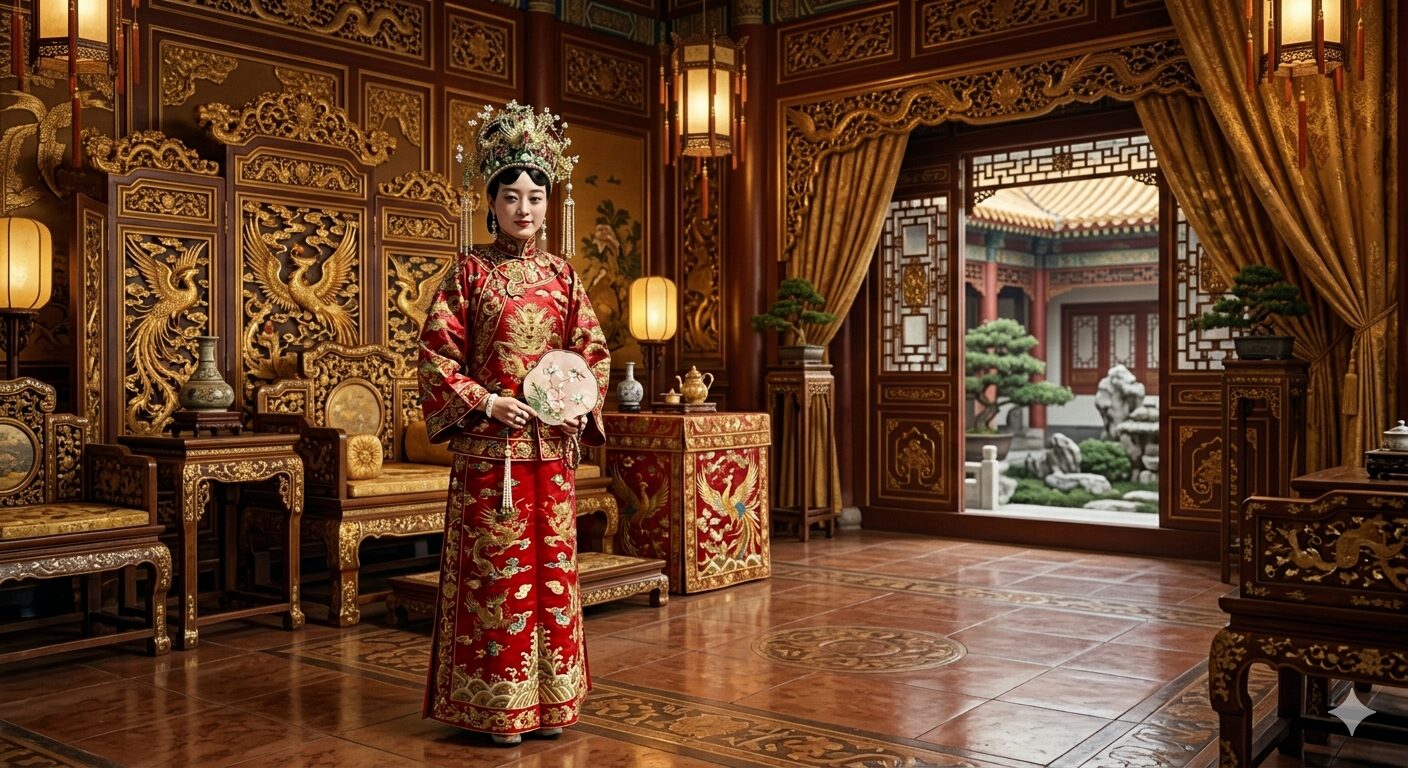
Wanrong — The Last Empress of China, Part I
From the Glory of the Gūwalgiya Clan to the Forbidden City
by Satoe | 還暦散歩 (Kanreki Sanpo) — Late Qing Dynasty Series
I. The Glory of the Gūwalgiya Clan
A Family Among the Eight Banners
The Gūwalgiya clan — the family into which Wanrong was born — was a distinguished Manchu family that had earned its place among the Eight Banners through military service during the Qing conquest of China. The blood and pride of a military aristocracy had been passed down through the generations.
The Eight Banners (Baqi) were the unique military and political organization of the Manchu people, formally established by Nurhaci in 1615. Originally a Manchu institution, it eventually incorporated Mongol and Han Chinese units as well. The eight banners were distinguished by color — yellow, white, red, and blue — each appearing in two forms: “plain” (zheng, a solid color) and “bordered” (xiang, with a contrasting border). Among the eight, three held the highest rank: the Plain Yellow Banner, the Bordered Yellow Banner, and the Plain White Banner. These three were known as the “Upper Three Banners” (Shang San Qi) — directly commanded by the emperor himself, responsible for guarding the palace and serving in the imperial administration. The remaining five were the “Lower Five Banners,” led by imperial princes and nobles.
Wanrong belonged to the Manchu Plain White Banner — one of the Upper Three Banners. She was not merely from a family “enrolled in the Eight Banners.” She came from the emperor’s own banners, the highest tier of Qing military aristocracy. Puyi himself belonged to the Plain Yellow Banner. Both stood at the very summit of the banner system.
The Era of Great-Grandfather and Grandfather
Wanrong’s great-grandfather served as deputy commander-in-chief during the reign of the Xianfeng Emperor, establishing the clan’s foundation as a military noble family.
His son — Wanrong’s grandfather, Gūwalgiya Changsun — served under three successive emperors: Xianfeng, Tongzhi, and Guangxu, and represented the peak of the clan’s glory. His outstanding military achievements earned him postings at the highest level, including as the General of Uriyangkhai and the General of Jilin, and he guarded the frontier for decades. He played a significant role in suppressing the Muslim rebellion in what is now Xinjiang, and in resisting Russian encroachment.
During the Guangxu era he was promoted to General of Jilin. In addition to his political achievements — bureaucratic reform, bandit suppression, and disaster relief — he supervised the compilation of the 122-volume local history Jilin Zhi. This work remains an important source for the history and geography of China’s northeast to this day.
Father: Gūwalgiya Rongyuan
Wanrong’s father, Gūwalgiya Rongyuan, was a first-rank official who had graduated from Imperial Peking University. A man of progressive ideas, he championed gender equality and placed great importance on educating his children.
Wanrong’s mother came from the imperial family and could trace her lineage back to the Qianlong Emperor himself. This means that both Wanrong and Puyi were fifth-generation descendants of the Qianlong Emperor.
Satoe’s Take: Although the Gūwalgiya clan held a place among the Eight Banners, the family’s true rise to power began only in the generation of Wanrong’s great-grandfather — making it a relatively new presence among Qing’s established noble families. Yet Wanrong herself belonged to the Manchu Plain White Banner — one of the Upper Three Banners, directly under the emperor’s command. A marriage alliance with the imperial house would have served as a powerful means of cementing the family’s status more firmly. What is striking is that even though ten years had already passed since the fall of the Qing dynasty, Wanrong’s father still paid an enormous bribe of 200,000 silver taels to secure for her the position of empress. To spend nearly the entire family fortune on a marriage into a dynasty that no longer held real power — in that desperate act, one senses the extraordinary ambition of a military aristocratic family determined to elevate its honor further still, through a blood connection to the imperial house. For a family of the Upper Three Banners, the empress’s seat was not an overreach — it was, in their eyes, where they belonged.
II. The Woman Called Wanrong
Her Education
Wanrong’s father Rongyuan ensured that his daughter received the same traditional education in music, chess (weiqi), calligraphy, and painting as her brothers — and went further still, hiring an English tutor, cultivating in her both a grounding in the Chinese classics and a knowledge of the Western world.
Among noblewomen of the late Qing period, it was exceedingly rare to be versed in both Chinese learning and Western learning. Wanrong, blessed with the refinement of an illustrious family and abundant talent, was truly an extraordinary figure.
Satoe’s Take: I believe her father was convinced that Wanrong — beautiful, talented, educated in both Chinese and Western traditions, fluent in English, and capable of representing the court in foreign diplomacy — was the very model of a “twentieth-century empress.” Against a court tradition that had long prioritized bloodline above all else — right up to the Empress of the Guangxu Emperor — this Beijing University-educated progressive seemed to find his ideal of an empress in the image of a modern woman combining intellect, beauty, and language skills.
The Cost of Entering the Palace
But the imperial court was a world far removed from her father’s ideals. In order to install Wanrong as empress, her father paid 200,000 silver taels in bribes to court officials, consuming nearly the entire family fortune.
Her Siblings
Wanrong’s elder brother Runliang married a sister of Puyi, and her younger brother Runkuo married a sister of Puyi. Through Wanrong’s entry into the palace, the Gūwalgiya family became doubly bound to the Qing imperial house.
Her younger brother Runqi studied at the Imperial Japanese Army Academy and served as Puyi’s bodyguard during the Manchukuo period. Fluent in multiple languages, he lived a turbulent life — from the son of a noble, to a war criminal, to an ordinary citizen. In his later years he became a scholar and physician, and devoted himself to restoring his sister Wanrong’s reputation. He insisted repeatedly that Wanrong was not a madwoman, but a victim of feudal marriage and the tragedies of her age.
Wanrong’s niece published an art collection as an art editor; Runkuo’s son became a seismologist. The blood of the Gūwalgiya clan lived on in each of them, in their own ways.
III. Entering the Palace — The Vanished Gate, the Ghost Gate, and the Emperor Who Could Only Wait
What the Gates of the Forbidden City Tell Us
The gates of the Forbidden City speak more eloquently than any words. Who passed through which gate — that was an unspoken declaration of exactly who that person was.
In the Qing cosmological worldview, direction was bound to destiny. South was the direction of yang, the Son of Heaven, legitimacy, and life. North was the direction of yin, death, flight, and endings. East was the direction of ghosts, the dead, and ill omen. The gates of the Forbidden City embodied this cosmology.
The Gate an Empress Was Meant to Use
The gates that an empress was properly meant to pass through were the Daqing Gate and the Meridian Gate (Wu Men). The Daqing Gate, situated at the southern end of what is now Tiananmen Square, was the gate of the highest rank in the Qing dynasty — permitted only to the emperor, the empress dowager, and the empress. On the day of her wedding, and only that day, an empress was allowed to pass through this gate.
And the Meridian Gate — beyond it lay the Hall of Supreme Harmony, the Hall of Central Harmony, and the Hall of Preserved Harmony: the very heart of Qing power. To enter through the southern gate was to connect directly with the center of power. To enter through the Meridian Gate was not mere ceremony — it was a declaration: “This woman is one who belongs to the legitimate lineage and power of the dynasty.”
But the Meridian Gate was not simply one opening. It had five passageways, each assigned to a different rank. The central passage was reserved for the emperor alone — with one exception: an empress passed through it on her wedding day, and the top three scholars of the imperial examination were permitted to walk through it once, on the day their results were announced. To either side of the center were passages for civil officials on the left and military officials on the right. The two outermost passages, set into the flanking walls, were for everyone else. Even the act of “entering through the Meridian Gate” was itself subdivided by rank. For an empress, to enter properly meant to walk the very same central path as the emperor — a declaration in stone and space that she stood beside him at the pinnacle of the dynasty.
The Gate for Imperial Consorts — and Empress Dowager Cixi
The gate through which imperial consorts entered was the Gate of Divine Prowess (Shenwu Men) in the north — the direction of yin, flight, and endings. Women undergoing the imperial selection process (xiunu) entered through this gate; those who were rejected left through the same gate.
Empress Dowager Cixi was one of them. She had passed through the Shenwu Gate because she had been chosen as a consort. The principal consort — the Eastern Empress Dowager — had entered the Forbidden City as an empress through the Daqing Gate. The gates they passed through told the entire story of the difference in their ranks.
And yet Cixi seized power equal to — indeed, greater than — the Eastern Empress Dowager. When a certain Qing imperial family member reportedly said to Cixi, “Those who entered through the Shenwu Gate ought to leave through the Shenwu Gate,” it was a devastating remark: “Have you forgotten which gate you walked through?”
The Gate Wanrong Actually Used — the East Glorious Gate (Donghua Men)
The gate Wanrong passed through was the East Glorious Gate (Donghua Men). East — the direction of ghosts, the dead, and ill omen. In the Qing dynasty, the coffins of emperors, empresses, and imperial family members were all carried through this gate. During the reign of the Jiaqing Emperor, rebels of the White Lotus Rebellion tried to storm the Forbidden City through this very gate. It also served as the daily entrance and exit point for court officials. The people of the court called it the “Ghost Gate” — not in the Japanese feng shui sense (where the unlucky direction is the northeast), but in the Chinese sense: the gate through which the souls of the dead pass. It was the gate of coffins, the gate of the departed.
Why the East Glorious Gate?
The reason lay in political reality. By 1922, the Qing dynasty had already fallen ten years earlier. Under the “Articles of Favorable Treatment of the Great Qing Emperor,” the Outer Court — including the Daqing Gate, the Meridian Gate, and the Three Great Halls — had come under the administration of the Beiyang government. The only space available to Puyi’s small court was the Inner Court, north of the Qianqing Gate. That Wanrong could not pass through the Daqing Gate and the Meridian Gate was not a deliberate snub — it was the harsh reality imposed on a fallen dynasty.
After repeated negotiations between the Office of the Grand Wedding Ceremony and the Beiyang government, it was exceptionally decided that the long-closed East Glorious Gate would be opened specially — and only for Wanrong’s palanquin. A red plaque was hung on the left column of the gate, reading: “All attendees and well-wishers are to enter through the Shenwu Gate.” To open a gate called the Ghost Gate exclusively for an empress, with every consideration possible — that was the best a fallen dynasty could do.
That same day, at the same hour, the secondary consort Wenxiu entered through the Shenwu Gate.
The Emperor Who Could Only Wait — in the Palace of Heavenly Purity
And Puyi — was waiting in the Palace of Heavenly Purity (Qianqing Gong). He could not enter the Outer Court. He had no freedom even to go to the gate to receive his bride. The seventeen-year-old emperor was permitted access to only half of his own palace complex. Records note that “the ceremony was hurried, and there was no direct welcome from the emperor” — but that was not coldness. It was powerlessness.
Satoe’s Take: Wanrong is the only empress in history who was able to pass through neither the Daqing Gate nor the Meridian Gate. She became empress without ever experiencing the proper ceremonies of her rank — not even once. But the meaning of that vanished gate has now been erased twice over. The Daqing Gate was demolished, and in its place stands the Chairman Mao Memorial Hall. On Tiananmen, a massive portrait of Mao Zedong hangs on high. To physically erase the gate that Wanrong should have passed through, and to place new symbols of authority on that very spot — the act of a conqueror erecting his own monument upon the most sacred symbols of the old dynasty is the most eloquent message power has always sent. The gate Wanrong should have passed through no longer exists. And few today even know what that vanished gate once meant. A double erasure lies there.
I have visited the Forbidden City myself. The moment I passed through the Meridian Gate, I was stopped in my tracks — the scene before me was exactly the coronation scene from the film The Last Emperor, come to life. The colossal “U”-shaped wall with its five gate towers stretching left and right, the vast courtyard opening up beyond — it overwhelms the body as much as the eye. You understand immediately: this is a space designed to make every person who enters feel small before imperial power. The Donghua Men, by contrast, I never even saw. My guide told me it was not worth visiting, and I walked past it. I did not know then that it was the gate Wanrong had passed through. That gap — between the gate that crushes you with its grandeur and the gate dismissed as not worth a glance — is itself the story of Wanrong’s wedding day.
IV. Life in the Forbidden City
The Palace of Gathered Elegance — from Empress Dowager Cixi to Wanrong
The Palace of Gathered Elegance (Chuxiu Gong), where Wanrong lived, bears a name meaning “to cultivate virtue and talent.” It was renovated in 1655 (the 12th year of Shunzhi) and then, in 1884 (the 10th year of Guangxu), underwent a massive reconstruction costing 630,000 silver taels to celebrate Empress Dowager Cixi’s 50th birthday. The formerly separate Yikun Gong and Chuxiu Gong were connected, forming a grand complex of four courtyards. This palace — once home to Cixi herself — was one of the most modern spaces in the entire Forbidden City.
Satoe’s Take: Just how vast a sum was 630,000 silver taels? Records from the Daoguang Emperor’s reign show that the entire annual expenditure of the imperial court did not exceed 200,000 silver taels. In other words, this single renovation project consumed more than three years’ worth of the Daoguang court’s entire budget. The thrifty Daoguang Emperor would likely have fainted at the news.
After entering the palace in 1922, Wanrong lived here. She renovated the Lijing Xuan hall at the rear of the Chuxiu Gong into a Western-style dining room, installing crystal chandeliers, a Western piano, and even a Western-style bathroom.
A Westernized Daily Life
In the palace’s Western-style dining room, Wanrong personally taught Puyi how to use a knife and fork, how to eat a steak, and how to drink coffee.
She hired an American female teacher, Isabel Ingram, to study English, and Puyi and Wanrong called each other by their English names — “Henry” and “Elizabeth.” A telephone was installed in the palace, connecting Puyi’s Yangxin Dian with Wanrong’s Chuxiu Gong.
Bicycles — A Small Rebellion
To understand why this mattered, one must first understand what court ladies were expected to wear. They were required to wear elaborate hair ornaments and platform shoes with high, thick soles (called “flower pot shoes”). The formal hair piece known as the da la ji — a large iron frame covered in blue satin and decorated with kingfisher feather ornaments and jewels — was so heavy that even the slightest rapid movement would cause it to sway. The platform shoes placed enormous strain on the ankles, and there was a real danger of spraining an ankle just from walking normally. Even modern period drama actresses have said they found it frightening — “the head feels so heavy, and I was afraid I’d twist my ankle.” As a result, court ladies had no choice but to be carried in palanquins or to walk slowly, supported by attendants — that was the palace’s idea of “normal.”
Both Wanrong and Puyi were devoted to cycling, and the palace had dozens of brand-new bicycles imported from Britain, Germany, and France. In an era when bicycles — called “iron donkeys” — were extraordinarily expensive, Wanrong frequently ordered the purchase of the latest models.
To pedal swiftly through spaces where one was only supposed to glide slowly with the help of attendants — no wonder the court was bewildered. The eunuchs had to jog alongside to keep the empress from falling.
Riding a bicycle made the da la ji impractical, so Wanrong removed it and pinned her hair with silver hairpins instead. Clothing was another issue. A qipao (cheongsam) was required to cover the feet entirely, with something resembling trousers worn beneath — but that was considered an undergarment. Cycling would cause the hem to ride up and expose the trousers — the equivalent, in modern terms, of showing one’s underwear in public, and considered thoroughly indecent. Showing the feet was itself a serious taboo; in the Qing dynasty, a woman’s feet carried sexual connotations, and exposing them was considered a grave violation of chastity. Even the glimpse of an embroidered shoe-tip was not mere “sloppiness” — it struck at something far deeper in the court’s moral code. And when Wanrong tucked her overly long qipao into a belt to move more freely, the court must have seen it as “an empress behaving in a manner utterly beneath her station.” To ride at all, she had to have something resembling ballet flats made for herself — which also scandalized those around her.
Puyi, to allow Wanrong to ride freely, had the threshold boards of the palace halls sawed down — and even had wooden ramps constructed over the tall steps. To appreciate just how extraordinary an act this was, one must understand what the threshold meant in Chinese culture.
The threshold (men kan) was originally a practical device — to prevent rainwater from flowing in, to block dust and sand, to keep out snakes, rats, and insects, and to protect the base of the doors from wear. But in China it had long carried symbolic meaning beyond its function. The Book of Rites states that officials and scholars entering and leaving the ruler’s gate must not step on the threshold — to step over it without touching it was a mark of respect for the master. The height of a threshold directly indicated the rank and social standing of a household: the more powerful and wealthy, the higher the threshold. The expression “the threshold is too high” — still used in modern Japanese — means something is beyond one’s reach; “not to let someone cross the threshold” means cutting off all ties. The thresholds of the Forbidden City were symbols of the order and authority of the Qing dynasty itself. To saw them down — that was to literally cut apart the order of the world for Wanrong’s sake, and in the eyes of the people of the court, it could only have been seen as a desecration of dynastic dignity.
A Lonely Empress
Yet Wanrong’s life in the palace was lonely. Puyi almost never shared a bed with her, and in the two years following their marriage, he visited the Chuxiu Gong only “a handful of times.”
She often sat by lamplight and wrote letters to Puyi in English, signing them “Elizabeth.” In the quiet of the night, she would sit alone before her mirror, gazing at herself in a kind of self-derision. It was common knowledge in the court that the emperor and empress did not share a bed.
In the suffocating life of the palace, Wanrong sought every pleasure she could find. She kept dogs, feeding them beef and pork liver. At the time, the majority of ordinary Chinese people could not afford beef or pork liver for themselves — feeding it to a dog was a luxury beyond imagining. And the habit of smoking water tobacco (shisha) began to take hold.
In China at the time, “smoking” meant water pipe tobacco, not modern cigarettes. This pleasure, enjoyed by drawing smoke through water, was widely popular even in the imperial court. The British noticed this and hit upon the idea of mixing opium into the water pipe tobacco. This is the historical chain of events that spread opium addiction across China and eventually led to the Opium Wars. Wanrong, too, was drawn from water pipe tobacco into opium in the course of this same current.
Satoe’s Take: In the film The Last Emperor, Wanrong’s opium smoking is depicted using something resembling a cigar — but this differs from the historical reality. To understand the smoking culture of the time is to understand that opium addiction could only have come through the gateway of the water pipe, and without depicting that, the true circumstances of Wanrong’s tragedy cannot be accurately conveyed.
V. The Day They Left the Forbidden City
On November 5, 1924, Feng Yuxiang launched a coup and ordered Puyi to leave the Forbidden City that very day. At that moment, Puyi was reportedly eating an apple in the Chuxiu Gong.
Puyi kept silent. The secondary consort Wenxiu suggested it might be acceptable to leave, but Wanrong firmly objected.
Yet that night, Wanrong accompanied Puyi and departed the Forbidden City. The gate they passed through on the way out was not the East Glorious Gate but the Gate of Divine Prowess (Shenwu Men) — the northern gate of the Inner Court.
Satoe’s Take: On the day she entered the palace, Wanrong passed through the East Glorious Gate — the gate of ghosts, the direction of ill omen, the east. And on the day she left, the gate she passed through was the Shenwu Gate — the direction of yin, flight, and endings, the north. She left the Forbidden City through the gate that imperial consorts used to enter. She had never been able to enter with the proper ceremonies befitting an empress, and her departure, too, was not through a proper gate.
The Shenwu Gate is also the gate of a dynasty’s ending. In 1644, the Chongzhen Emperor of the Ming dynasty passed through this gate on his way to Jingshan, where he took his own life. That day, the Ming dynasty ended. And in 1924, Puyi and Wanrong also passed through this gate. They would never return to the Forbidden City, and with that moment, the Qing dynasty, too, reached its true end. The gate one passes through declares one’s fate — and Wanrong’s life was exactly that.
Satoe’s Take: Wanrong, who had entered through the Ghost Gate — the East Glorious Gate — on the day she arrived, once again followed a destiny she had not chosen on the day she left. The palace to which her father had sent her after spending 200,000 silver taels gave her the name of empress, but not a place to live as one. The vanished gate, the emperor who could only wait, the lonely nights — and yet Wanrong never, until the very end, resisted the fact that she was “the empress.” Was that pride? Or submission to fate?
Satoe’s Take: In the film The Last Emperor, the scene of Puyi’s expulsion from the Forbidden City shows him squinting into blinding light as he crosses a military square and exits through what appears to be a southern gate. But this cannot be right. By that point, the southern Outer Court — including the great southern gates — was already under the administration of the Beiyang government. Puyi had no access to the south. He left through the Shenwu Gate in the north. Bertolucci used the gates as visual poetry — the blinding light of the outside world, the passage from darkness to dazzling freedom. It is beautiful cinema. But the gates of the Forbidden City were never merely a backdrop. Who passed through which gate, and in which direction — that was a declaration of who that person was, and what their fate would be. That meaning, I think, Bertolucci did not grasp.
And perhaps this is, at its root, a difference in how East and West see the world. To a Western eye, the scene reads as liberation — a man stepping out of a closed, imprisoned world into the open air of freedom. But to an Eastern eye, passing through the Shenwu Gate heading north means something else entirely: the ending of a dynasty. The direction of yin, of flight, of finality. The same gate through which the Chongzhen Emperor walked to his death in 1644, the day the Ming fell. What Bertolucci filmed as a moment of release, a Japanese viewer would recognize as a march toward extinction. The same gate. The same light. Two entirely opposite meanings, depending on which side of the world you were born on.
I have walked through the Shenwu Gate myself. There is no open square on the other side. Step out through that north-facing gate, and Jingshan hill rises immediately before you. There is no blinding light, no moment where the eyes would adjust and the face would flinch against the brightness. The gate Bertolucci filmed is simply not this gate. My daughter and I climbed Jingshan together, and as we walked I said to her: “It’s hard to imagine the Chongzhen Emperor climbing up here.” Partway up the hill is the spot where the last emperor of the Ming is said to have hanged himself. The emperor who was driven from the Forbidden City and took his own life — and Puyi, who walked out through that same Shenwu Gate. Looking back from the hill, the golden roof tiles of the Forbidden City layered and gleamed in the light. The Chongzhen Emperor, who ended his life on Jingshan, and Puyi, who was pushed out through the Shenwu Gate — both were emperors who reached the end of their dynasty with no means of facing the harsh reality before them. The same gate had witnessed the ending of two dynasties.
VI. After the Forbidden City — To Be Continued
The story that follows — Wanrong’s wandering after leaving the Forbidden City, her radiant years in Tianjin as “Elizabeth,” her own fateful choice to follow Puyi to Manchukuo, and the slow destruction of her mind and body there until her death in a Yanji prison in 1946 — is told in Part II. But even here, at the threshold of all that was to come, one thing was already settled. Wanrong wore the phoenix robe, the mark of an empress. Yet the Qing dynasty had fallen ten years before, and Puyi was an emperor without a throne — a fake emperor. From the very beginning she had been given only the form of an empress, never its substance. The gate she should have passed through was closed to her; the central path she should have walked, her feet never trod; the ceremonies were never completed. She never became an empress of the Qing dynasty in the full sense of the word. And yet — until the very end, Wanrong went on believing that she was the empress. Was that pitiable? Or was it that she held onto something no one could ever take from her? The answer waits in Part II. This article is part of the Late Qing Dynasty Series on the Japanese-language blog Kanreki Sanpo (還暦散歩). Wanrong wore the phoenix robe — the mark of an empress. .But the Qing dynasty had already fallen ten years before. Puyi, too, was a emperor without a throne, without real power — a fake emperor. From the very beginning, she had been given only the form of an empress, nothing more. The gate she should have passed through was closed to her. The central passage she should have walked was never trodden by her feet. The ceremonies were never completed. She never became an empress of the Qing dynasty in the full sense of the word. The Forbidden City receded into the distance. Manchukuo, too, collapsed. The robes were stripped away. The last official document recorded her as “fake empress.” And yet — even when the robes were gone, even when the palace was gone, even when her sanity was gone — Wanrong went on believing, until the very end, that she was the empress. Was that pitiable? Or was it that she held onto something no one could ever take from her?This article is part of the Late Qing Dynasty Series on the Japanese-language blog Kanreki Sanpo (還暦散歩).
Related: Yoshiko Kawashima Beyond “The Last Emperor “: What Her Japanese Hometown Remembers