Prologue — A 25-Year-Old at Chengde
In the summer of 1861, the Xianfeng Emperor died at the imperial Mountain Resort at Chengde — the hunting retreat beyond the Great Wall, then called Rehe (Jehol), where the court had fled. He was thirty. He left behind a five-year-old heir and a single Noble Consort, twenty-five years old: the woman remembered as Cixi. Within a few months she had helped engineer a palace coup, swept aside the regents her dying husband had appointed, and begun a span of effective rule over the Qing that would last nearly half a century — some forty-seven years. The question that draws most readers to her story is the simple one: How? In a court that explicitly barred women from politics, how does a junior consort end up holding the empire in her hands before her thirtieth birthday? The honest answer is not destiny, and not a single seizure of power. It is a chain of decisions — each one human, each understandable in its moment, several of them even sympathetic — and many of them made by men who feared the wrong things. To follow how Cixi rose, we have to begin a generation before she ever entered the palace. —1. The Fateful Choice of a Father, the Daoguang Emperor
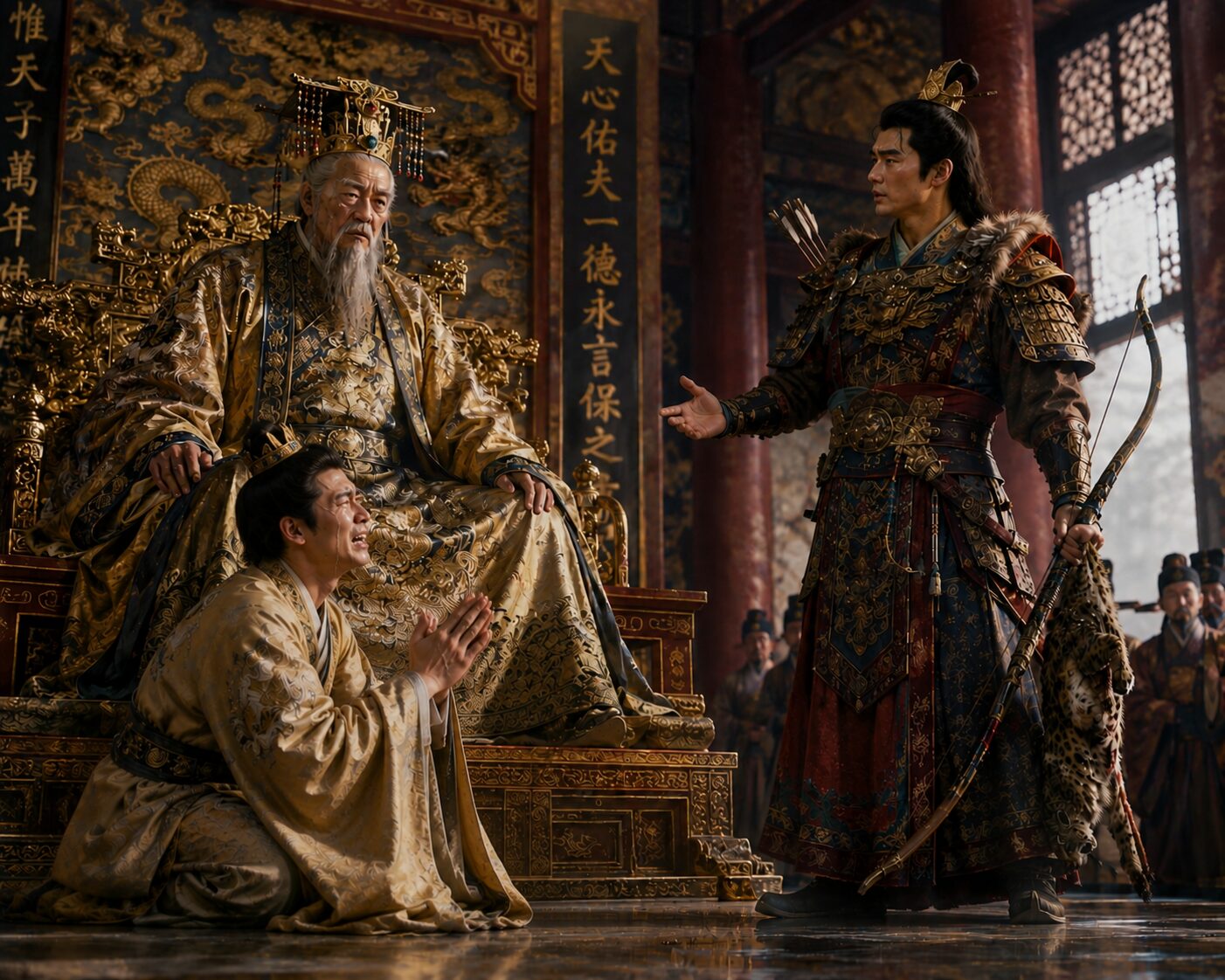
The story begins with a succession decision made by the Daoguang Emperor, torn between two sons: the elder, Yizhu — dutiful but unremarkable — and the younger, Yixin, the future Prince Gong, plainly the more gifted of the two. The episode that decided it has the shape of a parable — and the man who wrote the script, by tradition, was Yizhu’s tutor, Du Shoutian. At a spring hunt in the Nanyuan park south of Beijing, the princes were watched by their father. Yixin rode hard and brought down the most game. Yizhu, by contrast — lamed by a fall from a horse in his youth, and weakened by smallpox — knew that on horseback he could never match his robust brother; a crushing defeat was certain. So, following Du Shoutian’s coaching, he loosed not a single arrow, explaining that spring was the breeding season and that he could not bring himself to kill animals carrying young. He stepped off the field of contest altogether, converting a guaranteed humiliation into a display of benevolence. On another occasion, the father set his sons what amounted to a test of succession: when I am gone, or fall gravely ill, what will you do as ruler? Prince Gong laid out a clear, articulate vision of policy. Yizhu had no hope of winning on that ground. So, again on Du’s advice, instead of discussing governance he simply wept, saying that the very thought of such a day filled him with too much grief to speak of the future. Where he could not win on talent, he would perform benevolence and filial piety — turning his deficiency into apparent depth of devotion. That was Du Shoutian’s strategy. It worked. The Daoguang Emperor read benevolence and filial piety into what was, at least in part, calculation, and chose the son who seemed good over the son who was plainly able. The unremarkable elder brother became the Xianfeng Emperor; the brilliant younger one was set aside as Prince Gong. And it was this Xianfeng who would, in time, take into his harem the young woman who became Cixi. It was not talent but a tutor’s script that won Yizhu the throne. Before he was a ruler, he was a performer — his first great success was, of all things, an act. And that starting point would cast its shadow over everything to come. But the strategist who had won him the crown did not remain at his side for long. In 1852 — only two years into the reign — Du Shoutian died on a mission inspecting famine relief, at Huai’an. The emperor grieved deeply and granted his teacher the highest civil posthumous name, “Wenzheng.” The one man he had leaned on since boyhood — the one of whom it might be said, “as long as I do exactly as the teacher says, I cannot go wrong” — was gone at the very threshold of his reign. Just as the Taiping Rebellion blazed up and the empire began its turn into nightmare, the hand that had guided him was no longer there.—
2. A Throne Under Siege: The Empire Xianfeng Inherited
The empire Xianfeng inherited gave him no room to grow into the role. The Taiping Rebellion was burning through the south — the bloodiest civil war anywhere in the nineteenth century. The Second Opium War brought British and French armies to the gates of the capital; in 1860 the Old Summer Palace, the Yuanmingyuan, was looted and burned, and the court fled north to Chengde — and the emperor would never return alive to his capital. The treasury was buckling under the cost of war on two fronts. Here the parable of the hunt begins to curse its hero. Xianfeng seems to have understood, privately, that he had won the throne by performance and not by ability — and now the empire demanded the very capacity he lacked. The reforming zeal of his early reign rotted away. And yet — Yizhu had been exactly the sincere, obedient boy his father took him for. He had tried his hardest, doing just as Du Shoutian told him. The hunt, the weeping at the succession test — perhaps he was only ever being faithful to his teacher’s lessons. And the “padding” that everyone, with the best of intentions, had fitted to him — the boost that made him look greater than he was and lifted him onto the throne — would, in another age, have been a blessing. Sincere, attentive to the counsel of others, moved to pity even by defenseless creatures: in a peaceful, settled era he might have made a perfectly good custodian-emperor and seen out a tranquil reign. But what reality handed him was an empire torn by rebellion and foreign pressure, and a throne that demanded far more than he had. The well-meant elevation turned what would have been a virtue in calm times into a burden that, in this age, brought him nothing but suffering. This is the foundation on which everything rests. He was no tyrant — a cornered, isolated man, presiding over catastrophe while quietly aware that he was not equal to it. But the chair he had won by acting could not be left until death. He had no power to go forward and no door by which to retreat; and there was no road back to the boy who had once wholeheartedly believed he wanted to be emperor. Robbed of any escape, all that remained to him were the few pleasures that asked nothing of him. At the Mountain Resort, the emperor of a crumbling dynasty sank into wine, into opium, into opera. It was less debauchery, perhaps, than the single window left open in a room with no door. —3. Why Did Xianfeng Lean on Her?
Onto that isolation we must place one more pressure. Sushun, the dominant figure in the emperor’s inner circle, is said to have urged him to remove the Noble Consort — to “kill the mother and let the son live.” He invoked the cold precedent of Emperor Wu of Han, who had eliminated the mother of his young heir in advance to forestall a dowager’s domination: cut down the mother, or the boy-emperor will one day be swallowed by her. Xianfeng turned the idea over again and again. He weighed it. And still — he could not bring himself to decide. Why not? The easy answer is weakness of will, and there is truth in it. But consider who was actually left around him in his final years. The capable officials he had trusted were dead. As for the ministers who remained — thanks to Du Shoutian’s stagecraft, they believed their emperor to be “no fool.” And for exactly that reason, he could not afford to expose his real helplessness to them. The mask of the wise sovereign had become a cage. What of his brother? The one man with the intelligence to be a true partner was Prince Gong himself. But it was precisely Gong he could not bear to lean on. His brother, more than anyone, saw through to his incompetence — and to rely on him would be to admit that he was seen through. Sooner than bow before the brother he had beaten for the throne and never truly acknowledged, he would do anything else. And so, by elimination, the one who remained close at hand was a consort — fluent in Manchu and Chinese, sharp enough to discuss the day’s memorials as an equal, and yet no threat to his position — the very consort Sushun was urging him to destroy. He once even resolved on it, it is said: to strip the Noble Consort of her rank and cast her out. He half-steeled himself to it. And then he could not go through with it. The reason is simple. As long as he lived, she was far too useful a thing to depend on. He could not part now with the consort who sorted his memorials and could talk politics with him as an equal. So what he chose instead was to defer the decision. By tradition, Xianfeng left a secret arrangement with his principal wife, the Empress — the future Eastern Empress Dowager, Ci’an. After his death, should the Noble Consort presume upon her status as the emperor’s mother and go astray, should she overreach, Ci’an might depose her, or even put her to death. While he lived, he would keep her close; only the reckoning, after he was gone, would he hand to his wife. With his own hand, to the very end, he could not cross that line. And this safeguard, too, would later turn against its maker. Twenty years on, in 1881, the Eastern Empress Dowager died suddenly at forty-four. The official cause was illness, but suspicions that Cixi had poisoned her have never died away. The authority her husband had pressed into her hands as a trump card for the worst case was never once played — and its holder vanished along with it. > ✦ My interpretation > The decision he could not make was not really, I think, a matter of weak character. It was fear — the very specific fear of a frightened, failing man who had watched one person after another on whom he relied disappear. The man who had once leaned on his tutor Du Shoutian to win the throne was now leaning on a consort to keep his government running; he had already tasted, once, the pain of losing the only person who could steer him. Faced with the last one left — the only one he could truly talk politics with — he simply could not cut that lifeline with his own hand. To remove her would have been to complete his own isolation. Read this way, his indecision looks less like a flaw than a confession of how alone he was. The secret order to Ci’an is the continuation of that same confession. She was a dependency he could not give up while he lived — so he pushed the decision he should have made himself twice over: into the future, past his own death, and onto his wife’s shoulders. He could not let go, yet he knew she would one day have to be removed; and rather than carry that torn truth himself, he laid it on the Eastern Empress Dowager. —4. The Open Door: Cixi and the Memorials
She walked through that open door — and what did she pick up? This is the practical heart of the “how.” Cixi’s gifts were real, and unusual for a woman of the harem: she read and wrote both Manchu and Chinese, and her hand was fine. As the emperor’s health and will failed, she was summoned to help him work through the memorials — the official reports and petitions that drove the whole machinery of government. And that “help” advanced by stages, each one quietly more powerful than the last. At first she merely read the documents aloud to him. Then she was copying out his rescripts — the imperial judgments and instructions inscribed on each memorial. And finally she came to decide which memorials to hold back and which to send up at all. Through coded marks pressed in with a fingernail, through brief notations of “read” and “noted,” and above all through selective reporting, she took hold of the flow of information itself. In doing so she also shut Sushun’s faction out of doing the very same thing — manipulating what the throne was allowed to know. Seen coldly, this was an apprenticeship granted to no other woman of the dynasty. Sorting a dying man’s correspondence, she received hands-on instruction in administration, drew her own map of who held power across the empire, and learned the plumbing of the Qing state from the inside. By the time Xianfeng died, she was no longer a grieving girl with a grand title. She was a working operator who already knew exactly how the government moved. —5. The Final Calculation That Backfired: Xianfeng’s Last Will
Dying at Chengde, Xianfeng tried to fix the future in place. His design was elaborate, and it was built almost entirely out of his fears. He appointed eight Regent Ministers — Sushun foremost among them — to govern in his young son’s name. What he feared above all was the rise of a single overmighty regent. The Qing had a bitter precedent. In the dynasty’s early days, the regent prince Dorgon — uncle to the boy Shunzhi Emperor — had effectively eclipsed the child emperor and reigned above him: a single regent who swallowed the sovereign whole. And it was probably not that memory alone that rose in Xianfeng’s mind. If his able brother, Prince Gong, were to hold sole power, might the same tragedy not repeat — Prince Gong as Dorgon, his own son as another Shunzhi? And this brother was the very man he had once fought for the throne. The old memory of that contest gave his fear a vivid, personal edge. So, to prevent any one man’s dominance, he deliberately left out the most obvious candidate for regent — that same brother, Prince Gong. And as a final check, he placed two imperial seals in the hands of the two empress dowagers: the “Yushang” seal to the Eastern Empress Dowager, Ci’an, and the “Tongdaotang” seal nominally to the boy emperor — but in practice wielded by his mother, Cixi. No edict of the regents would be valid unless both seals were stamped together. On paper, a fine balance. In practice, every safeguard turned its fangs on its designer. The ministers treated the dowagers’ seals as a formality — not a partner to consult, but a stamp to be collected. Sushun’s faction declared openly that women had no business in the governance of the state, and acted on it. The contempt showed in small things, too. By tradition, during the stay at Chengde Sushun had only the meanest fare set before the two dowagers — a poor meal of something like soy milk. One was the Empress; the other, the new emperor’s own mother. He paid them no mind at all. As for excluding Prince Gong — far from neutralizing him, it set him loose. Shut out of the regency and resentful of those who had shut him out, the ablest prince in the empire was pushed straight toward the one person who held a seal and nursed the same grievance: Cixi. Xianfeng had built a machine to prevent both a single dominant ruler and the rise of Prince Gong. What he actually built was the alliance that would produce both. —6. The Xinyou Coup: Cixi and Prince Gong Make Their Move
It was over in a matter of months. As the funeral cortège made its slow way back toward Beijing, Cixi and Prince Gong moved. On home ground in the capital, with the levers of the bureaucracy in friendly hands, they struck. The coup was supported by more than the ambition of Cixi and Prince Gong. Sushun’s contempt had moved even the heart of the Eastern Empress Dowager, a woman by all accounts indifferent to power. Mild, and surely no seeker of political battle, the Empress nonetheless gave the coup her tacit blessing — a choice born, no doubt, of the humiliation she too had been made to swallow. Two empress dowagers and one prince: the three figures Xianfeng had tried to keep divided unto death were bound into one — ironically, by the arrogance of his own trusted minister. The coup of 1861 — named Xinyou for the year in the sexagenary cycle — shattered the eight Regent Ministers completely. They were stripped of office, the ringleaders condemned, and Sushun put to death. What was buried with him was not merely a rival faction, but one whole vision of how the dynasty might have been governed in those years. The regents gone, the seals consolidated, the boy on the throne and his mother behind it — a long era began: roughly forty-seven years in which, in one form or another, Cixi held real power over the Qing. And here the bitterest irony of all is folded in. The man who had counseled “kill the mother and let the son live” was now put to death by that very mother — Cixi. Marked for removal, he was removed instead, by the one he had named. All that survived was his prophecy. In time the young Tongzhi Emperor would be swallowed whole by his mother, exactly as Sushun had feared. The woman he said should be killed lived on; the man who said to kill her vanished; and only the warning — the emperor will be swallowed by his mother — survived, in order to come true. —Conclusion — A Threefold Irony
The cruelty of this story lies in its symmetry. And the ironies are nested, layered one inside another. The innermost ring is Sushun. The man who urged “kill the mother and let the son live” was buried by that very mother’s hand, and only his warning — the emperor will be swallowed by his mother — survived, to be proven right. Around it lies the ring of Xianfeng. The two things he feared most as he faced death — the rise of a single dominant ruler, and the rise of his brother, Prince Gong — were both summoned at once by his last, careful design, and bound together within a single coup. The safeguard itself was the trap. And the outermost ring reaches back furthest of all — to a spring hunt at Nanyuan, to a father who chose the son who seemed good over the son who was able. From the Daoguang Emperor’s preference for benevolence over talent came a weak emperor. From a weak, cornered, isolated emperor came his dependence on a clever consort. From that dependence came her education in power. And from his fear-ridden deathbed design came the alliance that set her loose. > ✦ My interpretation > Standing at the center of these nested rings was, in the end, a man with no self of his own. Put kindly, he was obedient. Put plainly, he was someone who could not live without depending on another. And what the Daoguang Emperor had once fondly approved as a “biddable, honest boy” — that, too, was surely this same absence of self. The father mistook a void for docility, an emptiness for a virtue. As a child he leaned on his tutor Du Shoutian; when he lost his teacher, he leaned next on a clever consort. The manner of the hunt, the tears at the succession test, even the careful design of his deathbed — none of it was something he created from nothing himself. He was always standing on a platform someone else held out for him — on that same “padding.” And the cruelest irony is this: it was exactly that nature — the inability to exist without leaning on someone — that handed the consort he leaned on the very power and opportunity to seize the dynasty. His weakness was the incubator of her strength. There is no lone villain here, and no decree of fate. There is only a chain of recognizable, human, sometimes even sympathetic choices — each made for reasons we can understand — which, when they came together, settled the shape of the dynasty’s final half-century.Series: The Fall of the Qing — six reigns, 120 years.
← Previous: The Xianfeng Emperor’s Financial Collapse: Hyperinflation, the Likin Tax, and the Roots of China’s Warlords
Next: Tongzhi Emperor (1856–1875): Reign, Death, and Cixi’s Son →