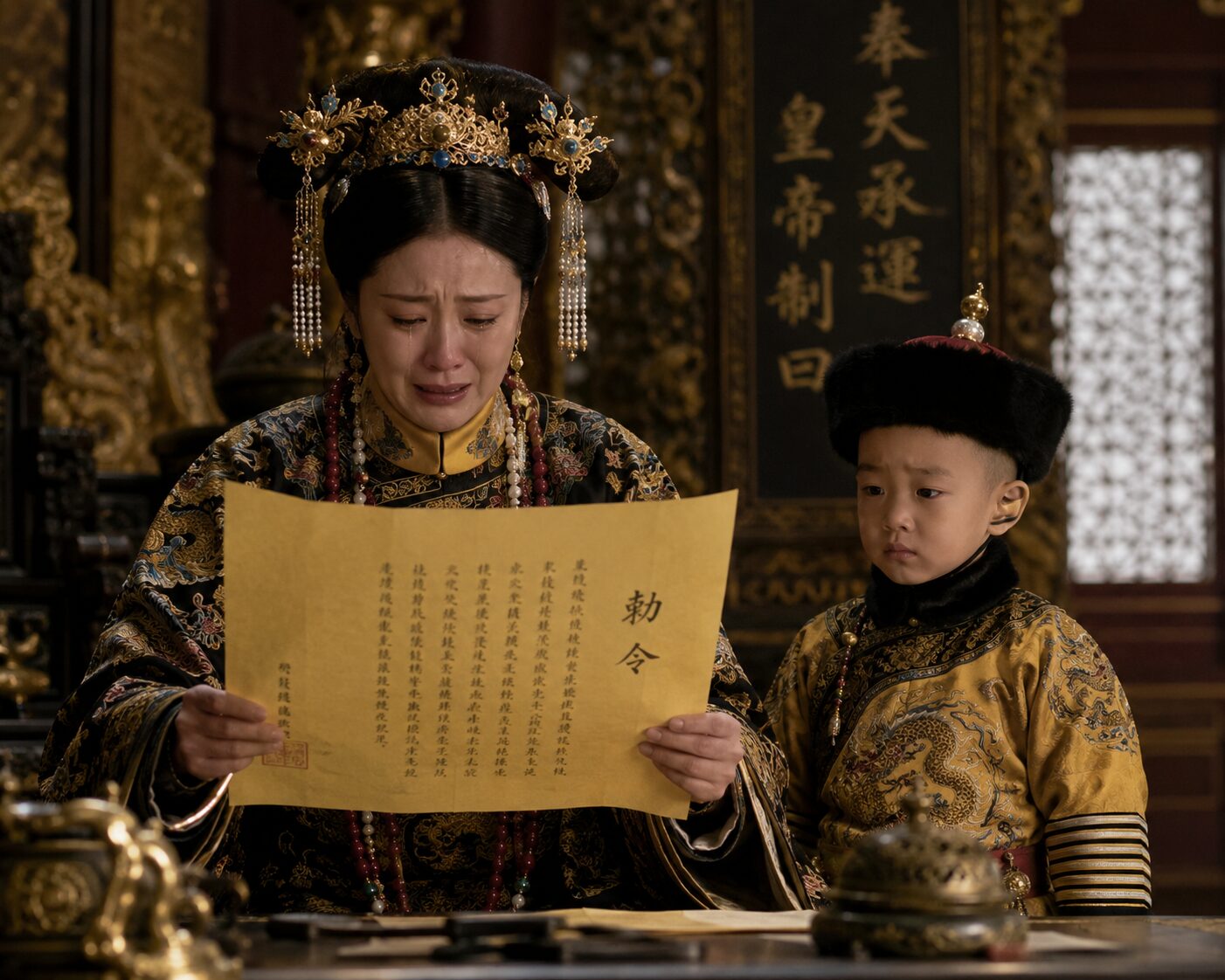
She has been remembered as a jealous, dull-witted, unattractive empress — the woman who lost her husband to a prettier rival and then lost a dynasty. But was that really who she was? A small glass-topped table I once saw at the Summer Palace in Beijing made me wonder.
On February 12, 1912, in the name of the six-year-old emperor Puyi, an edict of abdication was issued. With it, more than two thousand years of imperial rule in China — a system that traced its origins to the First Emperor of Qin in 221 BCE — came quietly, and decisively, to an end.
At the center of that moment stood a woman with no political training and no army: Empress Dowager Longyu.
Quick Facts: Empress Dowager Longyu
- Name: Yehe Nara Jingfen (葉赫那拉・静芬)
- Born / Died: January 28, 1868 – February 22, 1913 (aged 45)
- Family: Daughter of Guixiang, Empress Dowager Cixi’s younger brother — making her Cixi’s niece
- Titles: Empress of the Guangxu Emperor (1889–1908); Empress Dowager under Puyi (1908–1912)
- Key act: Issued the Imperial Edict of Abdication of the Qing Emperor on February 12, 1912
- Posthumous title: Empress Xiaodingjing
I. Who Was Longyu? A Marriage Arranged by Cixi
A Political Match
Longyu was born Jingfen of the Yehe Nara clan, the daughter of Empress Dowager Cixi’s younger brother. Cixi arranged for her niece to become empress to the Guangxu Emperor for a simple reason: a trusted member of her own family inside the emperor’s household would help her keep control of the court.
The two had known each other since childhood. But on their wedding night, Guangxu reportedly said to her:
“Elder Sister, I have always respected you. But how troubled my heart is.”
Guangxu went on to favor Consort Zhen, a spirited and intelligent young woman, and paid little attention to his empress. Cixi, for her part, grew frustrated with a niece who could not control the emperor.
“Big Wooden Head” — Life in the Shadows
Gentle, plain, and unassertive, Longyu was squeezed from both sides. She won neither her husband’s love nor her aunt’s approval, and within the palace she was mockingly nicknamed Da Mutou — “Big Wooden Head,” or simply “blockhead.”
The wife of a foreign diplomat described her as having “a gentle face, often tinged with sadness, lean and bony, long-faced, with a yellowish complexion and many bad teeth.”
— A Note from the Author: My Visit to the Summer Palace —
I once visited the Summer Palace (Yiheyuan) in Beijing. The Hall of Jade Billows (Yulantang), where the Guangxu Emperor was confined, and the Hall of Yiyun (Yiyunguan), the empress’s residence, face each other across a small courtyard, connected by a covered walkway.
The empress’s room was simpler than I had imagined. Her table was tiny — about fifty centimeters square — with the center of the top cut away like a picture frame and fitted with a sheet of glass.
Our guide explained that beneath the glass there had once been a water tank. Goldfish were kept in it, and the empress would watch them from above. Today the tank is empty.
I stood there and pictured the goldfish that were no longer there. Beautiful fish, tails drifting like silk, a living painting that changed with every passing moment.
But the goldfish had nowhere to go. They could not leave the tank. When they weakened, they would simply be scooped out and thrown away.
Weren’t they, I thought, exactly like the people who lived inside the Forbidden City?
A line from the Tang dynasty poet Liu Xiyi came to mind:
Year after year, the flowers bloom the same.
Year after year, the people are not.
年年歳歳花相似、歳歳年年人不同
The chair in front of the table had no back and no armrests — it was really just a stool. Both the table and the stool were light enough to pick up and move in a moment. I had expected an empress’s furniture to be heavy and imposing.
They had been placed near the courtyard, facing the emperor’s hall.
Eventually, Cixi had the way into the connecting walkway sealed off, and every window of the emperor’s hall that faced the empress’s side painted over and shut.
Guangxu watched it being done with his own eyes — and, it is said, he was delighted.
The sealed openings are still there today.
In a palace, a wall without windows would normally be painted or decorated. But these patches are a flat, prison-like gray, the brushstrokes still thick and smeared, just as they were left. They look nothing like part of a finished room. They look as if someone wanted it known: there, that’s shut.
I wonder what the empress felt when she learned of it.
✦ Satoe’s Take
A light table and a stool can be moved in a moment. They can be pushed aside at once.
Perhaps the empress chose them so that, if the emperor ever crossed the walkway, she could rise at once, clear them out of the way, and greet him. And she placed them where she could see his hall.
She was facing his window.
I felt the sadness of a woman’s heart in that small detail.
But he never came. Even before the windows were sealed, I don’t think he ever once looked out toward her.
She may well have been jealous of Consort Zhen, the most beautiful goldfish in the tank. That would only be human.
But they were all in the same tank. Consort Zhen’s brilliance was only a brief shimmer inside captivity. The fish that danced most beautifully of all was, according to tradition, drowned in a palace well in 1900.
The ladies-in-waiting grew old inside the walls without ever knowing the world beyond them. And the eunuchs — if they were ever sent out of the Forbidden City, where could they go? How would they live?
I remember a scene from a documentary I once watched, though I no longer recall which one. In the time of Puyi, eunuchs expelled from the Forbidden City were weeping as they carried small jars holding the part of their bodies that had been removed. Eunuchs kept these jars carefully, believing that if the contents were buried with them, they would be whole again in the next life. Thrown out of the tank, the goldfish had nowhere to go.
I think the empress was someone who spent her life inside that tank, watching the other fish.
I don’t believe Guangxu’s delight at the sealed passage came from spite. He had watched his reform allies — men like Tan Sitong — executed after the Hundred Days’ Reform of 1898. To accept Cixi’s niece would have felt like a betrayal of the dead. He didn’t reject her because he hated her. He rejected her because, as long as she was Cixi’s niece, he could not accept her.
And I think she understood all of it — that he didn’t hate her, why he never came, and that, caught between Cixi and the emperor, she could take neither side. Understanding everything, she could do nothing but watch the goldfish.
To understand completely and be able to change nothing — that quiet pain is what I saw in that glass-topped table.
The woman who had won neither her husband’s love nor her aunt’s favor would, at the most consequential moment in Chinese imperial history, have to make the decision alone.
Empress Dowager: The Last Representative
In November 1908, the Guangxu Emperor and Cixi died one day apart. The two-year-old Puyi was placed on the throne, and Longyu was elevated to Empress Dowager.
After the Wuchang Uprising of October 1911 set off revolution across China, Puyi’s regent — his father, Prince Chun (Zaifeng) — was unable to control events and resigned. Longyu, as the boy’s guardian, became the last representative of the Qing court. With no political experience and no troops of her own, her only real support was Yuan Shikai and his Beiyang Army.
II. The Last Resisters: Puwei and Shanqi
The Imperial Council, Early 1912
As the revolution spread from province to province, the court held a series of emergency councils in early 1912. Most officials, reading the direction of events, were ready to accept abdication.
Two princes refused: Prince Gong, Puwei, and Prince Su, Shanqi. They argued that the court should bring down Yuan Shikai’s cabinet, form a new government led by the imperial clan, and fight on. But the tide had already turned against the Qing.
(Their stories — two princes who tried to stay loyal to the dynasty to the very end — are told in separate articles in this series.)
Yuan Shikai’s Pressure Campaign
Yuan concentrated troops around Beijing and took control of the capital’s police. Princes who opposed abdication were not only intimidated but threatened with assassination.
The threat was real. In late January 1912, Liangbi, a leading figure among the anti-abdication princes, was killed by a revolutionary’s bomb. The imperial clan was terrified.
Puwei fled to Qingdao under German protection. Shanqi left on a Japanese warship for Lüshun (Port Arthur). The last voices of resistance in the palace fell silent.
Yuan is said to have sent Longyu this message:
“Read the history of the French Revolution. If the royal family had listened to the people a little sooner, they would never have been massacred.”
The image of the guillotine stayed with her, and her resistance began to wear away.
III. The Negotiation: What She Refused to Give Up
She Gave Up Almost Everything — But Not Two Things
Isolated and cornered, Longyu entered negotiations with Yuan over the terms of abdication. She was forced to concede on nearly every point. But on two, she reportedly held firm.
The final terms became known as the Articles of Favourable Treatment of the Qing Imperial Household (清室優待条件).
| Term | Final agreement |
|---|---|
| Annual allowance | 4 million taels of silver (4 million yuan once new currency was issued) |
| Residence | The imperial household would live in the Forbidden City for the time being, and later move to the Summer Palace |
| Imperial title | Retained; the former emperor would be treated with the courtesy due a foreign monarch |
Four Million Taels: Fighting for the People in the Tank
Yuan’s first offer for the annual allowance is said to have been three million taels. Longyu reportedly refused:
“If you cannot agree to this, then abdication is out of the question. Even if my son and I starve to death, I will not accept this humiliation.”
This was not about her own comfort. Close to a thousand people depended on the court — eunuchs, ladies-in-waiting, descendants of the Eight Banners, and members of the imperial clan who could not survive outside the palace walls. Longyu used what little leverage she had left to secure their livelihoods.
In the end, the allowance was set at four million taels.
Staying in the Forbidden City: Loyalty to the Ancestors
Yuan wanted Puyi moved to the Summer Palace after the abdication — a step that would cut the imperial household off from the symbolic heart of Beijing.
Longyu is said to have replied:
“Our ancestors are here. How can my son leave the palace?”
The final agreement said the household would live in the Forbidden City “for the time being” and move to the Summer Palace later. It was not a complete victory — only a delay. But that “time being” lasted twelve years, until the warlord Feng Yuxiang expelled Puyi from the Forbidden City in 1924.
IV. February 12, 1912: The End of an Era
The Edict
On February 12, 1912, in the Hall of Mental Cultivation (Yangxindian), with six-year-old Puyi beside her, Longyu issued the Imperial Edict of Abdication of the Qing Emperor.
The words she read were not her own. According to a report in the Shanghai newspaper Shenbao, the edict was drafted by Zhang Yuanqi, revised by Xu Shichang, and shown to Longyu by Yuan Shikai on January 25.
According to accounts of the day, she wept throughout, crying out “Our ancestors, our ancestors” again and again.
Prince Su, Shanqi, had already left Beijing.
More than two thousand years of imperial rule ended with a six-year-old boy and a weeping empress dowager.
Three Days Later
On February 15, just three days after the abdication, the Provisional Senate in Nanjing elected Yuan Shikai Provisional President of the Republic of China. He was sworn in at Beijing on March 10.
Sun Yat-sen had agreed to hand him the presidency on one condition: that he bring about the emperor’s abdication. Yuan had delivered — and collected his reward.
Longyu, meanwhile, was left carrying the weight of the dynasty’s end alone. She died on February 22, 1913, at the age of 45, barely a year after the abdication. Her death was attributed to illness, but it is said that isolation and grief had worn her down.
V. How History Has Judged Her
| Perspective | View |
|---|---|
| Negative | Portrayed as foolish and jealous, a bystander to the dynasty’s collapse. Some of the imperial clan regarded her as the woman who had given everything away, and reportedly refused even to send her birthday greetings |
| Positive | The Republican government praised her peaceful abdication, which spared China a prolonged civil war |
| Modern reassessment | A woman who made the most rational choice available in an impossible position, bore the shame of the dynasty’s end alone, and secured a livelihood for those who depended on the old court |
The Republican government held a national memorial assembly for her in the Hall of Supreme Harmony (Taihedian) — a gesture of gratitude for the peaceful transfer of power.
Longyu had none of Cixi’s political skill, none of Guangxu’s reforming ideals, and no command over the Beiyang Army. Caught between Yuan Shikai and the revolutionaries in the south, resistance would only have brought civil war and foreign intervention.
To the ministers around her, she reportedly said:
“Act as you see fit. Whatever happens, I will not blame you.”
Those words show both the helplessness of a woman swept along by history and her resolve, even so, to carry her responsibility as the head of the household.
Timeline: From Revolution to Abdication
- October 10, 1911 — Wuchang Uprising; provinces begin declaring independence
- December 1911 — Prince Chun resigns as regent
- January 1, 1912 — Sun Yat-sen takes office as Provisional President in Nanjing
- Late January 1912 — Liangbi assassinated; the anti-abdication faction collapses
- January 25, 1912 — Yuan Shikai presents the draft edict to Longyu (per Shenbao)
- February 12, 1912 — Longyu issues the Imperial Edict of Abdication
- February 15, 1912 — Yuan Shikai elected Provisional President
- March 10, 1912 — Yuan sworn in at Beijing
- February 22, 1913 — Longyu dies in the Forbidden City
- 1924 — Puyi expelled from the Forbidden City by Feng Yuxiang
A Final Thought
Longyu has been remembered as jealous, slow-witted, and plain. She had never stood on the political stage. She had none of Cixi’s strength, nothing of the iron will people expect of women who change history. She was a gentle woman whom everyone around her had called useless. And yet it fell to her, alone, to negotiate and decide the end of two thousand years of imperial rule. The princes who had urged resistance had fled Beijing; the ministers were busy securing their own futures. I cannot help feeling deeply sorry for her.
Cixi is said to have scorned her as useless — a niece who could neither control her husband nor rule the inner palace.
I don’t see her that way.
She was someone who never reached for power. She did not try to manipulate her husband, and she did not try to bring anyone down in the inner court. By Cixi’s measure, that made her useless.
But at the very end, that same woman chose the people in the tank over her own reputation. For the eunuchs, the ladies-in-waiting, the Banner descendants, and the imperial clan — people who could not survive outside the palace walls — she took on alone the decision no one else wanted: to end the dynasty.
She was not useless. She was someone who had to make a terrible choice to protect the people inside the goldfish tank.
After the abdication, the Forbidden City truly became a goldfish tank — a small court that had lost its country, living on inside its walls. What Longyu protected in the end was that tank, and the lives of those inside it.
She herself was gone within a year.
There are no goldfish beneath the glass of that little table at the Summer Palace anymore. But in my mind, they are still drifting there, tails like silk.
▶ Related: Prince Gong Puwei | Prince Su Shanqi | Regent Prince Chun Zaifeng
▶ Next: The Last Emperor, Puyi | ◄ Back to Series Index