I. Wandering — From the Royal Mansion to the German Legation, and On to Japan
After Leaving the Forbidden City
On November 5, 1924, Puyi and Wanrong, driven from the Forbidden City by Feng Yuxiang’s coup, first took refuge at the Prince Chun Mansion in Beijing — the residence of Puyi’s father, where Puyi had spent his early childhood. But they could not stay there long. The next place they turned to was the German Legation. But the German side refused them. Having nowhere left to go, the party finally arrived at the Japanese Legation in Beijing. The Japanese received them into their finest rooms and treated them with great care. But the imperial family’s demands knew no limit, and in time the Legation, too, found them difficult to manage. Eventually it was decided that they would move to Tianjin, where there was a larger Japanese concession. Satoe’s Take: Puyi and Wanrong turned to Japan not because they were “abducted” by Japan. It was their last remaining option, after Germany had turned them away. And their life in Tianjin, as we shall see, was so comfortable that it can hardly be called “coercion.” The story of “victims deceived by Japan” simply ignores this sequence of events.II. The Flower of Tianjin — The Days of Henry and Elizabeth
Queen of the Social Scene
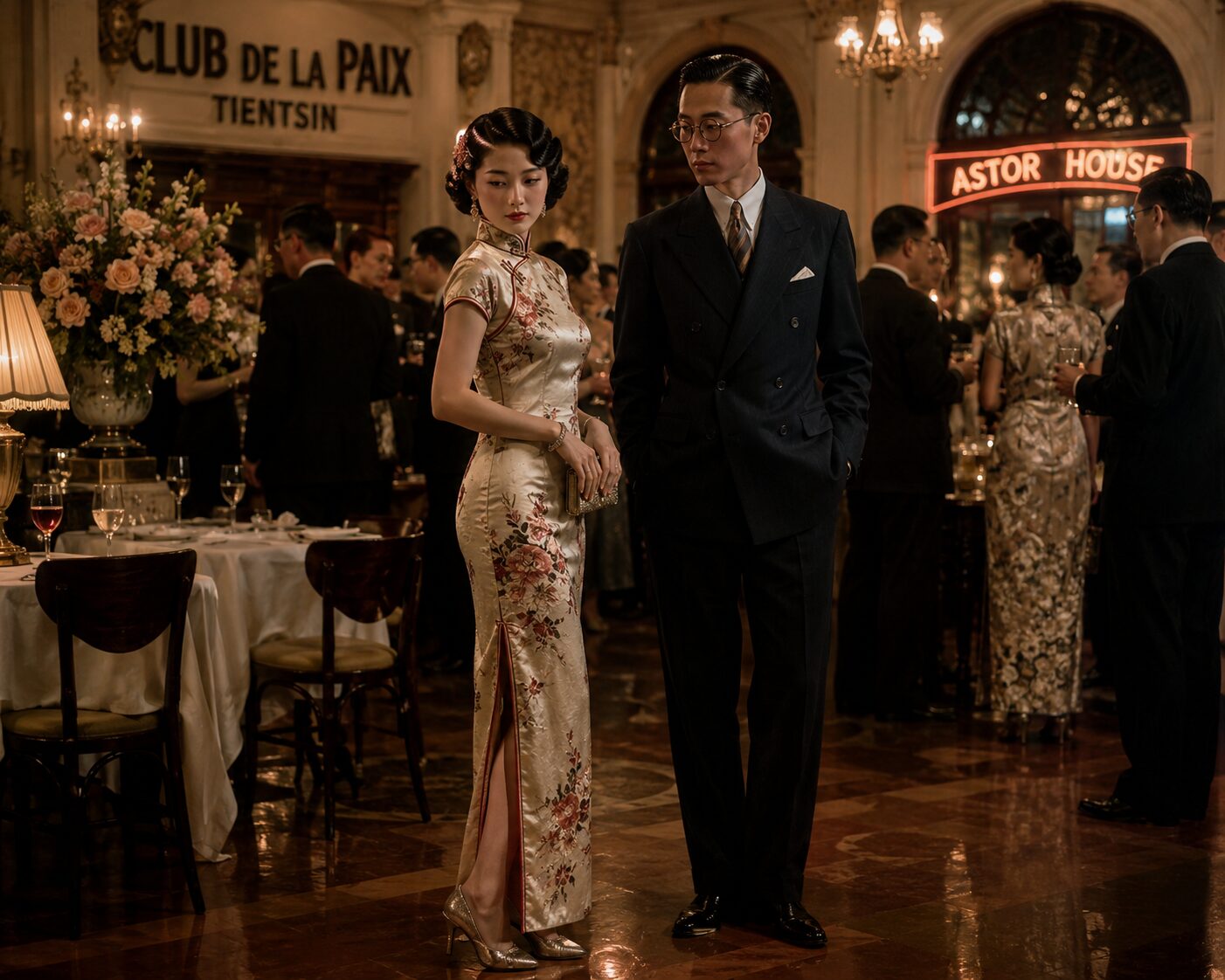
Life in the Japanese concession of Tianjin may have been the most radiant time of Wanrong’s life. Puyi called himself “Henry” and Wanrong “Elizabeth,” and together they stepped out into Western-style high society. Wanrong shed the qipao, wrapped herself in Western gowns, and wore high heels. She frequented parties where ambassadors, merchants, and notables of every field gathered, and her beauty and grace earned her the name “the flower of Tianjin society.” Saga Hiro — the Japanese woman who would later marry Puyi’s younger brother Pujie and become a member of the imperial family — left a testimony of her first impression on meeting Wanrong. Wanrong stood about 168 centimeters tall, and on top of that wore high heels even taller. Slender, with a striking bearing. To Saga Hiro’s eyes, she appeared an exceptionally beautiful woman.The Watch Engraved “I love you”
During this period, Puyi gave Wanrong a luxury watch set with diamonds. That watch is now held in a museum. On the back of the face, engraved in tiny letters, are the words — “I love you.” A woman who, in the Tianjin concession, dressed in Western clothes, stood upon the stage of international society, and received words of love from an emperor. The Wanrong of the Tianjin years was, in every sense, a darling of her age. Satoe’s Take: What this watch tells us is the warmth that the relationship between Wanrong and Puyi once held. When we consider that Puyi would later come to all but ignore Wanrong entirely, the weight of those words — “I love you” — stands out all the more. Perhaps the two of them, in Tianjin, still believed together in a future.III. To Manchukuo — Her Own Choice, and the Reality
A Eunuch’s Testimony — Wanrong Went of Her Own Will
Many Chinese sources record that Wanrong was “deceived” by the Japanese and taken to Manchukuo. But the testimony of a eunuch who served close to her tells a different fact. Wanrong went to Manchukuo of her own will. Why? The answer is surely clear. She might have been able to continue her comfortable life in Tianjin. But the title of “empress” would be lost. For Wanrong, that was not an option.The Fur Shawl
On the day of departure, after Wanrong had climbed into the car, she told her maid: “I’ve forgotten my fox-fur shawl. Go and fetch it.” That single remark mirrors what was in Wanrong’s heart. She was not “fleeing” to Manchukuo — she meant to “relocate” there. She intended to go to a place worth dressing up for. Satoe’s Take: Would a person who had been “deceived” send someone back for a fur shawl? Wanrong chose for herself, and went to Manchukuo by her own judgment. It was only that her judgment was naive.The Day She Arrived in Changchun
Film footage of Wanrong’s arrival survives. Her face was downcast. Changchun (Xinjing) was not Tianjin. Everything that met her eyes was desolate. There was no international high society, no scent of the West, no glittering parties. The narrator of the footage (on the Chinese side) says, “That is the face of a woman who has realized she was deceived.” But to me it looks different. Satoe’s Take: That downcast expression is not the face of a person who was “deceived.” It is the face of a person who has realized she was “naive.” This is the reality that the woman who had a fox-fur shawl brought to her saw the moment she arrived — that, I think, is what showed on Wanrong’s face. The Chinese narrator watches the footage from within the frame of the story “deceived by Japan.” But the evidence points the other way.IV. The Cage of Manchukuo — Isolation, Surveillance, Opium
The “Palace” as a Device of Separation
The “imperial palace” of Manchukuo was originally the office of the Jilin–Heilongjiang Salt Transport Bureau. A two-story building of gray brick. Puyi was placed in the west wing, Wanrong in the east wing. The two were deliberately separated. A few Chinese servants remained around her, but in reality they were under the strict surveillance of the Japanese. In time the Chinese servants were replaced one by one, until at last only Japanese staff remained. From Wanrong’s surroundings, the Chinese language vanished. Satoe’s Take: The division into east wing and west wing was not a mere matter of architectural convenience. It was a device to physically separate the two who, in Tianjin, had stood side by side as “Henry and Elizabeth.” To isolate Wanrong, to cut off her contact with the outside world, and in time to sink her into opium — I cannot help feeling that the first move of that blueprint was this very floor plan.Opium as “Favorable Treatment”
Wanrong had a certain mental instability to begin with, and opium had been used as a means of easing its symptoms. Even after she came to Manchukuo, the Japanese staff placed no restriction whatsoever on her consumption. As “favorable treatment for the empress,” she was given anything she wanted. According to court records, in the single year from 1938 to 1939 alone, Wanrong purchased 740 liang of opium — about two liang a day. This is a level of consumption that indicates severe dependency. The deeper her isolation grew, the more Wanrong relied on opium. The more opium she smoked, the more her mind and body were eaten away. From that vicious circle, there was no longer any means of escape.V. The Empress Her Father Made — The Cry in the Garden
Her Brother Runqi’s Testimony
Her younger brother Runqi bore witness to a scene like this. One day, Wanrong ran out into the garden and cried out: “I was made by my father.” Her father Rongyuan had scattered 200,000 silver taels in bribes through the court, paying a price that tilted the family toward ruin in order to install Wanrong on the empress’s throne. To repay that father’s expectations, Wanrong kept clinging to the title of empress. That she set off for Manchukuo while having a fur shawl fetched for her was, too, the product of that obsession. Satoe’s Take: There are accounts in Chinese sources that “Wanrong attempted to escape.” But I am doubtful. There are two reasons. The first is physical — as I will describe below, the Wanrong of her final years could neither stand on her own nor go to the toilet. Hers was not a body that could flee. The second is psychological — to escape would mean the title of empress would vanish. That alone, she could not have endured. The “cry in the garden” her brother describes was, I think, most likely not an attempt at “escape” but a cry that she was already at her limit. While she could still run, she ran only as far as she could run. The garden was the end of that distance. There, facing her brother, she spat out words in which gratitude toward her father and a curse upon him were mixed together.VI. The Collapse of the Body — What Became of the Flower of Tianjin
Saga Hiro’s Testimony
Saga Hiro witnessed Wanrong in her final period. There was nothing left there of the tall beauty she had seen in Tianjin. Wanrong lay in bed all day, smoking opium without cease. The muscles of her limbs had atrophied; she could no longer stand on her own or go to the toilet. Her back was bent, her teeth had crumbled to ruin, and pus dripped from her mouth.As a Dentist, and a Visitor to Care Homes
I am a dentist, and I also do work visiting nursing homes. So I understand, in concrete terms, what Wanrong’s final condition was like. When a person remains bedridden for a long period, the muscles of the limbs grow thin as sticks. Because the muscles that contract the body come to dominate over the muscles that extend it, the body curls up like a shrimp. That is why the back appears bent. When the body does not move, the bones, too, grow thin. Compression fractures become easy to suffer, and these in turn advance the deformation of the spine still further. When bone metabolism worsens, the teeth, naturally, weaken as well. They take on a melted appearance, periodontal disease advances, and pus comes from the mouth. A body that can no longer resist infection discharges pus not only from the mouth but from the whole body. And control of the bowels is lost. There is a foul odor. Satoe’s Take: In the film The Last Emperor, Wanrong slowly descends a grand staircase, spits at a Japanese officer, and leaves the palace of Manchukuo with resolute dignity. Beautiful, and proud. But the reality drawn by Saga Hiro’s testimony is entirely different. A woman who cannot stand on her own is in no position to descend a staircase. The Wanrong of the film is a “symbol.” But the Wanrong that Saga Hiro saw is the “reality.” A woman who, in Tianjin, had stood in high society at 168 centimeters tall in high heels was reduced to that state by opium and isolation. This is what years of it did to a human body.VII. Flight, and the Burden Borne by Saga Hiro and the Others
Amid the Collapse
In August 1945, the Soviet Union entered the war against Japan, and Manchukuo collapsed in the blink of an eye. The imperial party was forced into flight. In that chaos, the ones who moved Wanrong were Saga Hiro and the remaining servants. Unable to stand on her own. Unable to walk. Unable even to control her own excretion. To carry a person in such a state, amid the chaos of a collapsing empire — what an immense thing that was. Satoe’s Take: The Chinese sources, and the film as well, shine their spotlight on Wanrong’s “tragedy.” But almost no attention is turned to the burden borne by Saga Hiro and the servants who were at Wanrong’s side. To be beside a person in that condition is, physically and mentally, no ordinary thing. Saga Hiro carried her along in their flight. That was an admirable thing. The story that “the Japanese exploited Wanrong” does not see this fact.The Silence of the Soviet Soldier
In time the party was captured by the Soviet army. One soldier demanded: “I hear the empress is beautiful. Let me see her.” Those around him tried to stop him. But the soldier would not listen. According to Saga Hiro’s testimony, the soldier went into the place where Wanrong was. And then — he fell silent. He backed away, and came out. He said nothing. Satoe’s Take: What that soldier had meant to do is not hard to imagine. In the final days of a collapsed front, a soldier who said he was going to “see” a beautiful woman had, in all likelihood, one purpose. But he backed away and came out. What changed was not his heart, but what he saw. That silence speaks most eloquently of all about the figure of Wanrong in her final period. More accurate than any sentence is the silence of that Soviet soldier.VIII. Puyi’s Remarriage — Not a Bride, but a Caregiver
Puyi remarried during the Manchukuo period. According to one source, the woman was chosen less as a “bride” than, in large part, as “a caretaker for Wanrong.” For that very reason, there was no need for her to be of noble birth. What was needed was a person who would take on the care that no one wanted to do. Satoe’s Take: If this record is correct, then the treatment of Wanrong at this point is far too cruel. The title of “empress” still existed. But the reality was “a problem to be managed.” The man who, in Tianjin, had given her a watch engraved “I love you” came, in time, to take as his wife a “caregiver” to look after his wife. Within that gap lies the whole of the life that was Wanrong.IX. The End — “Fake Empress”
The Prison in Yanji
Captured by the Soviet army, Wanrong was transferred through various places in northeastern China before being held in a prison in Yanji, Jilin Province. She was separated from Saga Hiro along the way, and from then on there is no record by anyone close to her. According to what has been handed down, Wanrong lay on the lower bunk of a two-tier bed in a dark, damp concrete room. The agony of being deprived of opium was intense; she rolled about on the floor and screamed. Just before her death, her weight was about thirty kilograms. Her eyes were sunken, her teeth gone, she was covered in pus, and she looked — the guards testified — like a skeleton. And yet — only the voice that gave orders to her ladies-in-waiting never stopped. Even as she lay smeared in her own filth, she went on commanding in the voice of an empress. Opium took everything: her memory, her body, her grip on reality. But “herself as empress” alone, it could not take.Death and Record
On June 20, 1946, Wanrong breathed her last in prison. She was forty years old, by the Chinese reckoning. The prison record noted this: “Rong shi, age 40, fake empress.” Mocked as a fake empress, her body was thrown into a ditch beside the prison. Her remains have never been found. Satoe’s Take: There is a story, handed down by uncertain means, that a kind-hearted guard prepared a coffin and buried her secretly in the mountains south of Yanji — and another that a young guard quietly looked after her in her final days. But I now think these are fiction. History is full of consoling legends that someone attaches to a death too bleak to bear, placing a single act of human kindness at the very end of it. The truer account, I believe, is the bleak one: jeered at as a fake empress, her filthy corpse cast into a ditch. That is how it ended. “Fake empress” — those two words remained as the words that sum up Wanrong’s life. The name her father spent 200,000 silver taels to obtain was erased, at the moment of her death, by those two words. She could not pass through the gate she was meant to pass through (see Part I). She was not given a place to live as an empress. And after death, she was not even permitted to be called an empress — and her body was discarded like refuse. The gate vanished, the title was erased, and the grave has never been found. Three erasures lie there.In Closing — The Cage Called “Empress”
Was Wanrong a pitiable victim? It is true that she was exploited. Within the device that was Manchukuo, she was reduced to a wreck by opium. That is a fact. But at the same time, Wanrong chose for herself. Just as Puyi, refused by the German Legation, turned to Japan, Wanrong, too, made a choice. In order not to let go of the title of empress, she abandoned Tianjin and set out for Manchukuo with her fur shawl. As in the words she cried out to her brother in the garden, she had been made by her father, and she clung to the empress’s throne out of obligation to him. Is that “pitiable”? Or is it “to have lived by one’s own will”? Seeing Wanrong, who went on commanding in “the voice of an empress” even as she lay smeared in filth in prison, I think it is the latter. There was, in that woman, something no one could ever take from her. “Rong shi, age 40, fake empress.” That record is wrong. Wanrong knew, until the very end, that she was the empress. — This article is a continuation of “Wanrong — The Last Empress of China, Part I: From the Glory of the Gūwalgiya Clan to the Forbidden City.” “Satoe’s Take” represents the author’s personal analysis and interpretation. Please read it as distinct from the documented historical record. This article is part of the Late Qing Dynasty Series on the Japanese-language blog Kanreki Sanpo (還暦散歩).Related: Yoshiko Kawashima Beyond “The Last Emperor “: What Her Japanese Hometown Remembers