If you have read or watched The Elusive Samurai, you already know the Suwa Sect: Suwa Yorishige and his allies Hoshina, Shinomiya, Unno, Nezu and Mochizuki, who risk everything for the young Hōjō Tokiyuki.
In history this group is called the Suwa Shintō (諏訪神党), literally “the band of the Suwa kami.” It was not a single family. Its warriors came from all over Shinano Province, today’s Nagano Prefecture.
So what held them together?
The answer is faith in the kami of Suwa, and service in his festivals. They were allies not because they shared blood, but because they all belonged to the kami of Suwa.
“Warriors bound by faith” may bring the Crusades to mind: knights marching under a holy banner to fight unbelievers in a distant land. The Suwa Shintō was nothing like that.
They did not fight to spread their faith or to conquer anyone. Their kami lived in their own mountains, and his festivals were part of their everyday lives: the fields they farmed, the deer they hunted, the meals that gave them strength, the money that stayed in their villages. This is not a story of holy war. It is a story of the people of Shinano.
A note on the word “kami”
In this article I call the deity of Suwa a kami, not a “god.” In English, “God” often means a single, all-powerful being who demands that everyone believe in Him alone, and whose faith must be spread to others.
A Japanese kami is nothing like that. The kami of Suwa, Suwa Myōjin (諏訪明神), dwells in one particular place: the mountains and lake of Suwa. He does not insist that anyone believe in him alone. In medieval Japan, kami and the Buddha were worshipped side by side. He does not look for converts. What people offered him was not a creed but festivals, hunts and shared work.
A kami is less a master who must be obeyed than a presence that lives alongside the people of the land.
Understanding this helps answer a question many readers of the manga may have had: why did the Suwa clan go so far for Tokiyuki?
The kami’s vessel at the center
The clue is in the name: shintō, “the kami’s band.”
The Suwa clan held the hereditary office of Ohōri (大祝) at the Upper Shrine of Suwa Taisha. The Ohōri was not a priest who served the kami. He was the vessel in which the Suwa kami dwelt — the kami’s living presence among the people. The rites themselves were led by other shrine officials, such as the Jinchōkan of the Moriya clan. Yorishige in the manga holds the office of Ohōri.
According to Suwa City, the Ohōri office was passed down from ancient times until the end of the Edo period. In the Middle Ages, the Ohōri was also the political lord of the Suwa region.
The Suwa City Museum explains that from the late Heian period, people who worshipped the Suwa kami as a kami of war became warriors. Some of them took the name Miwa or Jin (神, “kami”), the original surname of the Suwa clan itself.
What bound them was not a bloodline but a shared identity: “We are the people of the Suwa kami.”
Sacred vessel, lord and warrior at once
This is what makes the Suwa clan so unusual.
While holding the sacred office of Ohōri, the Suwa also became gokenin (御家人), direct vassals of the Kamakura shogunate. They then grew close to the Hōjō, especially the main Tokusō line, and became miuchibito (御内人), private retainers of the Hōjō house.
The vessel of a kami, a lord and a warrior, all in one family. That was the medieval Suwa clan.
In medieval Japan, “shrine,” “warrior” and “politics” were not separated the way we separate them today.
Yoritomo and the festival duties
The founder of the Kamakura shogunate, Minamoto no Yoritomo, played a key role in shaping this system.
Yoritomo was deeply devoted to Suwa Taisha. In 1186 he offered sacred horses to both the Upper and Lower Shrines.
More importantly, he ordered the warriors of Shinano to serve as tōyaku (頭役), festival sponsors, for two great Suwa festivals: the Gogatsu-e (五月会, the Fifth Month Festival) and the Misayama-sai (御射山祭, a hunting festival held in the mountains). A tōyaku paid for and organized the festival.
So the warriors of Shinano did not just worship at Suwa. They had a public duty, as warriors, to support the kami’s festivals.
And there was one more order: obey the Ohōri. In the shogunate, they were Kamakura’s vassals. In the sacred rites, they stood in an order headed by the Ohōri, in whom the kami of Suwa dwelt.
What the festival duties paid back
Why did Shinano’s warriors take on this burden? Faith, certainly. But there were also concrete privileges.
1. Exemption from guard duty in Kamakura
Shogunal vassals had to take turns guarding the shogun’s palace in Kamakura. From Shinano, that meant a long round trip with retainers and horses, paying their own food for months. It drained both manpower and cash. Festival sponsors were exempt.
2. Exemption from the governor’s land survey — the real prize
When a new kokushi (国司, a provincial governor sent by the imperial court) took office, he carried out a land survey called kenchū (検注). Rice fields were re-measured and re-registered, and taxes were set from the new figures. Think of it as a tax audit by the new man in charge.
Local lords almost always had fields that were not on the books: newly opened land, fields quietly expanded. A survey would expose them all to tax. Serving as festival sponsor protected them from it.
Studies of sources related to the Azuma Kagami, the shogunate’s chronicle, confirm that these exemptions for festival sponsors, from Kamakura guard duty to the governor’s first survey, were real issues of the time.
In short, serving the Suwa kami brought real political and economic benefits.
✦ Satoe’s Take: the money stayed in Shinano
Being a festival sponsor was very expensive. That is still true today: local banks in Suwa offer an “Onbashira savings account,” so families can save up for the great Onbashira Festival.
But look at where the money went. Spent on guard duty in Kamakura or taxes to the provincial office, it left Shinano for good. Spent on the Suwa festivals, it went to local craftsmen, merchants and farmers, and stayed in Shinano.
The festival system was a privilege for warriors, and also a way of keeping Shinano’s wealth inside Shinano.
Deer, fields and the kajikimen
At the Ontōsai festival of the Upper Shrine, deer heads were once offered to the kami. The Misayama-sai itself was a hunting rite. Faith in Suwa was closely tied to hunting.
But Buddhism forbids killing. How could hunting and eating meat be allowed? The answer was the kajikimen (鹿食免), a permit issued by Suwa Taisha that allowed people to eat venison and other meat. With it came a verse, the Suwa no Kanmon, teaching that an animal eaten by a human enters a human body and can reach Buddhist enlightenment along with that person.
✦ Satoe’s Take: Without meat, people would not have the strength to work the fields. In mountainous Shinano, deer were an important source of food. The Suwa kami bridged the gap between Buddhist teaching and the realities of survival.
✦ Satoe’s Take: Today, southern Nagano has far too many deer, and they badly damage crops. In that era, I believe the hunting rites also kept deer numbers down and protected the fields. A sacred hunt that also protected farmers’ crops: here again, faith, warriors and daily life were woven together.
Kamakura’s protection for farmers
Warriors were not the only ones protected by the Kamakura order.
In 1264, the shogunate banned land stewards (jitō) from taking the wheat grown as a second crop in rice paddies (田麦, tamugi) as tax. That wheat was to belong to the farmers. Double-cropping was spreading at the time, and this law protected the second harvest as a lifeline for ordinary farmers.
In The Elusive Samurai, the new governor sent by the Kenmu government seizes even the wheat that was never supposed to be taxed, and the people of Shinano suffer.
As far as I could find, there is no specific historical record of a Kenmu-era governor in Shinano actually taking the farmers’ wheat. That scene is the manga’s storytelling.
✦ Satoe’s Take: Still, once the Kamakura shogunate was gone, it is natural to imagine that not only warriors’ privileges but also the rules protecting farmers began to crumble.
Why the Suwa Shintō was strong
Put it all together, and a Shinano warrior stood in a chain like this:
- He worshipped the Suwa kami.
- He served the kami’s festivals as a sponsor.
- He entered the sacred order headed by the Ohōri.
- In return, the shogunate granted him privileges.
And the money spent on the festivals circulated inside Shinano and enriched its people.
The Suwa Shintō was neither a purely religious group nor a blood clan. It was a system that combined sacred rites, warrior loyalty, and the protection and prosperity of ordinary people.
The Suwa clan were the vessel of the kami, lords leading warriors, and rulers who looked after their people’s livelihoods. Through the Suwa kami, they could unite both warriors and commoners.
Kamakura falls, and the foundation crumbles
In 1333 the Kamakura shogunate was destroyed. The chain that had held everything together — shogunate, vassals, Suwa Taisha, Ohōri — was broken at its root.
In its place came Emperor Go-Daigo’s Kenmu government. It set out to revive the power of provincial governors and their provincial offices.
For the Suwa Shintō, this was serious. There was no longer any guarantee that the exemption from the governor’s land survey would be honored.
The Kenmu government also sent new military governors (shugo) to the provinces. In Shinano, that was Ogasawara Sadamune, Tokiyuki’s rival in the manga. Now two new public authorities sat above Shinano’s warriors: the governor and the new shugo.
From the Kenmu side, the question was: “Just because Kamakura allowed it, can you ignore the governor’s authority?”
From the Suwa Shintō side: “For generations we have served the Suwa kami and carried out his festivals. That order cannot simply be swept away.”
✦ Satoe’s Take: There was also a clash of sensibilities. The governors sent from Kyoto carried the refined values of the capital, where killing and eating meat were seen as impure. But the people of Shinano lived by hunting deer, eating meat for strength, and working their fields, and the Suwa festivals were part of that life. As someone from Nagano myself, I am sure that when a refined courtier from the capital lectured them, the locals thought, “What on earth is he talking about?”
This was not just a land dispute. It was a clash over whom to obey, and between the way of life of a mountain province and the values of the capital.
Why the Suwa backed Tokiyuki
As miuchibito of the Hōjō, the Suwa clan had linked two powers: the warrior band gathered around the Suwa kami, and the Kamakura shogunate led by the Hōjō.
In 1333 the Hōjō fell. In 1335, when Hōjō Tokiyuki, son of the last Hōjō regent Takatoki, rose in the Nakasendai Rebellion (中先代の乱), Suwa Yorishige and his clan were at its heart.
“They owed the Hōjō a debt” does not explain this on its own. For the Suwa, the fall of Kamakura meant the collapse of the whole order — political, sacred and military — that they had lived by.
And it touched the livelihoods of Shinano’s people too.
✦ Satoe’s Take: The governor from the capital simply took money out of Shinano to pay for the luxurious lives of court nobles in Kyoto, and that money never came back. The Suwa Shintō, on the other hand, protected the fields through its sacred hunts and spent its money in Shinano through the festivals. For the people of Shinano, it was clear which side protected their lives. When the Suwa rose for Tokiyuki, many warriors and commoners followed — I think not only out of loyalty and faith, but because they felt it in their daily lives.
The Nakasendai Rebellion, and a resistance that kept smouldering
In 1335, the first moves came in northern Shinano.
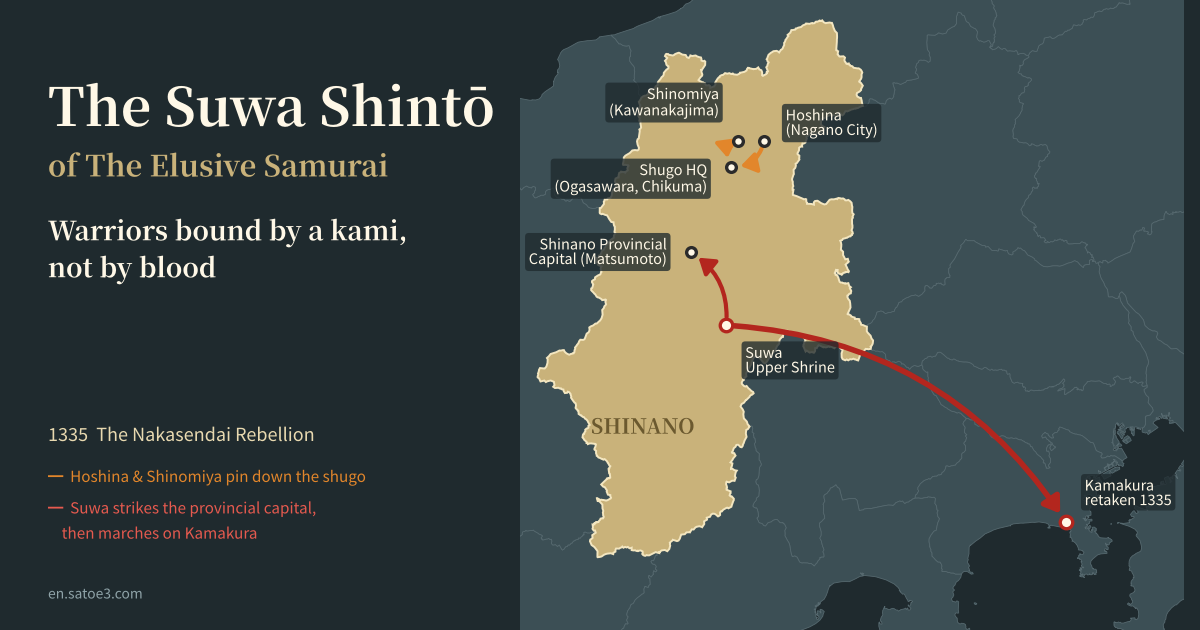
The Hoshina clan (in today’s Nagano City) and the Shinomiya clan (Kawanakajima) attacked the headquarters of the shugo Ogasawara Sadamune in today’s Chikuma City, and fought the Ichikawa clan on the shugo’s side. The Unno (Ueda), Nezu (Tōmi) and Mochizuki (Saku) clans also moved to support them.
Hoshina and Shinomiya never forced a decisive battle. They fell back slowly, fighting as they went, so the Ichikawa and Ogasawara could never pull their forces out of the north. The shugo’s army was pinned down in northern Shinano.
In that opening, the Suwa clan struck the provincial capital at today’s Matsumoto. Governor Kiyohara was driven to take his own life.
With Shinano under their control, the Suwa marched on Kamakura with Tokiyuki at their head, and took the city back.
✦ Satoe’s Take: The Shintō warriors of the north held the shugo in place while Suwa struck the capital. Warriors scattered across Shinano moved as one plan under the Suwa kami. That, I think, is the real strength of the bond called shintō.
But they held Kamakura for only about twenty days. Ashikaga Takauji marched down from Kyoto and defeated them, and Yorishige took his own life in Kamakura.
The resistance did not end there.
Tokiyuki survived, joined the Southern Court, and kept fighting to restore the Hōjō. In 1340 he was at Daitokuōji Castle in the Ina Valley, a Southern Court stronghold in Shinano, when Ogasawara Sadamune attacked it.
The Suwa Shintō, too, fought on — first as Hōjō loyalists, then as part of the Southern Court in the wars between the Northern and Southern Courts — against the Ogasawara, the Murakami and other Northern Court forces.
In 1355, the Suwa and their allies, rallied under Prince Munenaga (a son of Emperor Go-Daigo), were defeated by the shugo Ogasawara Nagamoto at the Battle of Kikyōgahara. After that, the Southern Court cause in Shinano declined, and with infighting within the Suwa clan, the Shintō slowly lost its unity.
For more than twenty years after the fall of Kamakura, the warriors bound together under the Suwa kami kept smouldering, trying to win back the order they had lost.
They were not fighting for a faith in the abstract. They were fighting for their fields, their festivals and their way of life. In the end, the story of the Suwa Shintō is the story of the people of Shinano.
Sources
- Nakasendai no Ran (Kotobank, Japanese)
- Suwa Shintō (3rd-in pedia, Japanese)
- Excavation report on Ogasawara clan sites (Comprehensive Database of Archaeological Site Reports in Japan)
- The road to retaking Kamakura (San-Tatsu, Japanese)
- Suzuki Yumi, Nakasendai no Ran: Hōjō Tokiyuki, Kamakura Bakufu Saikō no Yume (Chūkō Shinsho, 2021)