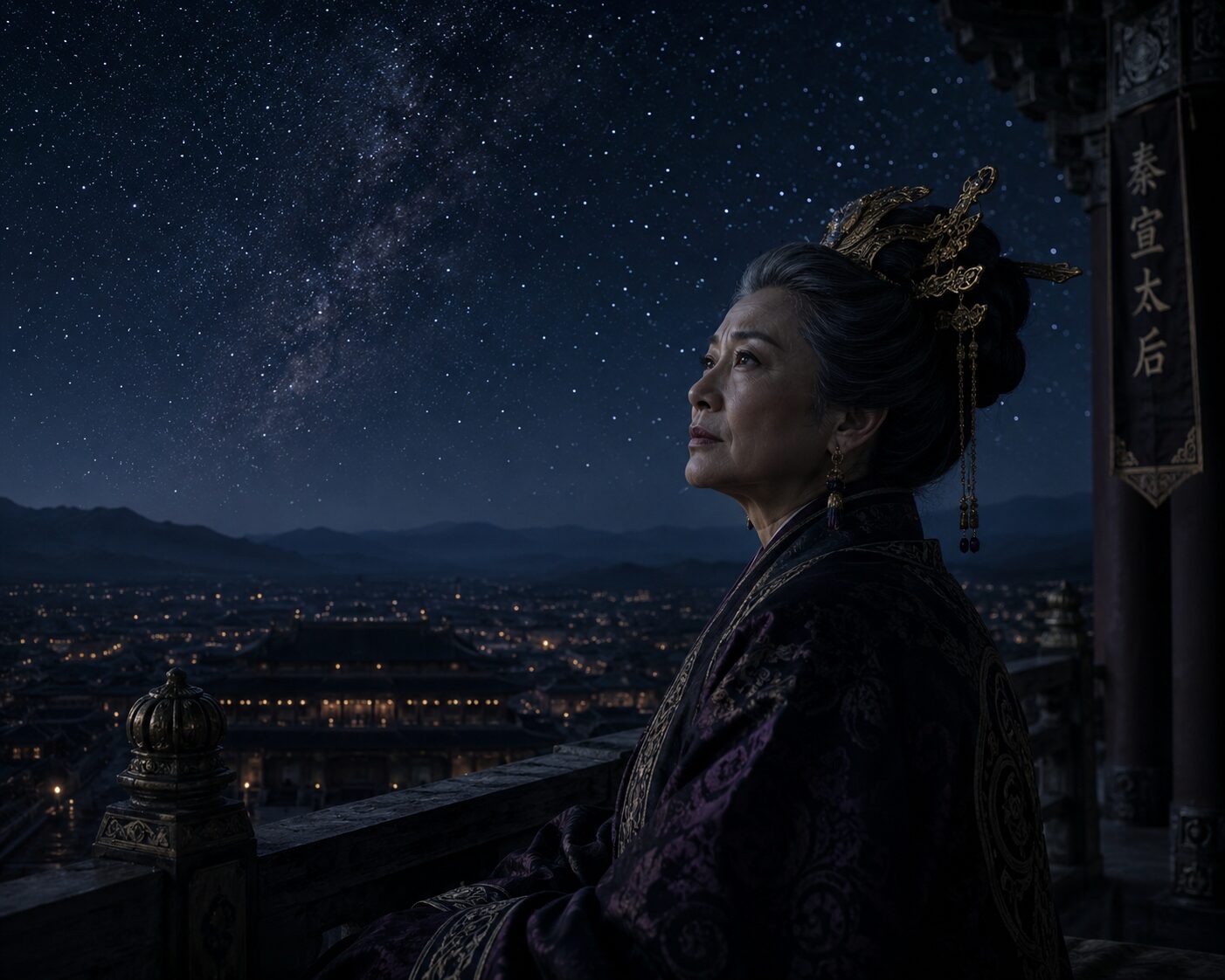
If you’ve watched the Chinese historical drama Legend of Mi Yue (芈月传), you’ll remember the quiet, aching melody that closes each episode. That song is “Yiren Rumeng” (伊人如梦) — roughly, “the beloved, like a dream.” Sung by Huo Zun, composed by A Kun, with lyrics by He Qiling, it gently carries the turbulent life of Mi Yue, the woman who rose to become Queen Dowager Xuan of the state of Qin.
But behind this modern song lies something far older. Its very title — yiren (伊人), “that beloved person” — comes from a poem written some 2,500 years ago.
The poem behind the word: “Jianjia” from the Book of Songs
That poem is “Jianjia” (蒹葭, “The Reeds”), from the Qin section of the Shijing — the Book of Songs, China’s oldest collection of poetry. Its most famous lines read:
所謂伊人,在水一方 The one I long for is somewhere across the water.
The poem paints a dawn scene in a vast reed marsh, white frost on the leaves, where the speaker searches for a beloved who is always just on the far side of the water — sought upstream, then downstream, yet never quite reached. It has been translated into English many times — by scholars such as James Legge, Arthur Waley, and Ezra Pound — but the feeling needs no scholarship: something beautiful, in plain sight, and forever out of reach. By Arcadia
✦ My Interpretation: Mi Yue and “Jianjia”
I should be honest: the lyrics of “Yiren Rumeng” don’t quote this ancient poem directly. Their imagery flows instead from two rivers — the Mi and the Wei.
And yet, to me, the song and “Jianjia” are bound together — through the word yiren, and through one shared theme: longing for someone you can never reach.
In the song, the Mi River runs warm while the Wei runs cold. The Mi (汨水) flows through Chu, the land of Mi Yue’s youth and of her first love, Huang Xie — the warm water of home. The Wei (渭水) flows through the Qin capital, where she now stands at the summit of power — cold water, far from where she began. Between those two rivers, across warm past and cold present, Mi Yue spent her whole life reaching for someone on the far shore. In water, one side — this is the very world of “Jianjia.”
Even with power in her hands, true love and peace remained across the water, out of reach. The title itself — Yiren Rumeng, the beloved like a dream — seems to say everything.
“What the Song Is Saying — An Interpretive Rendering
Here is how I read the song’s heart, in my own words —
The stars scattered across the sky shine almost as bright as the moon.
Counting them one by one, I count too the days we shared, and the promises we made.
My heart overflows with longing for you —
and yet all that remains is a single thread of loneliness.
Many times I have watched spring fill the fields with flowers,
and autumn frost wither them away.
The glory I once knew, the humiliation I endured — how could I ever count it all?
By the warm river of my homeland, we once met and talked together.
But now I stand alone, far from home,
on the bank of a cold and distant river.
How are you now?
Where have you gone?
Are you still the same as you once were, I wonder?
Since we parted,
spring after spring has passed, and autumn after autumn.
So much time has slipped away.
And though time and distance have carried us far apart,
my heart still turns to you, unchanged.
Meeting you, I came to know joy;
losing you, I came to know sorrow to its depths.
The days without you are unbearable.
I love you to the point of madness.
I want to give you all the love I have.
All I wish is to stay by your side, always —
to live with you, and to die with you.
Across 2,500 Years
The longing of “Jianjia” — for the one who stands forever across the water — has echoed down the centuries, into Mi Yue’s story, and into Huo Zun’s song. The ache for something beautiful and just out of reach is, perhaps, one we will always understand.
→ Read more about the source poem: “The Reeds” (Jianjia) from the Book of Songs —
―
Read more: “Full Moon” — The Opening Song of Legend of Mi Yue
―
← Back to the full guide: The Songs of Empresses in the Palace & The Legend of Mi Yue Explained