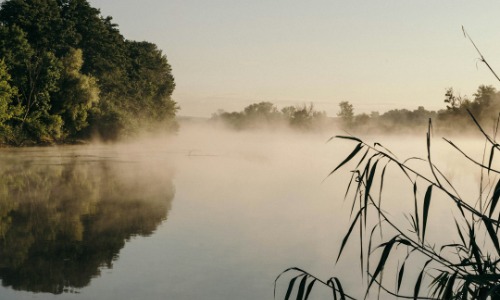
If you found your way here from the C-drama Legend of Mi Yue, you may already know the line “so-called the one I long for, on the far side of the water.” It comes from a poem some 2,500 years old — “Jianjia” (蒹葭, “The Reeds”), from the Shijing, or Book of Songs, China’s oldest collection of poetry. Its most famous opening lines are:
所謂伊人,在水一方 Suǒ wèi yīrén, zài shuǐ yī fāng “The one I long for is somewhere across the water.”
Here is the full poem, in my own translation.
The Reeds (Jianjia)
The reeds grow thick and grey-green; the white dew has turned to frost. The one I long for is somewhere across the water. I go upstream to find them — the way is hard and long. I go downstream to find them — and there they seem to be, in the middle of the water.
The reeds grow lush; the white dew is not yet dry. The one I long for is there by the water’s edge. I go upstream to find them — the way is hard and steep. I go downstream to find them — and there they seem to be, on an islet in the water.
The reeds grow dense and bright; the white dew has not yet faded. The one I long for is there at the water’s bank. I go upstream to find them — the way is hard and winding. I go downstream to find them — and there they seem to be, on a sandbar in the water.
What the poem means
At dawn, in a vast marsh of frost-covered reeds, someone searches for a beloved who is always just across the water. They go upstream, then downstream — yet the beloved keeps drifting away, to the middle of the river, to an islet, to a far sandbar. So close, and never reached.
Over the centuries, readers have understood the poem in different ways — as a longing for the lost rites and culture of the Zhou dynasty, as the pursuit of an unreachable ideal, or as a search for a hermit sage. Today it is most often read simply as a love poem: a song of yearning for someone who can never quite be reached. ResearchGate
✦ My Interpretation
What moves me most is that the poem never ends in either capture or surrender. To the last line, the beloved is still across the water — and still the speaker keeps searching. That suspended, unresolved longing is, I think, exactly what makes it beautiful. It is a feeling we all recognize: something lovely, in plain sight, and forever out of reach.
It is no wonder that this ancient poem still echoes today — even in a modern drama’s closing song.
→ Read more: “Yiren Rumeng” — The Ending Song of Legend of Mi Yue
―
← Back to the full guide: The Songs of Empresses in the Palace & The Legend of Mi Yue Explained